Dad had been talking about living here with Lisa.
Mom had already given the house an entirely different future.
“Did she tell you why?” I asked.
The woman laughed softly.
“She didn’t make a grand speech. She just said people shouldn’t have to sleep in hospital chairs because they happen to live two hours away.”
I had to sit down.
That sounded exactly like Mom.
Then I asked the question I’d been carrying since that afternoon outside the kitchen.
“Did she know?”
“Know what?”
“About Dad and Lisa.”
The woman became quiet.
“Cathy never said that.”
“But?”
Another pause.
“She once told me the house had started feeling strange.”
“Strange how?”
“She said people were discussing the future around her instead of with her.”
My fingers tightened around the phone.
“Did she say who?”
“No.”
Then the woman added something else.
“She talked about you often.”
My throat tightened.
“What did she say?”
“Mostly that you were spending too much time worrying about her and not enough time being nineteen.”
I laughed through my tears.
“That sounds like her.”
“Once, I asked whether you knew what she was arranging with the house.”
I waited.
“She said, ‘My girl’s nineteen. Let her be my daughter for a little while longer.’”
I covered my mouth.
For weeks, I’d told myself I had protected Mom by keeping Dad’s betrayal from her.
Now I wondered whether she’d been protecting me too.
Maybe neither of us knew exactly how much the other understood.
I stared at the brass 17 beside the door.
And suddenly I knew exactly what Dad and Lisa were getting as a wedding gift.
On the afternoon of their wedding, I went to Mom’s house.
The organization had begun preparing it for its new purpose.
New house numbers had arrived as part of the early work.
I carefully unscrewed the old brass 1 and 7.
The paint underneath was lighter, leaving a pale rectangle where they’d hung for decades.
I placed the numbers on a small piece of cardboard.
Then I put them inside a white gift box.
Underneath them, I added a card containing one sentence.
Hours later, I stood inside Dad and Lisa’s reception holding that box.
Lisa’s laugh reached me before I saw her.
Light.
Breathy.
Familiar.
The same laugh she’d used when I was little and she’d let me stay awake past bedtime whenever Mom wasn’t looking.
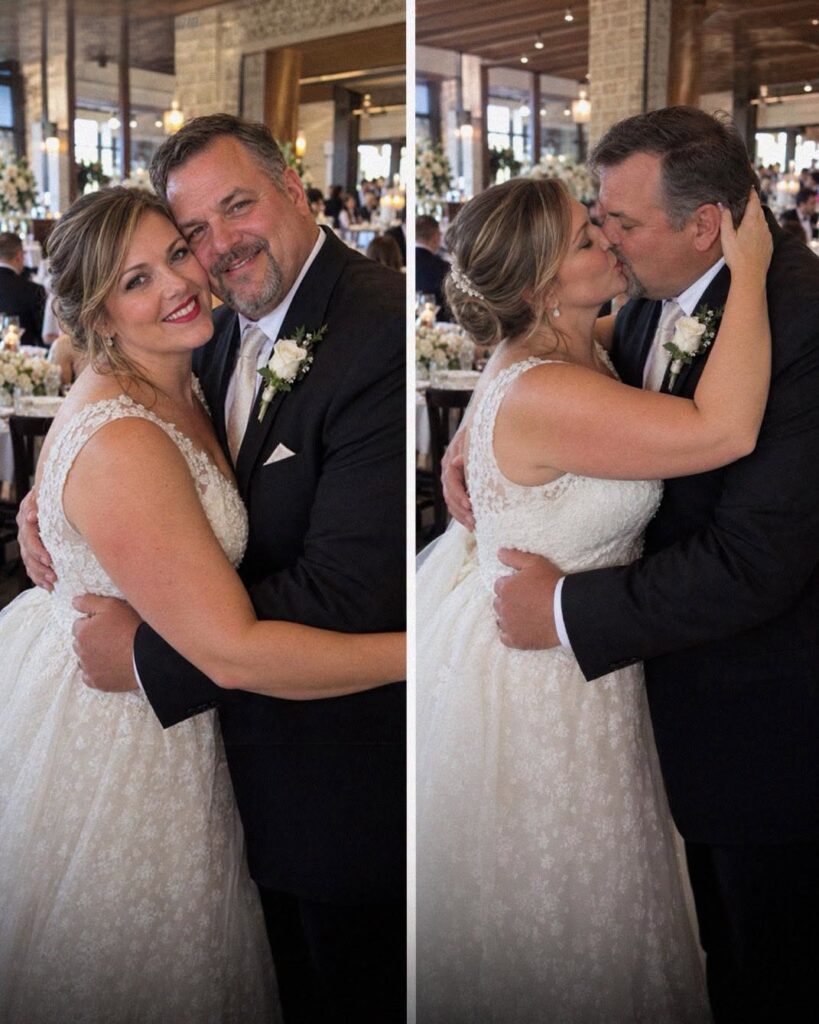
Now she wore white lace.
Standing beside my father beneath an arch of roses.
My mother’s sister.
My father’s new wife.
Dad noticed me first.
His smile lasted about a second.
“Kristen.”
“Dad.”
Lisa hurried over and kissed my cheek.
“I’m so glad you came.”
“Wouldn’t miss it.”
Then she noticed the box.
“You brought us something?”
“I did.”
Dad reached for it.
For a second, neither of us let go.
Then I released it.
Lisa laughed again.
Dad lifted the lid.
Lisa reached inside and pulled out the brass numbers.
“One and seven?”
Dad wasn’t looking at the numbers.
He’d seen the card.
He picked it up.
Read it.
Then slowly looked at me.
“What does this mean?”
Lisa grabbed the card.
Her expression changed as she read the sentence:
Since you were both waiting for Mom’s house, I saved you the part that was available.
“What did you do?”
Her voice was loud enough that nearby conversations stopped.
Dad folded the card.
I almost smiled.
Apparently he still believed uncomfortable truths became less real if other people couldn’t see them.
“I didn’t do anything.”
I let the silence sit between us.
“Mom did.”
Lisa looked at Dad.
“What did Cathy do?”
I picked up my purse.
“You should probably go see.”
Twenty minutes later, they pulled into Mom’s driveway behind me.
Still dressed for their wedding reception.
Lisa got out first.
Then stopped.
The brass 17 was gone.
New numbers were mounted beside the door.
Two volunteers were carrying folded sheets inside.
Another man was assembling a bed near the front window.
Dad walked toward the house.
“What is happening?”
A woman from the organization approached.
“We’re preparing the residence for our first guests.”
“What guests?”
“Cancer patients receiving treatment nearby and their caregivers.”
Lisa looked at Dad.
“No.”
Dad pointed toward the house.
“This was my wife’s property.”
“Yes.”
Something about the word was seemed to hit him.
“Who authorized this?”
“Cathy.”
Lisa stepped forward.
“She gave the house away?”
“She transferred ownership to our organization while retaining the right to live here for the remainder of her life.”
Lisa slowly turned toward Dad.
“You said she was signing it over.”
Dad’s face changed.
“I said I was handling it.”
“You said this house would be ours.”
“I said I was handling it.”
A volunteer carrying towels slowed down.
Dad noticed.
“Not here.”
Despite everything, I almost laughed.
Secrecy still mattered when the embarrassment belonged to him.
Lisa looked around.
Beds.
Fresh linens.
Boxes of toiletries.
Labels appearing on kitchen cabinets.
“She did this because of us.”
The woman from the organization shook her head.
“Cathy never mentioned either of you when she arranged the donation. She talked about families she’d met during treatment.”
Lisa fell silent.
Mom hadn’t spent her final months plotting revenge.
She hadn’t given the house away to punish Dad.
She had simply looked at something valuable she owned and asked who might need it after she was gone.
Somehow, that made the moment more powerful.
Dad finally turned toward me.
“How long did you know?”
“About the house?”
He shook his head.
“About Lisa and me.”
Lisa stared at him.
So Dad had understood my card immediately.
“Since before Mom died.”
His boutonniere was already drooping against his jacket.
“You heard us?”
“In the kitchen.”
His face drained.
“Kristen…”
“Don’t.”
“Your mother and I hadn’t been happy for—”
I raised my hand.
“If you want any chance of having a relationship with me after today, don’t give me a version where everybody somehow accidentally ended up here.”
He stopped.
For once, my father had no explanation prepared.
No grieving-widower story.
No convenient timeline.
No justification.
Just silence.
“I thought we were pretending not to know things in this family,” I said.
Then I walked inside.
Not because I’d forgiven him.
I hadn’t.
Not because humiliating him suddenly didn’t matter.
Part of me was still nineteen years old, standing behind that kitchen wall listening to two people I trusted discuss my mother’s death like an inconvenience standing between them and a house.
But as I entered Mom’s old bedroom, I noticed a volunteer struggling with a fitted sheet.
“Need help?”
She laughed.
“Desperately.”
I grabbed the opposite corner.
Outside, Dad and Lisa were arguing.
I stopped listening.
Later, I carried clean towels down the hallway.
There were mugs being unpacked in the kitchen.
Fresh blankets stacked in the closet.
A handwritten welcome card waiting on a bedside table for a family I’d never meet.
I passed the front door and stopped.
The new numbers looked clean against the old paint.
But beside them was a pale rectangle where the brass 17 had hung for decades.
I touched it once.
That empty patch was all that remained of the future Dad and Lisa had planned inside this house.
But Mom had left something much bigger behind.
Soon, someone exhausted from chemotherapy would sleep in her bedroom instead of a hospital chair.
A husband might make tea in her kitchen while his wife rested.
A frightened family might have somewhere quiet to breathe between appointments.
Dad had looked at Mom’s house and seen an inheritance.
Lisa had looked at it and imagined a new life.
Mom had looked at it and seen beds for strangers who needed somewhere to sleep.
From the kitchen, someone called:
“Kristen? Where should these mugs go?”
I looked at the pale mark beside the door one last time.
“Kitchen cabinet.”
Then I carried the towels inside.
Dad and Lisa could keep the old brass numbers.
Mom had already decided what truly belonged in the house.