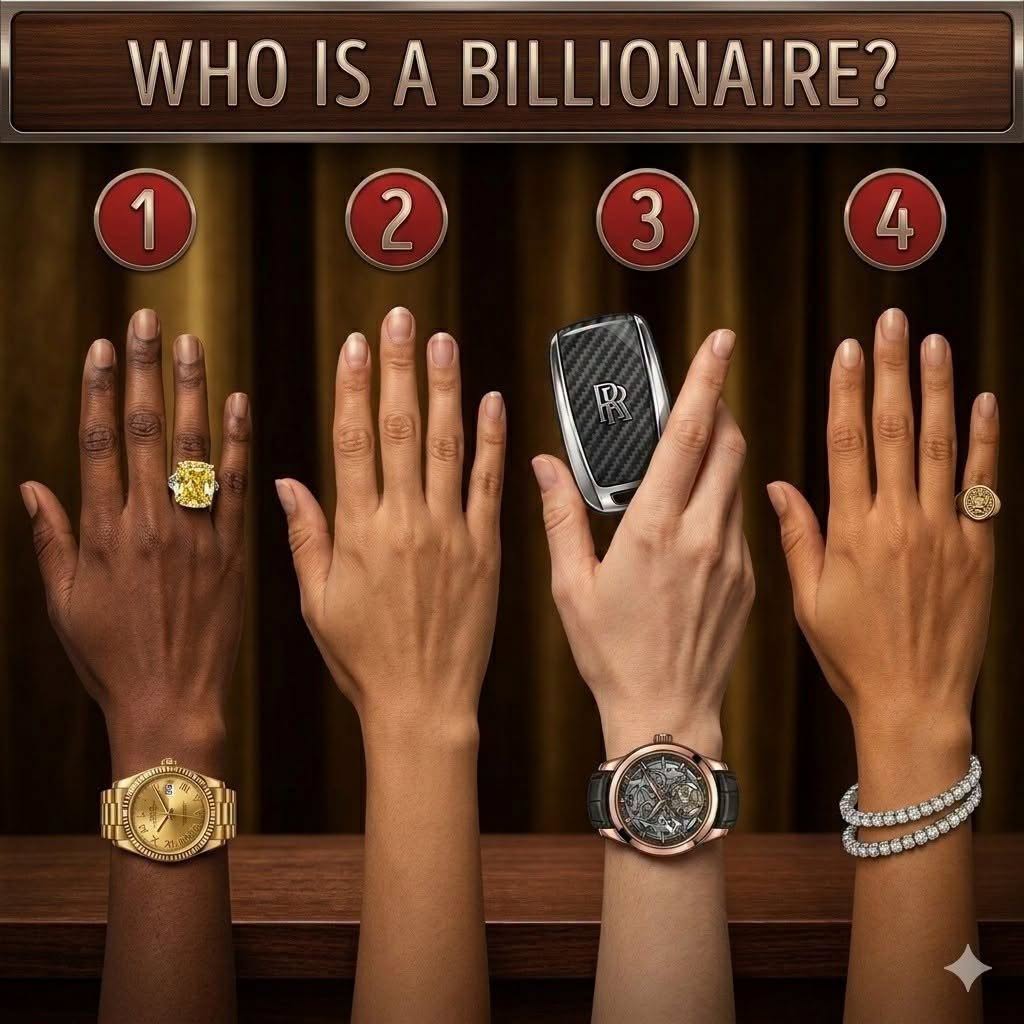
Person 1 makes an immediate impression. A large diamond ring and what appears to be an expensive gold watch create an unmistakable image of luxury. If you’re judging purely by visible possessions, this person seems like an obvious contender.
Person 2, meanwhile, appears almost suspiciously ordinary. There are no diamonds, luxury watches, car keys, or obvious status symbols. Just a clean, well-groomed hand.
That simplicity makes Person 2 easy to dismiss.
But it may also be the clue that makes people stop and reconsider.
Person 3 practically announces wealth. A Rolls-Royce key paired with an elaborate luxury watch creates perhaps the strongest display of financial status in the entire image.
If expensive possessions determine the answer, Person 3 would certainly be difficult to ignore.
Then there’s Person 4, whose jewelry suggests a somewhat more traditional form of luxury. A signet-style ring and bracelets create an elegant appearance that could easily be interpreted as an “old money” aesthetic.
So who is actually the billionaire?
The popular twist in puzzles like this is often Person 2.
The reasoning usually centers on the idea of “quiet luxury”—the belief that extremely wealthy people don’t necessarily need to advertise their financial status through conspicuous jewelry, recognizable logos, or expensive accessories.
Someone with enormous wealth could theoretically look completely ordinary.
But there’s an important catch.
You cannot actually determine whether someone is a billionaire from their hand, jewelry, grooming, or clothing.
A person wearing a Rolex might genuinely be extraordinarily wealthy.
Someone holding a Rolls-Royce key could own the car—or simply be holding the key.
A person wearing no jewelry whatsoever could be a billionaire, a millionaire, or have very little money.
Even so, that’s what makes the puzzle interesting.
It’s less about discovering someone’s bank balance and more about questioning the assumptions we make based on appearances.
We often associate expensive objects with wealth because they’re visible.
But financial security, investments, property, business ownership, savings, and other forms of wealth usually aren’t.
So if this is a trick puzzle built around the “quiet wealth” idea, Person 2 is probably the intended answer.
But in real life?
There isn’t enough information to know.
And perhaps that’s the real lesson hiding inside the image:
The person displaying the most wealth isn’t necessarily the person who has the most wealth.
So take another look before deciding.
Would you choose 1, 2, 3, or 4?