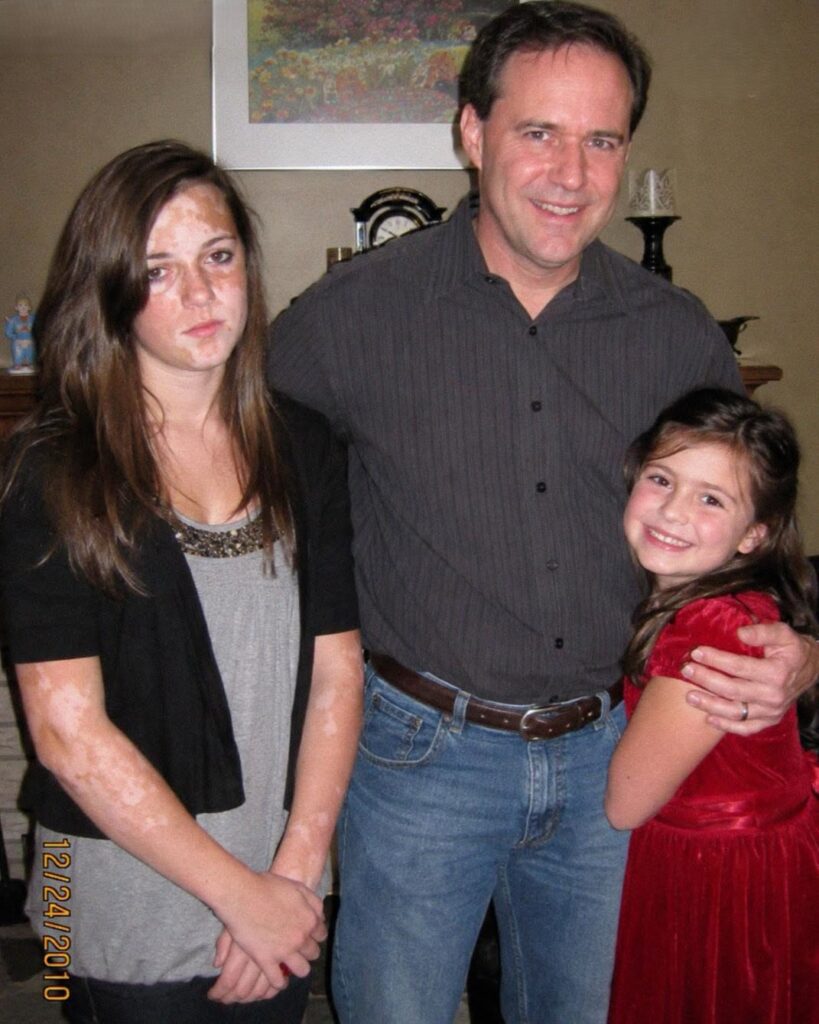
Cancer had reduced the broad-shouldered man I remembered to someone almost fragile.
Then he pushed the box toward me.
“Open it.”
The first thing I found inside was a plastic name badge.
My name was printed across it.
EMMA
GUEST OF JOHNNY
I recognized the hotel logo immediately.
And suddenly I wasn’t thirty-eight anymore.
I was sixteen.
Standing at the bottom of our staircase in my dead mother’s blue dress while my father looked at my face and decided my sister Lily would go with him instead.
I lifted the badge by its metal clip.
“You had a badge for me.”
Dad nodded.
“Yes.”
“You told me there was only one guest ticket.”
“I know.”
I reached deeper into the box.
Another invitation.
A company dinner from the following spring.
Three names were listed.
Johnny.
Lily.
Emma.
Then a wedding RSVP.
Three seats.
Then a Christmas dinner.
Another banquet.
A retirement celebration.
Again and again, I found my name.
Every event I remembered being excluded from.
Every evening Dad had told me there wasn’t enough room.
Every occasion when Lily had dressed up and gone with him while I stayed home.
I’d spent more than twenty years believing my father simply hadn’t wanted me there.
Now I discovered something worse.
He had planned to take me.
Every time.
“You put my name down.”
“Yes.”
“And then you changed your mind.”
Dad looked at the floor.
“Yes.”
“Why?”
He said nothing.
I slammed one of the invitations onto the table.
“You came here on my birthday and told me I needed to know the truth before you die. So tell me.”
Before he could answer, the front door opened.
Lily stepped inside carrying a gift bag.
She smiled until she saw Dad.
Then she noticed the box.
“What happened?”
I held up the badge.
“Did you know about these?”
She frowned.
“Know about what?”
“That I was supposed to go with you.”
Her expression changed.
“No.”
The answer came so quickly that I believed her.
Dad pushed himself slowly out of his chair.
“There is somewhere I need to take you.”
I almost laughed.
“Of course there is.”
“Emma—”
“No mysterious father lessons. No dramatic final explanations. Just tell me.”
“It’s not a lesson.”
He looked at me.
“It’s where I first failed you.”
That stopped me.
Twenty minutes later, Lily was driving us downtown.
Dad sat in the passenger seat.
I sat behind him holding the old badge.
Nobody spoke.
Then Lily turned onto an avenue I hadn’t visited in years.
I recognized the building immediately.
A five-star hotel.
It had been renovated, but the stone steps were the same.
So were the enormous windows.
“I’ve been here.”
Dad nodded.
“You were twelve.”
Something moved at the edge of my memory.
Mom fastening earrings.
Dad complaining about parking.
Lily being told she was too young to come.
And me standing in Mom’s bathroom staring at the pale patches spreading across my face.
Vitiligo had started changing my skin when I was young.
My mother refused to treat it like something shameful.
When I once begged her to buy heavy makeup I’d seen advertised, she told me:
“It’s skin, Emma. It doesn’t need permission to look like skin.”
Dad hadn’t been as comfortable.
I followed him into the hotel.
He stopped outside the ballroom.
“This used to be one of my company’s client dinners.”
“With Mom?”
He nodded.
“And you.”
I folded my arms.
“So?”
Dad looked at my face.
Then quickly looked away.
Even after all these years, I recognized that movement.
“Dad.”
He swallowed.
“There was a man sitting at our table that night.”
I waited.
“You’d started developing more patches around your eyes and hands.”
“I remember.”
“The man asked whether what you had was contagious.”
And suddenly I remembered him.
Not his face.
His watch.
A huge gold watch that caught the light whenever he moved his hand.
“What did you say?”
“I told him it was vitiligo.”
“And?”
Dad didn’t answer.
I did.
“You changed the subject.”
His eyes met mine.
“Yes.”
I couldn’t remember the exact words from that night.
But I remembered the feeling.
The pause.
The man’s embarrassed laugh.
Dad immediately asking him something about work.
And Mom reaching beneath the table to squeeze my hand.
“Did you tell him he was rude?”
“No.”
“Did you tell him not to talk about your daughter like she wasn’t sitting there?”
“No.”
“Did you say anything at all?”
Dad shook his head.
“No.”
Lily whispered:
“Dad…”
I turned toward her.
“Not yet.”
She fell silent.
Dad walked slowly toward a bench outside the ballroom and sat down.
“Your mother was furious with me.”
Despite everything, I almost smiled.
That sounded like Mom.
“What did she say?”
“She asked why I cared more about keeping a client comfortable than protecting my own daughter.”
“What did you tell her?”
“That I didn’t want to make a scene.”
Of course.
Dad had hated scenes.
Mom used to joke that if a chair caught fire in a restaurant, Dad would quietly move it outside rather than ask who’d started the fire.
Then Dad repeated the words Mom had said to him that night.
“She shouldn’t have to leave a room because somebody else doesn’t know how to behave.”
My throat tightened.
Then Mom had told him:
“Next time, stand beside your daughter.”
I looked down at the old badge.
“A few months later,” Dad continued, “your mother got sick.”
He suddenly looked much younger to me.
Not physically.
Emotionally.
Like the terrified man who’d once stood beside Mom’s hospital bed pretending he understood everything the doctors were saying.
“And then she died,” he whispered.
I waited.
“I kept thinking about this hotel.”
“Why?”
“Because I’d failed you here.”
I stared at him.
“So your response was to spend the next several years failing me again?”
Lily whispered my name.
Dad stopped her.
“No.”
He looked at me.
“She’s right.”
That surprised me.
“When you were sixteen, I put your name on the banquet list.”
“The night of the blue dress.”
“Yes.”
Two days before the dinner, Dad had overheard coworkers talking about another woman with vitiligo.
They were making jokes.
Cruel ones.
“And you thought they’d make jokes about me.”
“Yes.”
“You thought they’d stare.”
“Yes.”
“You thought somebody might ask whether I was contagious again.”
“Yes.”
Then I understood.
“And you were afraid you’d freeze.”
Dad looked at me.
There it was.
The truth.
He hadn’t simply been afraid someone would hurt me.
He was afraid that when it happened, he’d fail to defend me again.
“I told myself I was protecting you.”
“From what?”
“People like that.”
I waited.
Dad’s voice became quieter.
“And from finding out whether I was still the kind of father who couldn’t stand up for his daughter.”
There it was.
“I was protecting myself too.”
I walked away.
For years, I’d imagined Dad entering those beautiful rooms with Lily beside him, relieved that he didn’t have to bring the daughter whose skin looked different.
The truth was more complicated.
He’d wanted me there.
He’d put my name on the lists.
He’d imagined taking me.
Then fear arrived.
And every single time, he removed the person whose presence forced him to confront his own cowardice.
Me.
I turned around.
“Mom told you to stand beside me.”
Dad nodded.
“And your solution was to stop letting me stand beside you?”
He closed his eyes.
“Yes.”
Lily sat beside him now.
I pointed toward her.
“Why Lily?”
Dad answered immediately.
“Because people didn’t make comments about Lily.”
The words hung between us.
“So I was the problem you removed.”
“No.”
“That is exactly what you did.”
Dad looked at me for a long moment.
Then nodded.
“Yes.”
Lily suddenly stood.
“Did you tell me Emma didn’t want to come?”
Dad’s face changed.
“Lily…”
“Did you?”
“Sometimes.”
She stared at him.
I stared at her.
Lily turned toward me.
“When I was little, I’d ask why you weren’t coming.”
My stomach tightened.
“He told me you hated those events.”
“You believed him?”
“I was nine, Emma.”
That shut me up.
“And eventually,” she continued, “you started telling everybody you didn’t care.”
“I got tired of caring.”
“I know.”
Then Lily’s expression changed.
“Do you remember how I always brought you dessert?”
Of course I did.
Slices of cake wrapped in napkins.
Cookies stuffed into plastic bags.
Once, an entire cup of chocolate mousse that leaked inside her purse.
I’d hated those gifts.
They felt like scraps from rooms where I wasn’t welcome.
“I thought you pitied me.”
Lily stared at me.
“What?”
“The desserts.”
“No.”
She looked horrified.
“Emma, no. Dad told me you didn’t like the parties. I just knew you liked dessert.”
Suddenly I remembered that ridiculous chocolate mousse.
The brown stain covering the bottom of Lily’s purse.
For the first time that day, I almost laughed.
Then Lily turned toward Dad.
“You know what else you did?”
He looked at her.
“You called me ‘my beautiful girl’ every time you introduced me.”
His face crumpled.
“I meant it.”
“I know.”
Lily folded her arms.
“But after a while, beautiful stopped sounding like a compliment.”
Dad stared at her.
“It started sounding like the reason I got to go and Emma didn’t.”
Nobody spoke.
I looked down at the badge.
EMMA.
GUEST OF JOHNNY.
Then I remembered Mom’s blue dress.
Dad standing near the front door.
His eyes moving across my face.
Plans changed.
My stomach turned.
“This badge.”
Dad waited.
“This was for that night, wasn’t it?”
He nodded.
“The blue dress?”
“Yes.”
“The dress Mom wore to your anniversary dinner.”
“Yes.”
“You already had my badge.”
“Yes.”
“You’d already heard Mom tell you what you were supposed to do.”
His eyes stayed on mine.
“Yes.”
“Then why did you take Lily?”
Dad took a long time to answer.
Finally:
“Because when you came down those stairs, you looked so much like your mother.”
My throat tightened.
“For one second, I could hear her.”
His voice cracked.
“Next time, stand beside your daughter.”
I said nothing.
“And I realized I finally had another chance to do exactly what she’d told me.”
I waited.
Dad looked toward the floor.
“And I panicked.”
That was it.
No secret enemy.
No noble explanation.
No great sacrifice.
He’d known what was right.
He’d been given another opportunity.
And he’d chosen fear.
Again.
And again.
And again.
I walked over and placed the badge in his hand.
“You were so afraid somebody else might make me feel ugly that you became the person who did.”
Dad stared at my name.
Tears filled his eyes.
“I loved you.”
I said nothing.
“I loved you, Emma. And I behaved as though I was ashamed of you.”
That sentence hurt.
But I needed to hear it.
Then he said something else.
“You didn’t misunderstand what I did.”
I looked at him.
“You misunderstood why.”
That mattered.
Not enough to repair twenty years.
But it mattered.
“Why did you keep everything?”
Dad looked toward the box Lily was carrying.
“At first, because every time I came home without you, I hated myself.”
He swallowed.
“Later, throwing those things away felt like pretending it hadn’t happened.”
He didn’t ask me to forgive him.
Strangely, that helped more than anything.
When we returned to my house, Dad stopped on the porch.
Lily went inside.
Through the window, I could see my family pretending they hadn’t spent the last two hours wondering where we’d gone.
Dad looked at me.
“Do you want me to come back inside?”
Years earlier, he had stood at another door and decided I was the one who stayed behind.
This time, the door belonged to me.
“For cake,” I said.
He nodded.
“Okay.”
Later that evening, somebody shouted:
“Birthday picture!”
Everyone gathered together.
Dad stayed near the wall.
I noticed.
“Dad?”
He looked at me.
“If you’re going to be in it, come stand in it.”
He hesitated.
Then he walked over and stood beside me.
He started to put his arm around my shoulders.
Then stopped.
“Is this okay?”
The question surprised me.
I nodded.
“Yes.”
His arm settled lightly around me.
Lily squeezed in on my other side.
The camera flashed.
When we looked at the picture, it was terrible.
Lily was laughing.
Dad’s eyes were closed.
I had frosting on my sleeve.
And every pale patch on my face was completely visible.
Dad squinted at the photograph.
“Take another one.”
I studied it.
Thirty-eight-year-old me stood in the center.
No foundation covering my skin.
No blue dress borrowed from Mom.
No empty place where I should’ve been.
Dad beside me.
Lily beside me.
Imperfect.
Complicated.
Visible.
“No.”
Dad looked confused.
I handed the phone back.
“Keep this one.”
For most of my life, I’d believed my father had hidden me because he couldn’t bear other people seeing what made me different.
The truth was that he’d hidden me because my presence exposed something about him.
His fear.
His weakness.
His inability to defend me when it mattered.
Maybe that was why the truth didn’t instantly make forgiveness easier.
It simply made forgiveness mine to consider.
Dad had spent years deciding which rooms I could enter because he thought he was protecting me.
Now, finally, he had stopped deciding.
And as I looked at that terrible birthday photograph, I understood something my mother had known all along.
The answer had never been to keep me away from people who might stare.
It was to teach me that their staring didn’t determine whether I belonged.
Mom had understood that.
Dad hadn’t.
Maybe now he finally did.
I looked at the photograph one more time.
My skin wasn’t hidden.
My father wasn’t looking away.
And nobody had been left outside the room.
“Definitely keep it,” I said.