That day was different.
Her face had gone pale, and one hand was pressed beneath her stomach.
“Of course,” I said.
A few feet away sat a beautiful upholstered chair beside a nursery display.
A small card on the armrest actually encouraged customers to try the furniture.
I started guiding Isabella toward it.
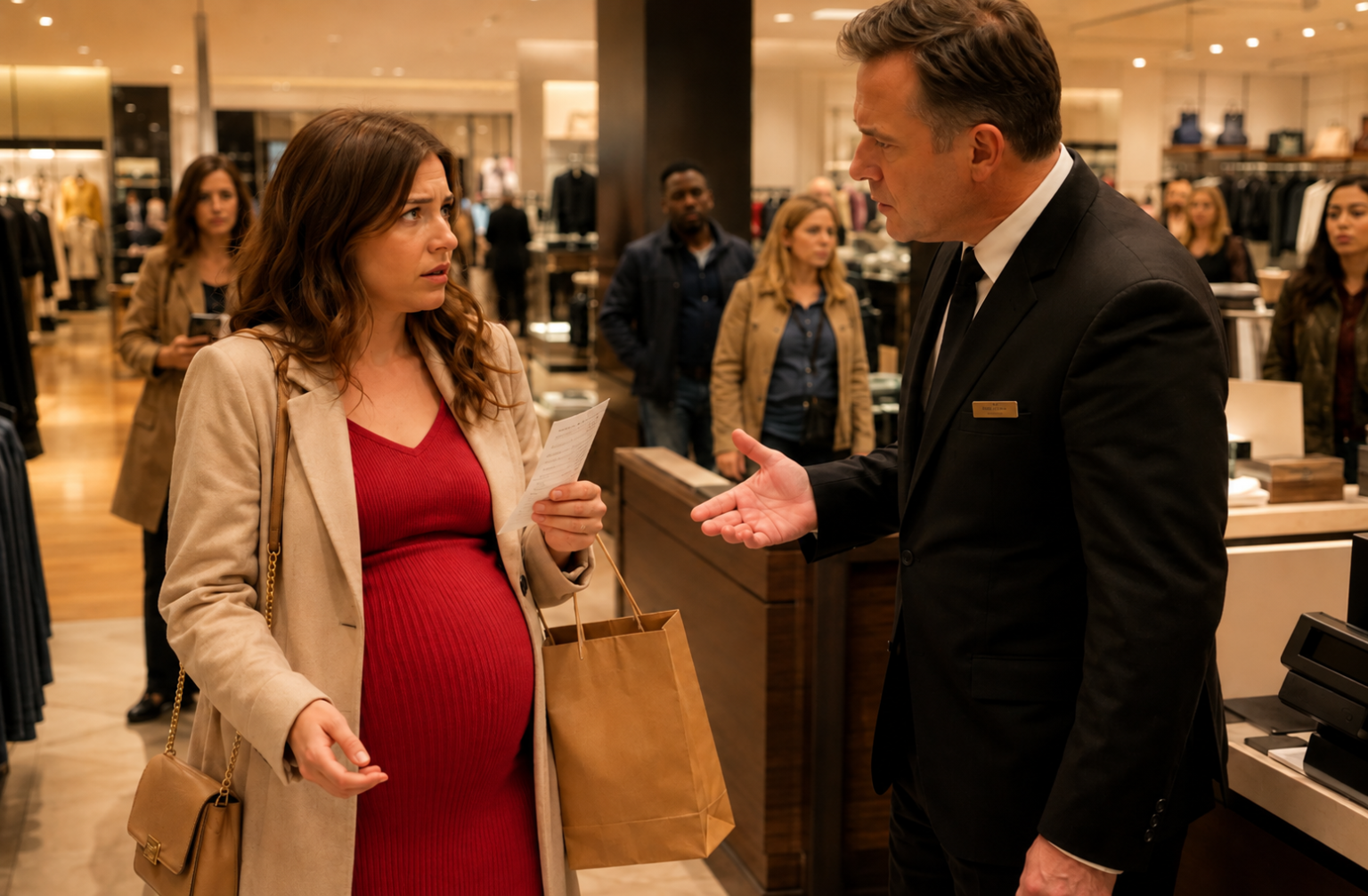
She had taken maybe two steps when a man in a dark suit moved directly in front of us.
“I’m sorry. That display is reserved for customers.”
I stared at him.
“We are customers.”
His name tag identified him as the store manager.
He looked at Isabella.
Gray sweatshirt.
Black maternity leggings.
Comfortable sneakers.
Then his eyes moved to me.
My old winter coat had seen better days.
Finally, he glanced across the showroom at a sharply dressed couple examining an expensive bedroom collection.
“They’re considering purchasing the entire set,” he said.
I understood immediately.
This wasn’t about protecting the chair.
It was about who he thought deserved to sit in it.
Isabella shifted uncomfortably.
“I just need five minutes.”
The manager sighed.
Actually sighed.
As though an eight-month-pregnant woman asking to sit down was disrupting his business.
“Customers come first.”
Isabella lowered her eyes.
That hurt me more than anything he had said.
My daughter had always hated inconveniencing people.
When she was little, she once apologized to a boy who stepped on her foot.
Now she was standing there embarrassed because her body needed five minutes of rest while growing another human being.
I stepped forward.
“I’d like your name.”
Before he could answer, someone appeared behind him.
“Here, ma’am.”
An older salesman unfolded a simple metal chair.
Isabella looked relieved.
“Thank you.”
She sat immediately.
The manager’s expression hardened.
“Frank, I told you not to bring those onto the showroom floor.”
Frank ignored him.
Instead, he looked at Isabella.
Then at me.
Something changed in his expression.
He stepped closer.
“Mrs. Bennett?”
I frowned.
“Do I know you?”
Before Frank could answer, the front doors opened.
An elderly man in a dark wool coat walked inside.
The atmosphere changed immediately.
Employees straightened.
Conversations stopped.
The manager stepped away from us.
“Mr. Callahan.”
I knew the name.
It was written in enormous letters across the front of the building.
The owner.
Mr. Callahan greeted several employees as he crossed the showroom.
Then he saw Isabella sitting on the folding chair.
His smile disappeared.
His eyes moved to me.
And he stopped.
For several seconds, he simply stared.
I knew there was something familiar about him too, but I couldn’t place it.
The manager hurried over.
“Sir, there was a small misunderstanding. They were blocking—”
Mr. Callahan raised one hand.
The manager stopped talking.
Then Mr. Callahan noticed the folder I was carrying.
A yellowed piece of paper was sticking out between the pages.
An old receipt.
I’d found it that morning while searching through paperwork.
The crib Isabella liked reminded me of the nursery furniture my late husband, Thomas, had bought when she was a baby.
So I’d brought the receipt as a joke.
“Look at this,” I’d told Isabella in the car. “Your father paid less for an entire nursery than you’re about to pay for one crib.”
Thomas had been gone six years.
Even saying that still hurt.
Mr. Callahan pointed toward the receipt.
“May I see that?”
I handed it to him.
The moment he saw the old store logo, his expression changed.
Then he read the name at the bottom.
Thomas Bennett.
Mr. Callahan slowly turned the receipt over.
His face went pale.
“Who gave you this?”
“It belonged to my husband.”
His eyes lifted.
“Thomas?”
I nodded.
“He died six years ago.”
Mr. Callahan closed his eyes.
For a moment, he looked much older.
“What does it say?” I asked.
He turned the receipt toward me.
Someone had written five words on the back in faded blue ink.
“Thomas B. — I owe you more than furniture.”
I looked at him.
“You wrote that?”
He nodded.
Then he turned toward his employees.
“Please stop admitting new customers for a few minutes.”
The manager looked startled.
“Sir?”
“I need to understand something.”
Mr. Callahan apologized to the customers already inside and made sure they were assisted.
Then he returned to us.
“Mrs. Bennett,” he said quietly, “your husband helped keep this company alive.”
I almost laughed.
“Thomas?”
“Yes.”
Mr. Callahan led us toward a seating area.
This time, nobody objected when Isabella sat on one of the showroom sofas.
Frank remained nearby.
Mr. Callahan still held the receipt as though it were something precious.
“When I opened my first store, I thought working hard would be enough.”
He smiled sadly.
“It wasn’t.”
He had inventory bills.
Rent.
Delivery expenses.
Payroll.
And not enough customers.
“I was weeks away from losing everything.”
Then Thomas entered the story.
My husband had been coordinating furnishings for a large housing development.
Dozens of units needed furniture.
Thomas could have divided the order among several established suppliers.
Instead, he gave most of it to Callahan’s tiny new store.
“That order helped,” Mr. Callahan explained. “But it wasn’t what saved me.”
“What did?”
“Thomas paid early.”
I frowned.
“Why?”
“He knew I was struggling.”
The contract allowed the company to wait weeks before paying.
Thomas arranged for the first payment to be released immediately.
Frank nodded.
“I remember.”
We turned toward him.
“We didn’t know if we were getting paid that week.”
Mr. Callahan looked at the receipt.
“Thomas’s payment covered payroll, rent and an overdue supplier invoice. It gave me enough time to survive until more orders came.”
I couldn’t believe it.
Thomas had never told me.
Not once.
“He did things like that,” I whispered.
Frank smiled.
“He didn’t make a performance out of helping people.”
Then I finally remembered Frank.
A much younger man with more hair, helping Thomas load furniture samples into our station wagon.
Baby Isabella crying in the back.
“You worked there.”
Frank grinned.
“More than thirty years ago.”
Mr. Callahan told me he’d repeatedly tried to repay Thomas.
Thomas refused.
“He kept insisting it was business.”
I laughed through the lump in my throat.
“That sounds like him.”
“So I wrote that on the receipt because it was the only thank-you he’d accept.”
Mr. Callahan carefully placed the paper on the table.
Then he looked at Isabella.
His expression changed.
“Now someone explain why Thomas Bennett’s pregnant daughter is sitting on a folding chair in my showroom.”
The manager immediately stepped forward.
“It was a misunderstanding.”
“No,” I said.
Everyone looked at me.
“It wasn’t.”
And then I told Mr. Callahan exactly what happened.
Isabella had needed five minutes to sit down.
The display chair was specifically marked for customers to try.
The manager had stopped her.
When I explained that we were customers, he’d looked at our clothes.
Then at the wealthy-looking couple nearby.
Finally, he’d told us:
“Customers come first.”
Mr. Callahan’s jaw tightened.
He turned toward Frank.
“Is that accurate?”
Frank hesitated.
Then nodded.
“Yes.”
The manager immediately defended himself.
“I was protecting a likely sale.”
Mr. Callahan stared at him.
“By refusing to let a pregnant woman sit down?”
“They were considering the entire collection.”
“And Mrs. Bennett and her daughter?”
The manager glanced at our folder.
“I didn’t know how much they intended to purchase.”
Mr. Callahan’s voice became quieter.
“So you treated them differently because you guessed how much money they had.”
“I made a sales judgment.”
Mr. Callahan looked around the showroom.
Then he announced that the store would temporarily close to new customers while he spoke with his employees.
Isabella surprised me by asking to stay.
“I want to know whether he does this to other people.”
So we stayed.
At first, the employees were silent.
Then Mr. Callahan asked one question.
“Has this happened before?”
A young saleswoman slowly raised her hand.
“Not exactly like this.”
The manager glared at her.
Mr. Callahan noticed.
“Look at me, not him.”
She swallowed.
“He tells us to focus on people who look ready to spend money.”
Another employee nodded.
“He calls them high-value customers.”
The manager interrupted.
“Every retail business prioritizes good leads.”
Mr. Callahan ignored him.
“What does ‘look ready to spend money’ mean?”
Silence.
Frank finally answered.
“Expensive clothes. Watches. Cars.”
Then the stories started.
An elderly couple wandered around for twenty minutes before anyone helped them.
A young father was ignored because the manager assumed he couldn’t afford the bedroom furniture he was looking at.
A woman arrived wearing work clothes and was discouraged from trying an expensive sofa.
She returned another day.
And bought it.
The manager continued defending himself.
“I’m responsible for sales.”
Mr. Callahan faced him.
“You’re responsible for the people who walk through those doors.”
Then Isabella spoke.
Quietly.
“You still haven’t apologized.”
The manager looked at her.
“You explained why you thought you were right,” she continued. “That’s not the same thing.”
I looked at my daughter.
And I couldn’t have been prouder.
Mr. Callahan then turned toward Frank.
“You knew you’d get in trouble for bringing that chair out.”
Frank shrugged.
“She needed to sit.”
“The manager specifically told you not to.”
Frank looked toward Isabella.
“I wasn’t going to leave a pregnant woman standing because somebody thought an empty chair looked more expensive.”
Several employees smiled.
Mr. Callahan didn’t fire the manager in front of us.
He took him into the office.
Then he spent nearly forty minutes speaking privately with employees and reviewing previous complaints.
Meanwhile, Isabella and I returned to the nursery section with Frank.
Eventually, she stopped beside a wooden crib.
She ran her fingers along the rail.
“This is the one.”
Frank smiled.
“Good choice.”
When Mr. Callahan returned, the manager wasn’t with him.
“I’ve ended his employment.”
I didn’t know what to say.
He immediately clarified something important.
“This isn’t because you’re Thomas’s widow. What happened today exposed a problem that already existed.”
There had been complaints.
There had been warnings.
There had been a pattern.
Today had simply made it impossible to ignore.
Then Mr. Callahan turned toward Frank.
“I need a new floor manager.”
Frank laughed.
“Me?”
“You.”
“I’m sixty-seven.”
“And?”
“People my age are supposed to be reducing responsibility.”
Mr. Callahan smiled.
“You’ve been showing better judgment than the person who had the job.”
Frank thought for a moment.
Then pointed toward the folding chair.
“First rule. Those stay available.”
“Agreed.”
Frank held out his hand.
“Then I’ll try it.”
Afterward, Mr. Callahan joined us beside Isabella’s crib.
“You’ve chosen one?”
She nodded.
“I’d like to give it to you.”
“No.”
The answer came from me immediately.
Mr. Callahan blinked.
“Mrs. Bennett—”
“We’re paying for the crib.”
“Please. Let me do this.”
I picked up Thomas’s receipt.
“My husband didn’t help you thirty years ago so his daughter could collect a debt today.”
Mr. Callahan stared at me.
“He would’ve hated that.”
A reluctant smile appeared.
“He did enjoy arguing.”
“He considered it exercise.”
Isabella laughed.
I handed the receipt back.
“Thomas helped because he believed it was the right thing to do. If you want to repay him, remember that when somebody else needs help.”
Mr. Callahan looked disappointed.
Then Isabella touched my arm.
“Mom.”
Beside the crib stood a matching wooden rocking chair.
Mr. Callahan noticed where she was looking.
“Then let me give her the chair.”
I started shaking my head.
“A gift,” he said. “Not repayment. From an old man who remembers her father.”
Isabella gave me the look she’d perfected around age twelve.
I sighed.
“The crib gets paid for.”
“Agreed.”
“The chair is a gift.”
“In Thomas’s memory.”
I finally nodded.
“All right.”
Frank began writing up the order.
Then suddenly he stopped.
“Wait.”
He picked up the old receipt.
Then looked at the manufacturer’s label on the new crib.
“No way.”
“What?”
He held them side by side.
The manufacturer was the same.
More than thirty years earlier, Thomas had bought Isabella’s nursery furniture from that company.
Without knowing it, Isabella had chosen them again for her own baby.
She touched the rocking chair.
“Dad would’ve liked that.”
My throat tightened.
“Yes.”
Two weeks before Isabella’s due date, the chair arrived at her house.
I went over to help finish the nursery.
After we were done, Isabella went to make tea.
I sat alone in the rocking chair.
The wood creaked softly.
And suddenly, I could see Thomas.
Thirty-two years old.
Exhausted after work.
Baby Isabella against his chest.
Rocking her at two in the morning because she refused to sleep unless somebody held her.
I had spent most of my life with that man.
Yet an old receipt had introduced me to a part of him I’d never known.
Thomas had once noticed that a struggling businessman needed room to breathe.
So he helped.
He didn’t announce it.
He didn’t ask for recognition.
He didn’t even tell his wife.
Thirty years later, Frank still remembered him.
Mr. Callahan still remembered him.
And a business that might have disappeared was still standing.
Isabella returned carrying two mugs.
She saw my hand resting on the chair.
“You okay?”
I nodded.
“Your father would’ve said we’re making too much fuss.”
She smiled.
“Absolutely.”
I looked around the nursery.
At the crib my daughter had paid for herself.
At the chair given in memory of her father.
At the woman who had once been my baby, now days away from holding a baby of her own.
That morning, one man had looked at our clothes and decided how much kindness we deserved.
Thirty years earlier, Thomas had looked at a struggling business owner and decided kindness didn’t need to be earned at all.
Maybe that was why both moments lasted longer than anyone expected.
Cruelty leaves consequences.
So does kindness.
Thomas’s kindness had traveled through three decades without him ever knowing where it would end.
And somehow, after he was gone, it found its way back to his daughter.
Not as payment.
Not as charity.
Not as a debt finally collected.
Just as a wooden rocking chair beside a crib.
Waiting for another tired parent who needed somewhere to sit.