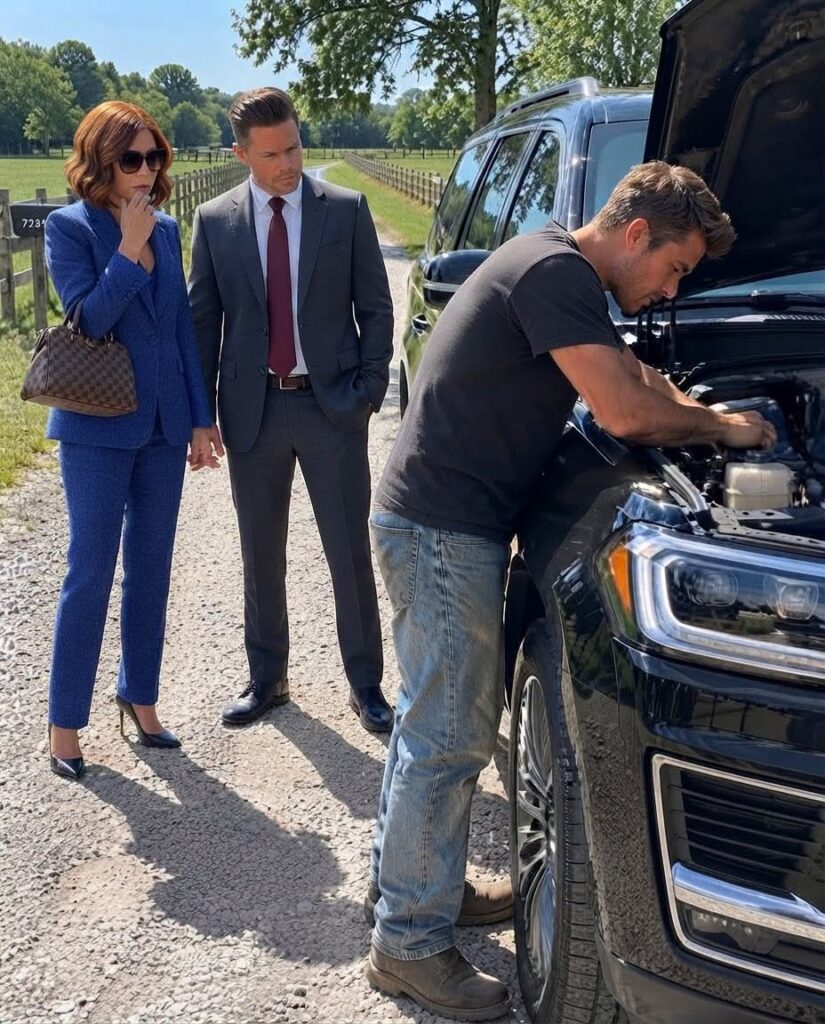
Now it was running perfectly.
The boy had fixed it using a piece of wire, an old connector and tools that looked as though they’d come from someone’s kitchen drawer.
“How did you know what was wrong?” Wendell asked.
Jaylen Tate shrugged.
“I just know engines.”
“No,” Wendell said. “You understand systems.”
That caught the boy’s attention.
Wendell owned Hayes Renewables, a major energy company specializing in battery storage and power-grid technology.
As he drove Jaylen home, the boy became fascinated by the SUV’s electronics.
“If one battery stops working,” Jaylen said, “the others shouldn’t all stop too.”
Wendell glanced at him.
“What should happen?”
“The power should go around it.”
“Like what?”
Jaylen thought for a moment.
“Ants.”
Wendell almost laughed.
Jaylen didn’t.
“Ants don’t need one ant controlling everything. They leave signals. If one path stops working, the others find another.”
Wendell tightened his grip on the steering wheel.
For eighteen months, his engineers had been struggling with a surprisingly similar problem.
Battery networks worked beautifully under controlled conditions. Rural environments were harder: heat, dust, poor connectivity, unreliable equipment.
Sometimes one faulty sensor could cause an entire local system to shut itself down.
His engineers had responded by adding more sensors, more software and more centralized control.
Jaylen was suggesting the opposite.
Make each component responsible for less.
And design the network assuming something would eventually fail.
“How old are you?”
“Thirteen.”
“You sound like one of my engineers.”
Jaylen smiled.
“Maybe your engineers should read more books about ants.”
Wendell laughed.
Then they reached Jaylen’s house.
It was small, with peeling blue paint and a window partly covered with cardboard.
Jaylen’s mother, Lorna, appeared on the porch.
She looked ill.
Jaylen handed her the grocery bag he’d been carrying.
Inside was a prescription.
Wendell understood.
The boy hadn’t been wandering around fixing cars for fun.
He’d been walking home with his mother’s medicine.
Before leaving, Wendell offered Jaylen his business card.
Lorna immediately stopped him.
“No.”
Wendell lowered his hand.
“I only want to see some of the things he works on.”
“You’re not the first person who’s been impressed by him.”
Her voice was polite but firm.
“And I’m not letting anybody use my son.”
Wendell left.
But the conversation stayed with him.
The next morning, he returned.
This time, Lorna reluctantly allowed Jaylen to show him the shed behind their house.
Wendell stepped inside and stopped.
It wasn’t a child’s collection of junk.
It was a workshop.
Old circuit boards were sorted into jars. Broken motors had been dismantled for parts. Cardboard sheets covered the walls with diagrams of pumps, batteries, charging systems and improvised electrical networks.
In the center sat Jaylen’s most ambitious project.
“What does this do?”
“It doesn’t work properly yet.”
“What is it supposed to do?”
“Keep Mama’s medicine cold when the electricity goes out.”
Jaylen explained that he’d been experimenting with solar power, car batteries and other small energy sources.
The problem was that they behaved differently.
“So I made them share simple information,” he said. “Each part only needs to know what’s happening beside it.”
“Like ants.”
Jaylen smiled.
“Exactly.”
“If one fails?”
“The others work around it.”
Wendell stared at the diagrams.
They were crude.
Incomplete.
Technically immature.
But the underlying idea was real.
His company had spent millions making its systems smarter at the center.
Jaylen was designing something that didn’t need a reliable center at all.
“Where did you learn distributed control?”
Jaylen frowned.
“I don’t know what that means.”
Wendell smiled.
“It means you may have independently stumbled into something my engineers would find very interesting.”
Then Lorna appeared.
Her expression hardened when she saw Wendell studying the diagrams.
“That belongs to my son.”
“I agree.”
“You say that now.”
There was history behind the sentence.
Eventually, she told him.
Jaylen’s father, Caleb, had worked as a maintenance technician at a facility belonging to a company Hayes Renewables later acquired.
Caleb had raised safety concerns about overheating equipment.
After an accident at the facility, there had been arguments over responsibility, medical claims and what the company actually knew.
Caleb’s health later deteriorated, and he died.
Jaylen had been nine.
Wendell didn’t pretend to know details he hadn’t verified.
“I don’t remember the case,” he admitted.
“That doesn’t surprise me,” Lorna said.
The words landed harder than an accusation.
Wendell ran a company large enough that a family’s worst experience could exist somewhere inside its records without him ever learning their names.
Jaylen stared at him.
“Was it your company?”
“Eventually, yes.”
“Did you know about Dad?”
“No.”
Jaylen looked away.
Wendell could have explained acquisitions, subsidiaries and layers of management.
Instead, he said, “But I understand why that answer doesn’t make you trust me.”
That afternoon, Wendell asked his legal team to locate the old records.
He also made something clear.
Nobody was to approach Jaylen about his design.
No engineer.
No executive.
No patent attorney.
Not without Lorna’s permission and independent representation for the family.
Several days later, the archived records confirmed that Caleb had raised safety concerns before the accident.
Exactly what legal responsibility the company had was complicated and still needed proper review.
But Wendell saw enough to understand Lorna’s distrust hadn’t come from nowhere.
So he returned.
This time, he brought no contract.
“I had the records reviewed,” he told her. “Your husband did report concerns.”
Lorna closed her eyes.
For years, she’d been told the situation was more complicated than she remembered.
“What’s going to happen?”
“We’re reopening the internal review. Separately, I want the company to address what happened to your family through attorneys so you have someone representing only you.”
She looked suspicious.
“And Jaylen?”
“Nothing happens with Jaylen unless you and he choose it.”
Jaylen looked at him.
“What if your engineers want my idea?”
“Then first we determine whether there’s actually something protectable and useful.”
“And if there is?”
“It stays yours unless you decide otherwise.”
Wendell pointed toward the diagrams.
“My company doesn’t get to own something because its CEO happened to break down on the right road.”
For the first time, Lorna almost smiled.
Over the following months, the process moved slowly.
That was intentional.
Jaylen received independent legal advice before anyone discussed intellectual property.
Hayes Renewables arranged for several engineers to review his prototype with the family’s permission.
They didn’t discover that a thirteen-year-old had magically solved a billion-dollar engineering problem.
Reality was more interesting.
Jaylen’s prototype had serious limitations.
Some parts were unsafe.
Others wouldn’t scale.
Several ideas already existed in different forms.
But one aspect of his approach impressed the engineering team enough that they wanted to continue exploring it.
Most importantly, they were impressed by Jaylen himself.
He didn’t merely repair things.
He naturally thought in systems.
When an engineer explained why one of his circuits wouldn’t work at larger scale, Jaylen didn’t become defensive.
He asked why.
Then he changed the drawing.
Again.
And again.
Eventually, Hayes Renewables funded a supervised educational program for him—not as payment for surrendering his ideas, but because Wendell believed his talent deserved proper opportunities.
Better equipment.
Engineering courses.
A mentor.
Later, if his work produced intellectual property the company wanted, that would be handled separately and formally.
One afternoon, Wendell visited the Tate house again.
Jaylen’s shed had a new workbench.
But the old jars were still there.
So were the cardboard diagrams.
“You kept all this?”
Jaylen looked offended.
“Those are good parts.”
Wendell laughed.
Then he noticed the original power box.
“Still working on it?”
“Version six.”
“What happened to version five?”
“Caught fire.”
Wendell stared at him.
“Small fire.”
“Your mother knows?”
Jaylen glanced toward the house.
“Probably.”
“Jaylen.”
“Definitely.”
They both laughed.
Then the boy became serious.
“Mr. Hayes?”
“Yes?”
“Did my dad really warn them?”
Wendell nodded.
“He did.”
“And they should’ve listened?”
“Yes.”
Jaylen looked toward his workshop.
“My dad always said machines usually tell you what’s wrong before they break. People just don’t listen.”
Wendell thought about Caleb’s report.
Then about the company he’d spent decades building.
Jaylen had told him something similar the first afternoon they met.
Most broken things were only one bad connection away from working again.
Wendell had assumed he was talking about engines.
Now he understood the larger lesson.
A good system wasn’t one in which nothing ever failed.
It was one that noticed failure, responded honestly and didn’t allow one broken connection to bring everything else down.
Jaylen had understood that at thirteen.
Wendell had needed a billion-dollar company—and a broken SUV on an Alabama road—to learn the same thing.