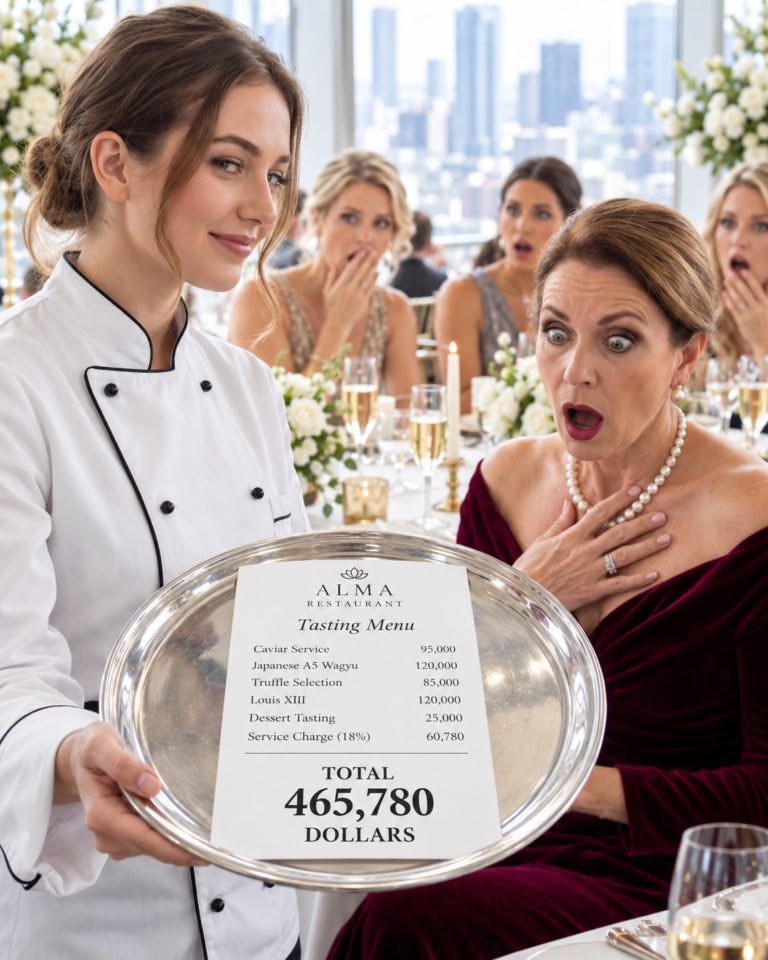
“Camilla, we’re full. Should I tell them we can’t accommodate them?”
I looked at Beatrice.
For years, she’d walked into Lumina as if she owned it.
I had built the restaurant myself after years as a line cook, sous-chef and executive chef. Lucas, my husband, hadn’t invested a dollar.
Beatrice told people otherwise.
“My son gave Camilla the restaurant,” she’d say. “She handles the cooking.”
Worse, she routinely ordered expensive meals and left without paying.
Lucas always defended her.
“She’s my mother. Stop making a big deal over a few meals.”
I’d tolerated it far too long.
That afternoon, I made a different decision.
“Seat them,” I told Gavin.
“All thirty-nine?”
“All of them. And make sure everything they order goes onto one itemized bill under Beatrice’s name.”
He looked at me for a moment.
Then he understood.
The private room became a three-hour feast.
Steaks. Seafood. Desserts. Reserve bottles from the cellar.
Beatrice repeatedly announced that everyone should order freely because she was treating them.
Then, while I was pouring wine, one of her friends asked where Lucas was.
Beatrice laughed.
“My son has a lovely young woman keeping him entertained these days.”
The table went quiet.
I stopped pouring.
Beatrice knew about the affair.
I’d suspected Lucas was cheating for three months. I’d found hotel charges, jewelry purchases and unexplained transfers.
But I’d never known his mother knew.
One woman asked, “Does Camilla know?”
Beatrice shrugged.
“She spends her life in this kitchen. Lucas deserves to enjoy himself.”
Then she said something even worse.
“Besides, he’s spending money from the restaurant. Eventually it’ll all belong to him anyway.”
I placed the bottle down.
That morning, I’d already met my divorce attorney.
Lucas had been using marital money—and potentially business funds—to finance expenses I couldn’t explain. My attorney was sorting through the records.
I wasn’t going to accuse anyone of crimes in a dining room.
But my marriage was finished.
And Beatrice had just confirmed that she considered my business hers to consume.
Three hours later, Gavin brought me the final bill.
$23,289.
I carried it to the private room.
“Ladies, I hope you enjoyed everything.”
Beatrice smiled.
“Wonderful. We’ll definitely come again.”
I placed the bill in front of her.
Her smile vanished.
“What is this?”
“The check.”
She stared at the total.
“Twenty-three thousand dollars?”
“You ordered for thirty-nine people and selected some of our most expensive food and wine.”
She pushed it away.
“Don’t be ridiculous. Give this to Lucas.”
“You repeatedly told everyone you were hosting and paying.”
Her friends started looking at one another.
“Camilla, we’re family.”
“That doesn’t make the restaurant free.”
Her face reddened.
Then she reached into her handbag and pulled out a folder.
“Fine. If we’re discussing business, sign these.”
I opened it.
The documents concerned transferring an ownership interest in Lumina to Lucas.
I almost laughed.
“Where did you get these?”
“Lucas prepared them. It’s time he took over the business side. You can continue running the kitchen.”
I closed the folder.
“No.”
Several women suddenly became fascinated with their phones.
Beatrice stared at me.
“What do you mean, no?”
“I mean Lucas doesn’t own Lumina. You don’t own Lumina. And I’m not signing my restaurant over to anybody.”
“But Lucas said—”
“Call him.”
So she did.
She put him on speakerphone.
“Lucas, tell your wife to stop this nonsense. She’s trying to charge me twenty-three thousand dollars, and she refuses to sign the transfer papers.”
Silence.
Then Lucas spoke.
“Mom… why did you take thirty-eight people there?”
“You said the restaurant would eventually be yours!”
“Mom.”
His voice became strained.
“It isn’t mine.”
Beatrice froze.
“What?”
“I don’t own the restaurant.”
The women around her began exchanging looks.
“But you told me—”
“I said I was trying to work things out with Camilla.”
“You told me she would sign!”
“I hoped she would.”
I leaned toward the phone.
“I won’t.”
“Camilla—”
“And from now on, speak to my attorney about anything involving our finances.”
Another silence.
Beatrice looked at me.
“What attorney?”
I took a second envelope from beneath the bill and placed it on the table.
“My divorce attorney.”
Her face changed completely.
“Divorce?”
“Lucas and I are separating.”
“Because of some little affair?”
A few women visibly recoiled.
I looked at her.
“No, Beatrice. Because your son lied to me, spent money behind my back and apparently expected me to eventually hand him part of the business I built.”
Then I pushed the restaurant bill toward her again.
“And none of that changes this.”
She refused to pay.
So we handled it like a business dispute.
Gavin documented the orders. We preserved the security footage and reservation records we’d created when the group was seated. Beatrice’s repeated statements that she was hosting the meal had been heard by staff and guests.
Several of her friends immediately offered to pay for their own portions once they realized Beatrice hadn’t actually arranged anything with me.
Others were furious.
“You told us this was your treat.”
“I thought Lucas would cover it!”
“That’s not what you said.”
By the end of the afternoon, a substantial portion of the bill had been paid by individual guests.
Beatrice still refused responsibility for the remainder.
I didn’t scream.
I didn’t threaten to have her dragged away.
I gave the unpaid account and documentation to my attorney and let the appropriate process handle it.
The more important matter was Lucas.
Our divorce took months, not days.
Attorneys reviewed the finances.
Some of the expenses I’d found were marital expenditures connected to his affair. Other transfers involving the restaurant required separate accounting to determine exactly what had happened and whether Lucas had authority to make them.
There was no dramatic confession.
There didn’t need to be.
Bank records are less exciting than confessions, but they’re usually more useful.
Lucas eventually admitted he’d assumed I would forgive him.
He’d also assumed that because we were married, he’d eventually have some claim or influence over Lumina.
“You always put the marriage first,” he told me during one of our final conversations.
“I did.”
“So when did that change?”
“When I realized you were using that against me.”
He looked down.
“And my mother?”
“Is no longer welcome to charge anything to this restaurant.”
Despite everything, I almost smiled.
“That policy is permanent.”
Months later, the divorce was resolved.
Lumina remained mine.
Beatrice’s banquet account was eventually dealt with separately, without turning my dining room into a courtroom.
The strangest change came afterward.
Every time the front door opened, I stopped expecting to hear Beatrice announcing what she wanted for free.
One evening, an elderly couple who’d been customers since my first year came in for dinner.
I cooked for them myself.
At the end of the meal, I brought their check.
The husband placed his card on the tray.
His wife looked at me.
“You seem different lately.”
“Different how?”
“Relaxed.”
I glanced around the restaurant.
My cooks were cleaning the line.
Gavin was checking tomorrow’s reservations.
Customers were finishing dessert.
Everything I’d spent years building was still there.
For a long time, Lucas and Beatrice had used one word whenever they wanted something from me.
Family.
Family meant free dinners.
Family meant overlooking money.
Family meant forgiving disrespect.
Family meant giving a little more because I could supposedly afford it.
I’d finally understood something.
Being family doesn’t give anyone ownership of your work.
I picked up the couple’s paid bill and smiled.
“I think I finally stopped confusing generosity with obligation.”
Then I carried the tray back to the kitchen.
The restaurant was still mine.
And for the first time in years, nobody walking through its doors could convince me otherwise.