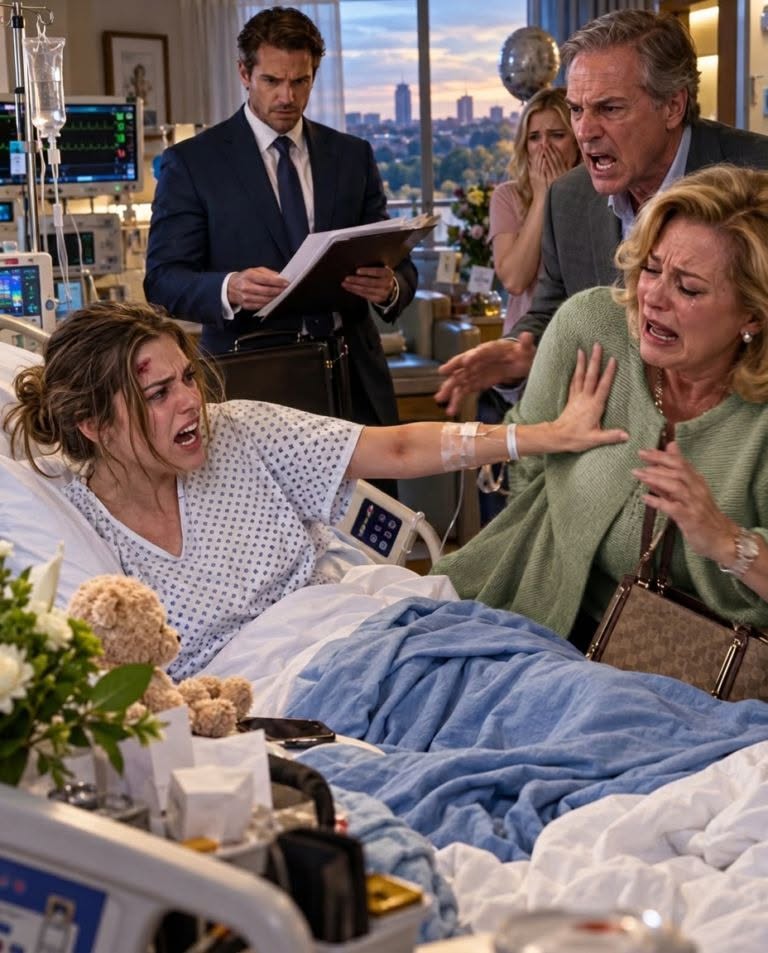
My mother did send one text.
We’re at Lauren’s. Is this urgent?
My younger sister had just moved into a new house.
Apparently, she needed help unpacking.
At 6:40 that evening, Lauren posted a video thanking Mom and Dad for spending the day helping her settle in.
Dad was carrying a lamp.
Mom was arranging cushions.
I watched it from a hospital bed with an IV in my arm.
Then I called my estate attorney.
Julian arrived a little after eight.
I’d sold my medical software company two years earlier, so my estate was substantial. My parents knew I was wealthy.
They didn’t know exactly how wealthy.
They also didn’t know how much I’d planned to leave them.
There was a lake house they loved, significant financial assets, provisions for Lauren’s future children and positions connected to my charitable foundation.
“Miranda,” Julian said, “you don’t have to make permanent decisions tonight.”
“I know.”
“Then you’re sure?”
“Yes.”
A doctor had already confirmed I was alert and capable of making decisions. Julian made certain everything was properly witnessed and documented.
My parents were removed as beneficiaries.
So was Lauren.
I wasn’t doing it because of one missed call.
The nine calls had simply forced me to admit what I’d spent thirty-four years refusing to say out loud.
Lauren had always come first.
When I won a science competition as a child, my parents left early for her dance recital.
At my college graduation, they left because Lauren was upset over a boyfriend.
When I built my company, they called me lucky.
When I sold it, my mother’s first question was whether I could help Lauren buy a house.
I did.
I gave her $90,000 toward the down payment.
She never really thanked me.
Still, I kept telling myself that one day something important enough would happen that my parents would choose me.
Then I ended up frightened in a hospital bed.
And they chose Lauren’s moving boxes.
Mom and Dad finally arrived after ten that night.
Mom walked in carrying coffee.
“Miranda, you scared us.”
I stared at her.
“No, Mom. I didn’t.”
She stopped.
“If I’d scared you, you would’ve answered the phone.”
Dad immediately started explaining that they hadn’t understood how serious the accident was.
“Nine calls,” I said.
Mom’s face changed.
“I called before surgery. A nurse called you too. I left a message saying I was scared and asking you to come.”
Neither of them answered.
Then Dad noticed Julian.
“What is your lawyer doing here?”
“I asked him to come.”
“Why?”
“I changed my estate plan.”
Silence.
Julian explained only what I had authorized him to disclose.
They were no longer beneficiaries.
Neither was Lauren.
Mom sat down.
Dad stared at me as though I’d slapped him.
“You’re disinheriting your family because we missed some phone calls?”
“No. I’m changing what happens to my money because today finally made me understand our relationship.”
“Miranda, we’re your parents.”
“I know.”
“We gave you everything.”
That sentence hurt more than I expected.
“You gave Lauren everything,” I said. “You gave me whatever was left and called me independent.”
Mom began crying.
“We thought you were fine. You’re always fine.”
And there it was.
The explanation they’d used my entire life.
Lauren needed them.
Miranda was fine.
“You know why I’m always fine?” I asked. “Because I learned very young that needing you didn’t make you come.”
Nobody spoke.
“I’ve spent my entire life waiting for you to choose me when it mattered. Today I finally stopped waiting.”
Mom reached for the bed rail.
“Please don’t do this because you’re angry.”
“I’m not angry.”
And strangely, I wasn’t.
I was exhausted.
“I don’t want you punished. I don’t want you poor. I’m just no longer building my future around people who weren’t there when I needed them.”
A nurse eventually asked them to leave because my heart rate was climbing.
Dad stopped at the door.
“You’ll feel differently when you’ve calmed down.”
“I’ve never been calmer.”
They left.
My coffee sat untouched beside the window.
The nurse stayed.
So did Julian.
The next morning, my best friend Tessa flew in from Austin after Julian called her.
She walked into my room furious and crying.
“I cannot believe you didn’t call me.”
“I didn’t want to worry you.”
“That is literally what friends are for.”
She stayed nine days.
That sentence changed something in me.
I’d spent years believing that asking for help was a burden.
Maybe that was another thing my family had taught me incorrectly.
My father returned to the hospital two days later.
He didn’t demand to see me.
He simply waited downstairs until I agreed.
We met in a small hospital garden.
He looked exhausted.
“I need to tell you something,” he said.
I waited.
“The first time you called that morning, I saw your name.”
My stomach tightened.
“It said Miranda — Hospital.”
He swallowed.
“And I turned the phone over.”
That hurt more than any excuse could have.
“Why?”
“Because Lauren needed help, and I assumed you’d be fine.”
He rubbed his face.
“I’ve been telling myself that story for thirty years. Lauren was sensitive. You were strong. She needed us. You didn’t.”
He looked at me.
“It made me feel like I had two daughters I loved equally. One simply required more attention.”
I said nothing.
“But sitting outside your room, I realized something. You weren’t the daughter who needed less.”
His voice broke.
“You were the daughter who stopped asking.”
For once, my father wasn’t defending himself.
He wasn’t asking me to change the will.
He wasn’t blaming the accident, my sister or bad timing.
He was simply admitting what he’d done.
“Strong people still need their parents, Dad.”
“I know.”
“Do you?”
“Yes.”
I believed that he understood the sentence.
I didn’t yet know whether he’d live by it.
“I’m not putting you back in the will,” I said.
He nodded.
“I’m not asking you to.”
“And I’m not pretending everything is fixed because you apologized.”
“I know.”
“But if you actually want a relationship with me, don’t wait for me to forgive you.”
He looked confused.
“Then what do I do?”
“Show up.”
That was all.
Recovery took months.
During that time, Dad started calling once a week.
Not asking about money.
Not asking whether I’d reconsidered anything.
Just asking how physical therapy was going.
Sometimes our conversations lasted three minutes.
Sometimes twenty.
Mom took longer.
Her first apology contained so many explanations that it barely felt like one.
Her second was different.
She wrote that she’d finally understood how often she’d interpreted my silence as proof that I needed nothing, rather than evidence that I’d learned not to ask.
She didn’t request forgiveness.
She simply apologized.
Lauren eventually came too.
Alone.
She admitted she’d seen my hospital messages that day and assumed Mom and Dad would deal with them.
That, she said, was what she’d done her whole life.
Let somebody else deal with things.
She apologized for the house money.
For never asking what things cost me.
For calling my decision cruel before asking whether I was even okay.
I didn’t restore her inheritance either.
“I need to know whether we can be sisters when there’s no money attached.”
Lauren nodded.
“I think I need to know that too.”
So we started there.
Slowly.
Nothing returned to what it had been.
That was probably the healthiest part.
My will stayed changed.
My parents never regained automatic access to my money.
Lauren stopped expecting me to rescue her.
And I stopped pretending independence meant never needing anyone.
Almost a year after the accident, I was sitting outside one Sunday morning when I looked at my phone.
For reasons I still can’t completely explain, I called my mother.
She answered on the first ring.
“Miranda? What’s wrong? Are you okay? Do you need me?”
I closed my eyes.
For a moment, I was back in that hospital room staring at the clock.
Nine unanswered calls.
“Nothing’s wrong,” I said.
Mom exhaled.
“Thank God.”
“I just wanted to hear whether you’d pick up.”
There was a long silence.
Then she started crying.
“I’ll pick up, Miranda.”
I believed her.
Not because she said it.
Because for almost a year, she’d been proving it.
I never changed my will back.
Some things shouldn’t be restored to their original form.
Sometimes they need to be rebuilt differently.
And that was what happened to my family.
Nine unanswered calls ended the relationship we’d pretended to have.
Everything that came afterward had to be built from scratch.
This time, at least, everyone showed up.