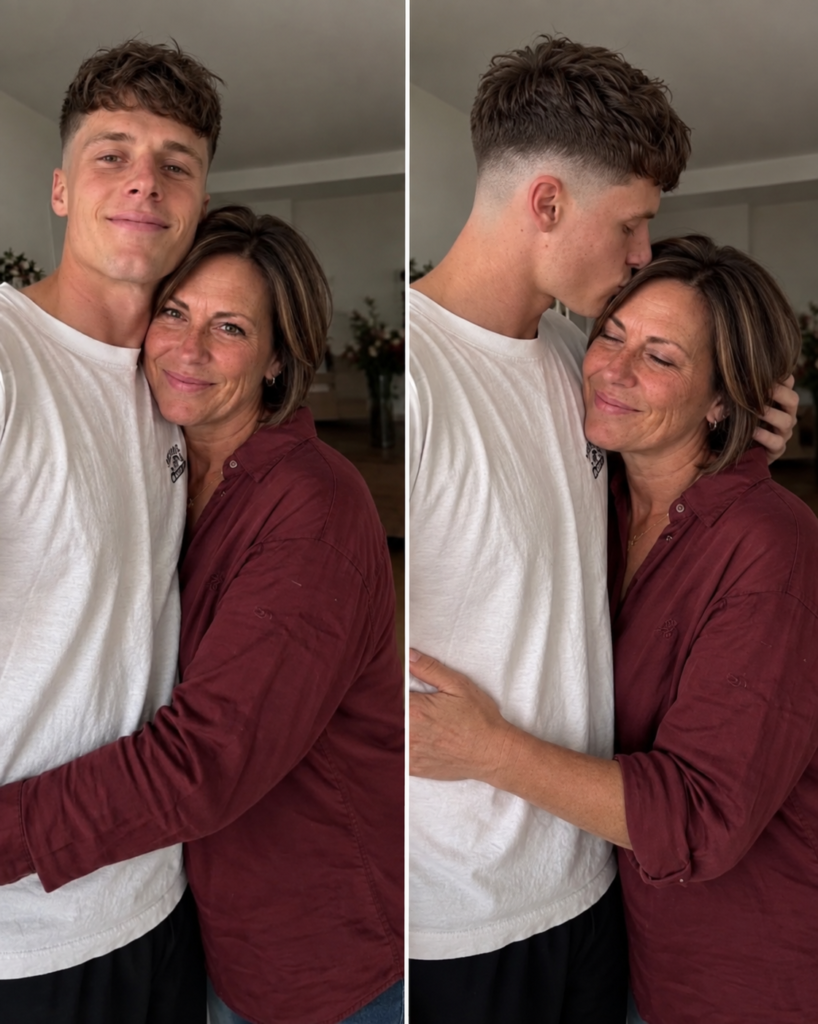
Then I turned it over.
In Claire’s handwriting were five words:
Found Ethan today. Tell him.
Underneath was a date.
The exact day Claire and I had matched on Tinder.
I checked it twice.
Then I heard her coming out of the bedroom.
And suddenly I understood something terrifying.
The woman I’d been dating for six months had known exactly who I was before I’d known anything about her.
It started with my phone.
I’d dropped it somewhere between the couch cushion and armrest while waiting for Claire to change.
I muttered something my mother would’ve objected to and shoved my hand into the gap.
Two quarters.
A pen cap.
Something that felt disturbingly like an ancient potato chip.
Then my phone.
But when I pulled my hand out, something else came with it.
A photograph fluttered onto the rug.
I picked it up automatically.
Then froze.
The photograph was old.
Its colors had faded around the edges, and a group of children sat on what appeared to be a library floor, each holding a book.
Near the end of the row was a skinny boy with messy brown hair and a missing front tooth.
Me.
Eight years old.
Maybe nine.
I knew immediately because of the striped shirt.
My mother had loved that shirt.
I’d hated it with the passion only an eight-year-old can feel toward clothing.
But I wasn’t alone in the picture.
Beside me was a little girl wearing thick purple glasses.
I turned the photograph over.
In faded blue ink:
Nora + Ethan, Summer Reading Club.
Then came Claire’s newer handwriting.
Found Ethan today. Tell him.
And the date.
The day we’d matched.
“Ethan?”
Claire’s voice came from the bedroom.
I didn’t answer.
A moment later, she walked into the living room wearing the dress I’d bought her.
Emerald green.
She’d pointed it out weeks earlier, then put it back after seeing the price.
I’d returned without her and bought it.
She looked beautiful.
For about two seconds, she smiled.
Then she saw what was in my hand.
Her fingers stopped halfway through fastening an earring.
“Where did you get that?”
I almost laughed.
“Your couch.”
Claire said nothing.
I lifted the photograph.
“Who’s Nora?”
Her hand slowly dropped.
“Ethan…”
“No.”
I turned the photograph around.
“Why did you write this on the day we met?”
She looked toward the couch.
Then toward me.
Finally:
“Because I knew who you were.”
I stared at her.
“Before Tinder?”
“Yes.”
The room seemed to shrink.
“You knew me before we matched?”
“Yes.”
“How?”
Claire looked at the photograph.
“Nora was my sister.”
I looked at the little girl again.
Something moved at the edge of my memory.
Glasses.
A laugh.
A book opened across two sets of knees.
Then it vanished.
“Your sister?”
“My half-sister. She was much younger than me.”
“Why am I in a photograph with her?”
“Because you were friends.”
I stared at Claire.
For six months, I’d believed our story started on a dating app.
I was twenty-five and nearly ready to delete Tinder.
Claire was forty-five.
The twenty-year age difference had made me hesitate.
Her first message made me laugh.
Our first coffee lasted almost four hours.
By our third date, she knew I hated cinnamon in coffee.
I knew she bought terrible refrigerator magnets whenever she traveled.
She remembered my boss’s name.
My favorite pizza.
How I’d gotten the scar on my wrist.
With Claire, I’d always felt like there were no games.
Apparently, I was wrong.
“So you matched with me because of Nora.”
“At first, yes.”
That answer hurt.
“You recognized me from childhood and said nothing.”
“I know.”
“You sat across from me drinking coffee already knowing who I was.”
“Yes.”
“And I knew nothing about you.”
Claire closed her eyes.
“Yes.”
I tapped the handwriting on the photograph.
“Found Ethan today. Tell him.”
I looked at her.
“Tell me what?”
Claire didn’t answer immediately.
“Where was this taken?” I asked.
“The Pine Street library.”
I frowned.
“Didn’t they renovate that place?”
“The original children’s room is still there.”
Then something came back.
Low bookshelves.
Beanbags.
A paper sun hanging crookedly from the ceiling.
Dusty carpet.
I looked at the girl again.
“Her glasses were yellow.”
Claire blinked.
“What?”
“Nora’s glasses. They weren’t purple.”
“They were.”
“No.”
The memory became stronger.
“They were yellow.”
For the first time all evening, Claire laughed.
“She painted them.”
“What?”
“With yellow nail polish. Our mother almost had a nervous breakdown.”
And suddenly I saw her.
Not the girl in the photograph.
Nora.
Cross-legged on the library floor.
Thick yellow glasses.
A paperback held ridiculously close to her face.
Annoying me.
Arguing with me.
Real.
I sat down.
Claire took a small step toward me.
“Do you want to go there?”
I looked up.
She immediately stopped.
“Sorry.”
“What?”
“That was the wrong question.”
She took a breath.
“If you want to know what happened, I’ll tell you here. Or I can show you where the photograph was taken. Or I can leave.”
For the first time that night, Claire wasn’t deciding for me.
I grabbed my jacket.
“Take me to the library.”
She changed out of the green dress without another word.
Twenty minutes later, we were standing inside the Pine Street branch.
The adult section meant nothing to me.
Then we entered the children’s room.
I stopped.
It was smaller than I remembered.
Much smaller.
But something about it felt familiar.
I walked slowly between the shelves.
“There used to be a blue rug.”
Claire pointed toward the corner.
“Right there.”
It was gray now.
I lowered myself into one of the tiny chairs.
My knees barely fit beneath the table.
Claire stayed near the doorway.
Then I noticed a shelf of adventure books.
Another memory surfaced.
A book slamming shut.
Nora accusing me of reading too slowly.
Me accusing her of skipping pages.
I laughed.
Claire didn’t ask why.
“She cheated.”
“Oh, constantly.”
“She skipped ahead.”
“Constantly.”
“I hated that.”
“She knew.”
I looked at Claire.
She was smiling.
But not at me.
For a moment, she was looking at her little sister again.
That was when I finally asked:
“Was Nora sick?”
Claire’s smile disappeared.
“Yes.”
“How sick?”
“She had a chronic condition from childhood. That summer was actually one of her better periods.”
“So she came here?”
“Every week she could.”
Claire approached the table but stopped on the other side.
“She hated when people asked what was wrong with her before they asked her name.”
“I didn’t know.”
“That was why she liked you.”
I gave her a look.
“Don’t turn eight-year-old me into some wonderful little saint.”
Claire almost smiled.
“You weren’t.”
“Good.”
“You once made her cry because you accused her of cheating at Uno.”
“Was she cheating?”
“Absolutely.”
I laughed.
Then the laughter disappeared.
“What happened?”
Claire pulled out the chair opposite me.
“Can I sit?”
I nodded.
She sat.
“Near the end of that summer, our mother took Nora away for specialized treatment. Everyone expected her to come back after a few weeks.”
I stared at the scratched tabletop.
“She didn’t.”
“No.”
“What happened?”
“She got worse.”
Claire’s voice became quieter.
“She died that winter.”
I stopped moving.
Somewhere elsewhere in the library, a child laughed.
“Nobody told me?”
“No.”
“But you knew about me.”
“Yes.”
“You remembered me all these years?”
“Not exactly.”
Claire folded her hands.
“I knew there’d been a boy named Ethan. I knew your mother drove a red car. I knew you’d moved not long after Nora got sick.”
“That’s it?”
“Mostly.”
“So how did you find me?”
“I didn’t.”
She looked at me.
“Seventeen years later, your face appeared on my phone.”
I stared at her.
“Tinder.”
“Yes.”
“And you recognized me?”
“Not immediately. Then I saw your name.”
She paused.
“And the scar.”
I instinctively touched my wrist.
“Nora had mentioned it.”
“So you swiped right.”
“Yes.”
“Because you wanted to tell me she’d died.”
“One coffee.”
“What?”
“That was my plan.”
Claire looked ashamed.
“Meet you once. Tell you who I was. Tell you what happened to Nora. Thank you for being her friend.”
“And then?”
“You ordered another coffee.”
I remembered.
“You stayed,” she continued, “until the employees started stacking chairs around us.”
“That doesn’t explain why you lied.”
“No.”
At least she didn’t pretend it did.
“If Nora hadn’t existed, would you have swiped right on me?”
Claire was silent for several seconds.
“I don’t know.”
That hurt.
She could’ve given me the easy answer.
Of course.
I would’ve noticed you anyway.
Instead, she told me the truth.
“I probably wouldn’t have stopped on your profile long enough to find out,” she admitted.
I looked away.
“But Nora got me to that coffee shop,” Claire continued. “She didn’t make me order another coffee. She didn’t make me stay four hours. And she definitely didn’t make me fall in love with you.”
I looked back at her.
“You still lied.”
“Yes.”
“What happened after that first coffee doesn’t erase how you got there.”
“I know.”
“There you go again.”
Claire stopped.
“Sorry.”
I stood.
“Why didn’t you tell me?”
“At first?”
“Yes.”
“Because I didn’t want you to think I was using Nora to get close to you.”
“You were.”
Claire nodded.
“To meet you. Yes.”
“And after that?”
She looked down.
For several seconds, she said nothing.
Then:
“I was afraid you’d leave.”
That was the first explanation she’d given me that didn’t sound noble.
Not protecting me.
Not protecting Nora’s memory.
Fear.
Human and selfish.
I could understand it.
Understanding wasn’t the same as forgiving it.
“I need to be alone.”
Claire stood immediately.
“Do you want me to leave?”
I considered it.
Then shook my head.
“Stay here.”
She nodded.
I walked outside.
Alone.
And Claire let me.
Halfway across the library courtyard, another memory came rushing back.
Nora snapping her book shut.
Me getting angry.
My own childish voice:
Fine. Finish it yourself.
I stopped walking.
My stomach turned.
What if those were the final words I’d ever said to her?
I pulled out my phone.
Can you come outside?
Claire appeared about a minute later.
She stopped several feet away.
“I remembered something.”
She waited.
“I told Nora to finish the book herself.”
Claire’s expression changed.
“Was that the last time I saw her?”
She thought carefully.
Then shook her head.
“I don’t know.”
“You don’t?”
“No.”
I expected that answer to hurt.
Instead, it helped.
Because Claire could’ve invented something comforting.
She didn’t.
“I don’t know exactly what your final conversation was,” she said.
Then she smiled faintly.
“But Nora talked about you afterward.”
“What did she say?”
“Mostly that you were annoying.”
I laughed despite myself.
Claire smiled.
“She also said you always waited when she fell behind reading.”
I looked at the photograph.
Nora had existed somewhere inside my memory for seventeen years.
A blank space I’d forgotten was blank.
Now pieces were returning.
Yellow glasses.
Raisins she hated.
Cheating at Uno.
Skipping pages.
Making me angry.
Making me laugh.
A person.
Not a tragedy.
Not Claire’s reason for finding me.
Nora.
I looked at Claire.
“I believe you love me.”
Her eyes filled.
“But I don’t know what I trust yet.”
She nodded.
“I understand.”
“No.”
I shook my head.
“You don’t. Neither do I.”
Claire accepted that.
Then she asked:
“What do you want me to do?”
That question surprised me.
“Tonight?”
“Yes.”
“Tell me about Nora.”
“And after?”
“I want to go home.”
“Okay.”
We spent another hour in that library.
Claire told me Nora hated raisins.
She wanted a motorcycle when she turned sixteen.
She believed board-game rules were “suggestions.”
She loved thunderstorms but hated balloons popping.
She had once tried to convince their mother that homework was discriminatory against children who preferred television.
Nothing dramatic.
That was what I needed.
I didn’t want the story of how Nora died.
I wanted the story of how she’d lived.
Eventually, Claire and I returned to her apartment.
The green dress was folded neatly over a chair.
“Do you want me to return it?” she asked.
I looked at it.
“No.”
Claire seemed surprised.
“I bought it because you wanted it,” I said. “That part was real.”
Then I went home.
I didn’t call her the next day.
Or the day after.
On the fourth day, I returned to Pine Street by myself.
I found the adventure book Nora and I used to argue about.
I checked it out.
Then I sat at the tiny table and finished it.
The ending was terrible.
I pulled out my phone.
Nora was right. The ending is awful.
Claire replied almost immediately.
She was unbearable when she was right.
I smiled.
Then I typed:
I’m still at the library if you want to come argue about it.
Twenty minutes later, Claire appeared.
She didn’t sit beside me.
She stood near the table.
“Can I?”
I nodded.
She sat.
We started talking about the book.
Not our relationship.
Not forgiveness.
Not what came next.
Just the book.
At one point, while I was reading a passage aloud, Claire automatically reached toward the page.
I placed one finger on it.
“Hey. I’m not done.”
Her hand stopped.
“Sorry.”
Then she pulled it back.
And waited.
I finished the paragraph.
Afterward, I turned the page myself.
It was a tiny moment.
Probably meaningless to anyone else.
But it mattered to me.
Because Claire couldn’t undo the fact that she’d entered my life knowing something I didn’t.
She couldn’t return those six months and give me the choice she’d taken away.
And I still didn’t know whether we’d survive what she’d hidden.
But maybe trust wasn’t going to come back through one grand apology.
Maybe it would happen exactly like this.
One question at a time.
One truth at a time.
One boundary respected at a time.
Claire had spent six months deciding when I was ready to turn the page.
Now she finally understood.
The page was mine.
And if there was going to be another chapter between us, I would decide when to turn it.