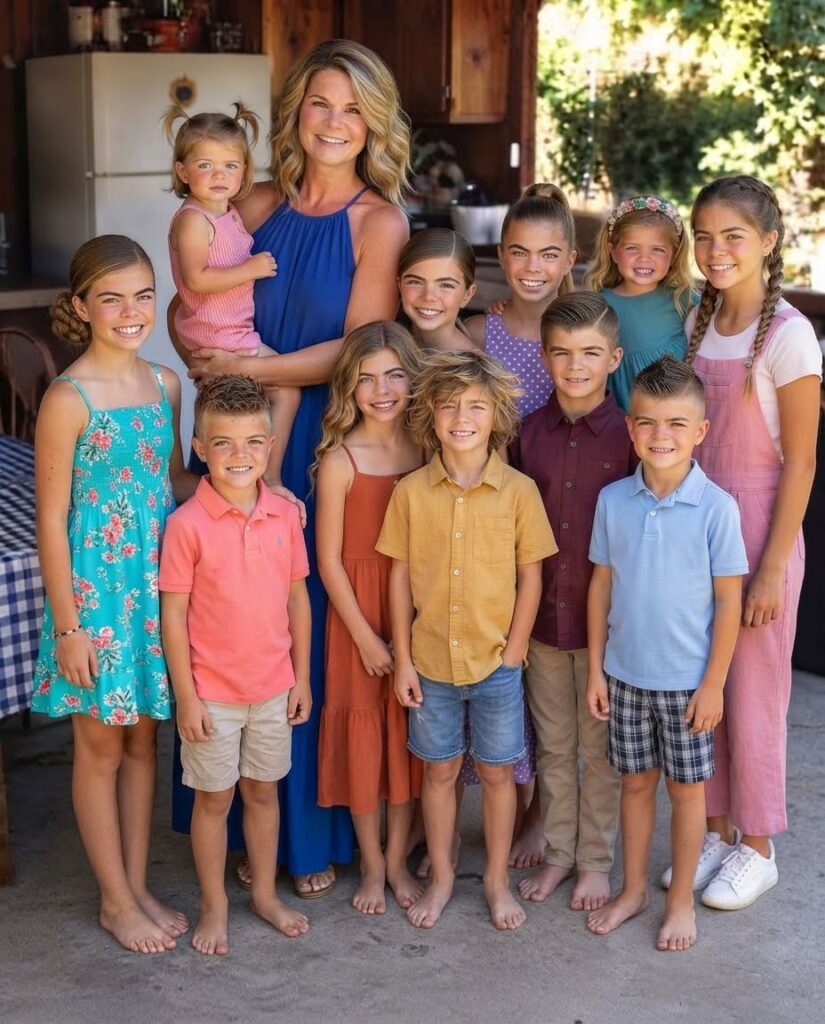
On the kitchen table was a note.
I’m sorry. I can’t do this anymore.
That was it.
No explanation. No phone number. No instructions.
And Julian hadn’t only left me.
Ten frightened children were still asleep upstairs.
Their mother had died several years earlier, and when I met Julian, I fell in love with the entire chaotic family that came with him. I’d helped with homework, attended school events, learned who hated tomatoes and who needed the hallway light left on at night.
But I wasn’t their mother.
I wasn’t even their stepmother yet.
So the moment I realized Julian was truly gone, I called the police.
What followed was nothing like the dramatic decision people later imagined when they heard our story. I didn’t simply announce that I was keeping ten children and become their legal mother overnight.
There were police interviews.
Social workers.
Relatives to contact.
Emergency arrangements.
Questions about whether Julian had left voluntarily, whether he was in danger and whether he might return.
For weeks, I expected him to.
Every sound in the driveway made me look toward the window.
Every phone call from an unfamiliar number made my heart race.
Nothing.
Some of the children had relatives who could theoretically have taken them, but separating ten siblings who had already lost their mother and then apparently their father became its own painful question. I asked to remain involved while the authorities and family worked through what should happen.
Temporary arrangements became longer ones.
Longer arrangements eventually became permanent.
The legal details took years and didn’t happen identically for every child, particularly because they weren’t all the same age. But by the time the youngest ones were growing up, there was no meaningful distinction left in my mind.
They were my children.
And I was their mother.
My parents thought I’d sacrificed my life.
Maybe in some ways I had.
Money was tight. Dating was almost impossible. There were years when somebody always needed braces, shoes, school fees or a ride somewhere while I needed sleep.
But there were also birthdays.
Graduations.
First jobs.
Broken hearts.
Weddings.
Grandchildren.
Sunday dinners became our tradition even after everyone had grown up. My dining room was never large enough, somebody was always arguing about sports and there were never enough chairs.
Thirty years passed that way.
Julian became a wound we learned to live around.
Then, one Sunday afternoon, someone knocked on my door.
An elderly man stood outside holding an envelope.
“Evelyn?”
“Yes?”
“My name is Arthur Vance. I represented Julian many years ago.”
I hadn’t heard a stranger say Julian’s name in decades.
I gripped the doorframe.
“Is he alive?”
Arthur’s expression answered before he spoke.
“He died recently.”
Behind me, the dining room had gone quiet.
Several of the children were there with their own families.
Arthur held out the envelope.
“He asked that you receive this after his death.”
I stared at it.
“Where has he been?”
Arthur hesitated.
“Most of what I can tell you is in the letter. Some of it I can explain afterward.”
I sat at the dining table surrounded by the people Julian had left behind and opened it.
I recognized the handwriting immediately.
Evelyn,
There is no explanation I can give that will make what I did to you and the children right.
That sentence stopped me.
Not necessary.
Not heroic.
Not forgive me because I had no choice.
Right from the beginning, Julian admitted what he’d done.
Years before we met, he had become involved with a business whose owners were eventually investigated for serious criminal activity. Julian wasn’t one of the principal people involved, but he’d seen records and transactions that later became important.
Eventually, investigators approached him.
He cooperated.
He told me none of it.
Shortly before our wedding, Julian became convinced that people connected to the investigation knew he was helping authorities. According to the letter, he’d received threats that mentioned his family.
He panicked.
Instead of telling me, contacting an attorney about protecting the children or allowing law enforcement to determine what danger actually existed, Julian made his own decision.
He disappeared.
I told myself that if I severed every visible connection to you, anyone watching would believe you knew nothing and were useless as leverage against me.
I read that sentence twice.
Then came the one that hurt more.
I cannot tell you with certainty that I was right.
That changed everything.
Julian hadn’t spent thirty years as some invisible hero nobly sacrificing himself for us.
He had been frightened.
Maybe the threat had been real. Arthur later confirmed that there had indeed been an investigation and that Julian’s cooperation had mattered.
But disappearing from his children’s lives had been Julian’s choice.
And he had lived with it.
The letter continued.
At first I believed I would come back when everything ended.
Then months became years.
By the time I understood that the immediate danger had passed, you had created stability for the children that I had destroyed.
I was ashamed.
Every year I waited made returning harder.
Eventually I realized I was no longer staying away only to protect you.
I was staying away because I was afraid to face what I had done.
My oldest son, Marcus, stood behind my chair with one hand on my shoulder.
Nobody spoke.
Julian wrote that through Arthur, he had occasionally learned how the children were doing.
Not every birthday.
Not every soccer game.
Not every detail of their lives.
Just fragments.
A graduation announcement.
A marriage.
News that another grandchild had been born.
And, eventually, the knowledge that the woman he’d abandoned one week before their wedding had stayed and raised his children.
There is no version of this story in which I get those years back.
You were there.
I wasn’t.
Whatever reasons I had when I left cannot change that.
By then I was crying.
So were several of the children.
There was a modest trust.
Julian had saved and invested over the years, and what remained was divided among his children, with a separate amount left to me. It wasn’t enough to transform everybody’s lives overnight.
That almost made me grateful.
I didn’t want thirty years of absence converted into a price.
Arthur returned the next day with several personal belongings Julian had kept.
Among them was my engagement ring.
I sat holding it for a long time.
There were also journals.
Not thousands of perfectly documented entries proving Julian had somehow watched every moment of our lives from afar.
Just several notebooks.
Some contained ordinary thoughts.
Others contained letters he’d never sent.
One was addressed to Marcus.
Arthur told me you graduated. I started writing a letter and then realized I had no right to appear in your life simply because I was proud of you. But I am.
Another was written to one of the girls after Arthur learned she’d gotten married.
And there were pages addressed to me.
One began:
Today would have been our fifteenth anniversary if I had been braver.
That word stayed with me.
Braver.
Not luckier.
Not safer.
Braver.
For most of my life, I’d believed Julian left because he stopped loving us.
The truth was more complicated and, in some ways, more painful.
He had loved us.
He had also failed us.
Both things could be true.
That was difficult for some of the children to accept.
One of my sons refused to read the journals for almost a year.
“He could’ve come back,” he told me.
“Yes.”
“He knew where we were.”
“Yes.”
“You’re not going to defend him?”
“No.”
He stared at me.
“I thought you’d tell me he was protecting us.”
“I think he believed that when he left.”
“And afterward?”
I looked down at Julian’s letter.
“Afterward, I think shame became easier than coming home.”
My son nodded.
That answer, at least, he could understand.
Other children responded differently. One read every page immediately. Another wanted nothing except the letter Julian had written specifically to her. Some forgave him.
Some didn’t.
I stopped believing there had to be one correct response.
I had my own anger to work through.
Julian’s explanation changed the story I’d told myself for thirty years, but it didn’t erase those years.
I had worked multiple jobs.
Children had cried for their father.
I’d sat through school events where every other child seemed to have two parents.
I’d made decisions alone that should have belonged to two people.
Love didn’t retroactively make his absence harmless.
Eventually, I placed my engagement ring on a chain and wore it around my neck.
Not because I considered myself Julian’s widow.
I wasn’t.
We had never married.
I wore it because the woman who had once accepted that ring had been real, and so had the life that followed after he disappeared.
Months later, the family gathered for our usual Sunday dinner.
Nothing luxurious.
My house.
Too many people.
Too much food.
Not enough chairs.
One of my grandsons was chasing another through the hallway while Marcus complained that someone had ruined the potatoes.
I sat at the edge of the table watching them.
Thirty years earlier, ten frightened children had awakened to discover that their father was gone.
I had stayed.
That remained true regardless of why Julian left.
His final letter didn’t turn him into a hero.
It didn’t turn him into a monster either.
It gave us something messier.
A frightened man had made a decision he believed would protect his family. Then, when the immediate danger passed, guilt and shame kept him away until returning felt impossible.
He loved his children.
He failed them.
He loved me.
He failed me too.
And somehow, from that failure, the rest of us had still built a family.
Near the end of his final letter, Julian had written:
If they hate me, let them.
If they forgive me, I don’t deserve to ask for it.
Just tell them there was never a day when I forgot they existed.
I never told the children what they were supposed to do with those words.
They were adults.
The choice belonged to them.
As for me, I eventually found something that wasn’t quite forgiveness and wasn’t anger either.
It was understanding.
That Sunday, I touched the ring beneath my collar and listened to the noise around my table.
For thirty years, I’d wondered why Julian left.
Now I knew.
But the answer didn’t change the most important part of our story.
He left.
I stayed.
And these were the lives we built afterward.