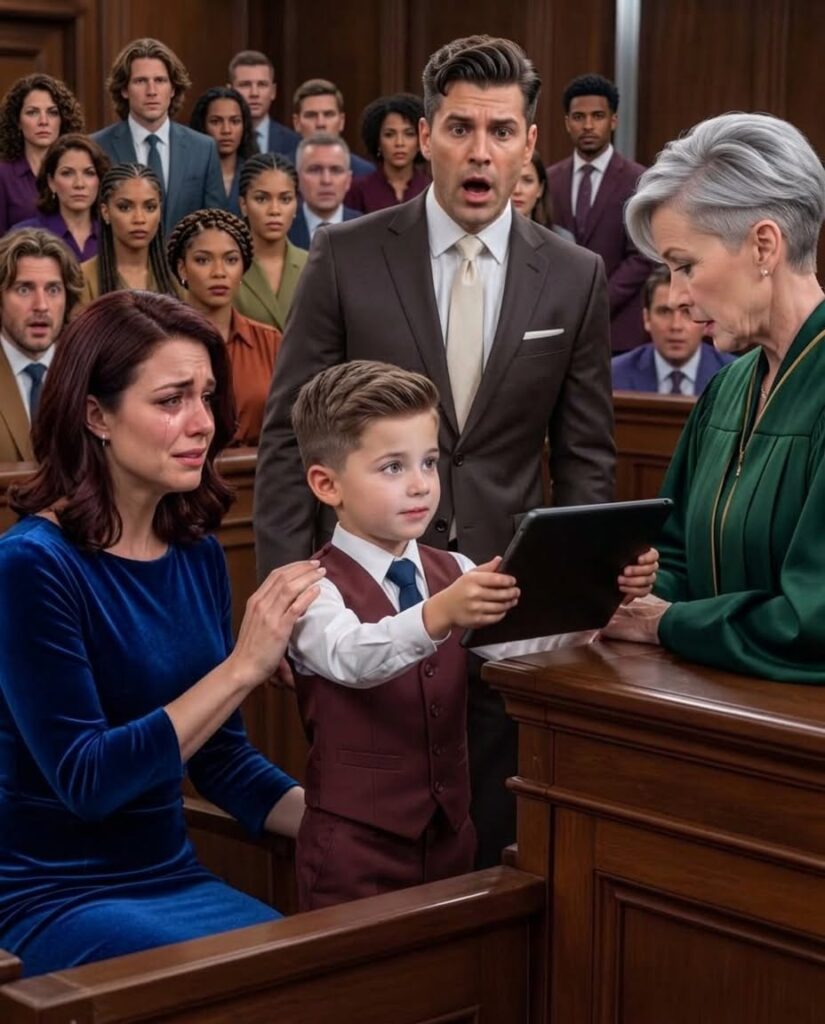
What Julian seemed to have forgotten was what I did before I left my career to raise our son.
For ten years, I had been a forensic accountant.
And numbers don’t become more believable just because somebody lies confidently about them.
My suspicions had begun months before the divorce. Money was moving strangely between Julian’s business and accounts I didn’t recognize. Payments labeled as consulting expenses didn’t correspond to consultants I knew. Marital funds had been used for expenses that had nothing to do with our household.
Then I found evidence that Julian had been paying part of Chloe’s living expenses.
I didn’t confront him immediately.
Instead, I started preserving records I was legally entitled to access and took them to an attorney.
That decision probably saved me.
My lawyer brought in an independent forensic accountant rather than relying solely on my own analysis. I understood the records, but in a contested divorce, having an outside professional document the findings mattered.
The preliminary review found enough discrepancies to justify asking for formal financial discovery.
There were unexplained transfers.
Related business entities.
Payments that didn’t match their descriptions.
And substantial marital money that appeared to have been moved shortly before Julian filed for divorce.
That didn’t mean we’d already proven fraud or hidden assets. It meant there were questions Julian was going to have to answer with documents rather than explanations.
The custody issue frightened me more.
Julian had spent months telling Noah that I was “having problems.” Eleanor had reinforced it. Noah became increasingly careful about what he said around his father, and I could tell he believed one wrong sentence might somehow cause our family to collapse.
I didn’t interrogate him.
My attorney specifically warned me not to.
Instead, Noah was eventually able to speak with professionals involved in the custody process without either parent directing the conversation.
That was when another piece of the story surfaced.
Months earlier, Noah had accidentally recorded part of an argument between Julian and me on an old digital camera he’d been playing with upstairs.
He hadn’t shown me.
He was afraid.
On the recording, Julian could be heard threatening to use custody against me during an argument over financial documents. More importantly, part of what he’d later described as one of my “violent outbursts” sounded very different on the recording.
There was crashing glass.
But there was also Julian’s voice immediately beforehand.
Noah eventually admitted that he’d seen his father knock dishes from the counter.
That evidence didn’t instantly decide the case.
It became something for the lawyers and custody professionals to examine. The original device and memory card had to be preserved. The circumstances of the recording mattered. So did the fact that the person who had made it was an eight-year-old child caught in the middle of his parents’ marriage.
But it changed something important.
Julian could no longer rely entirely on a story in which every conflict had been caused by me.
Neither could Eleanor.
Over the following months, the financial case developed separately.
Formal discovery produced records we hadn’t initially possessed. Account statements led to corporate records. Corporate records led to additional transactions. Some of the transfers had legitimate explanations.
Others didn’t.
The picture that eventually emerged was less dramatic than the conspiracy I’d feared, but serious enough.
Julian had moved marital money without disclosing it properly. He had used business entities to obscure certain expenses and had paid costs connected to Chloe while telling me our finances were tightening. There were also discrepancies in his business records that my divorce attorney referred to specialists rather than trying to turn our family case into a criminal prosecution.
That distinction mattered.
The divorce court’s job was to determine our finances, property and arrangements for Noah.
If other records suggested tax or financial offenses, the appropriate authorities would decide what to do with them.
I wasn’t going to stand in a courtroom and announce that I’d solved an international financial conspiracy.
I didn’t need to.
The records were enough.
Julian’s position changed as discovery continued.
The man who had originally demanded the house, most of our savings and primary custody began talking about settlement.
One evening, through our attorneys, he proposed that I keep the house if I stopped pursuing some of the financial questions.
I declined.
Not because I wanted revenge.
Because by then I understood that agreeing to an incomplete financial picture simply to end the conflict could affect Noah and me for years.
So we kept going.
Custody was the hardest part.
I didn’t want Noah separated from his father as punishment for what Julian had done to me. But I also wasn’t willing to pretend that involving an eight-year-old in adult accusations was harmless.
The eventual parenting arrangement reflected that.
There were boundaries around communication. Decisions concerning Noah had to go through proper channels rather than through him. His relationship with his father was handled according to the recommendations and orders that came out of the custody process, not according to what either Julian or I wanted in an angry moment.
Most importantly, Noah started seeing a therapist.
One evening, months into the divorce, he asked me something while I was making dinner.
“Was I bad for keeping the camera?”
I turned off the stove.
“No.”
“Dad told me I shouldn’t record people.”
“He’s right that you shouldn’t secretly record people just because you’re upset with them.”
Noah looked confused.
“Then I did something bad?”
“No.”
I sat beside him.
“You were a kid who got scared during an argument. You don’t have to decide whether what happened was evidence or who was right. That’s what the adults are supposed to handle.”
His shoulders relaxed.
That was when I realized how much responsibility he’d been carrying.
I had spent so much time proving what Julian had done that I almost missed what the conflict itself was doing to our son.
After that, the camera stopped being part of our conversations at home.
The lawyers had what they needed.
Noah was allowed to be eight again.
The divorce took much longer than Julian had expected.
There was no single courtroom moment when the judge discovered everything and his entire life collapsed.
Instead, there were depositions, financial disclosures, revised filings, negotiations, evaluations and long stretches where seemingly nothing happened.
Eventually, we reached the end.
The final financial settlement accounted for assets and money that had initially been missing from Julian’s disclosures. I didn’t receive everything I wanted. Neither did he.
That’s generally what settlements look like.
The separate review of his business affairs continued beyond the divorce, and I deliberately stopped treating its outcome as part of my personal victory. If he’d broken laws, that was for investigators and courts to determine. If he hadn’t, I wasn’t going to invent crimes because I was angry with him.
Chloe disappeared from our personal lives.
Eleanor never apologized in the way I’d once imagined she might. She continued believing I’d destroyed her son’s family by refusing to remain quiet.
Eventually, I stopped needing her to understand.
The most important change happened much closer to home.
I returned to work.
At first, I worried that ten years away from forensic accounting had made me obsolete. It hadn’t. The software had changed. Regulations had changed. I had plenty to relearn.
But the underlying skill was still there.
Follow the records.
Separate assumptions from evidence.
Don’t decide what happened before the numbers tell you.
I eventually joined a firm doing financial analysis for litigation and business disputes. Later, I began taking on more family-law-related work, helping attorneys understand complicated marital finances.
There was a certain irony in it.
Julian had described me in court as financially irresponsible.
His divorce was what brought me back to the profession where I’d once made my living finding money people hoped nobody would notice.
Noah changed too.
He became less watchful.
That mattered more to me than the house or the settlement.
For a long time, he’d listened to every conversation between adults as though he needed to determine whether danger was coming. Gradually, that stopped.
One afternoon I found his old silver camera in a drawer.
“Do you want this?” I asked.
He barely looked up from his homework.
“Nah.”
I smiled.
A year earlier, that camera had contained something he believed could decide whether his family survived.
Now it was just an old camera.
I put it back in the drawer.
For years, I’d believed keeping quiet was how I protected my family.
Don’t challenge Julian too aggressively.
Don’t upset Eleanor.
Don’t ask too many questions about the business.
Don’t let Noah see conflict.
Keep everything together.
What I eventually learned was that silence can preserve peace only when peace actually exists.
Sometimes silence simply makes life easier for the person who benefits from nobody asking questions.
Julian had counted on my silence.
He had also counted on something else.
He remembered the woman who had left her career years earlier to stay home with our son.
He forgot the forensic accountant she’d been before that.
I hadn’t.