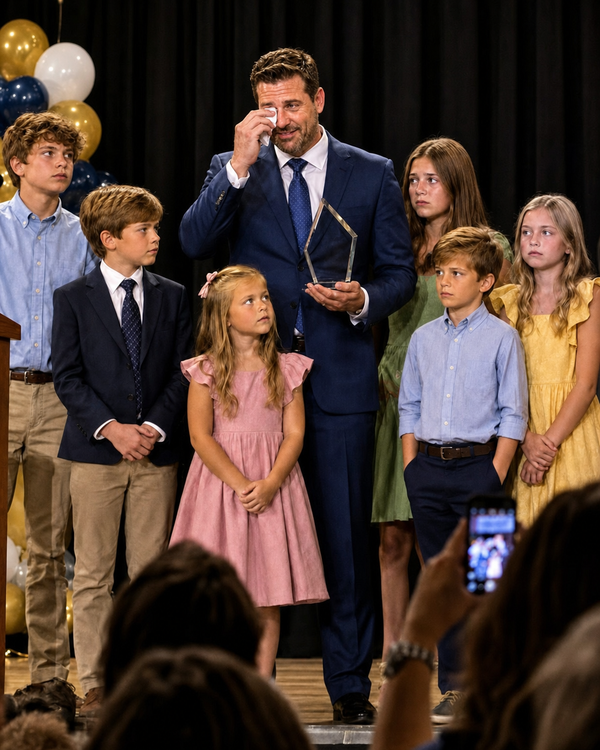
By the time the ceremony arrived Friday evening, I still didn’t fully understand what he had done to win it. All I knew was that he’d told me attendance mattered, that the principal had personally invited us, and that he sounded pleased with himself in a way that unsettled me more than it should have.
The Family Man Façade
After our third child was born, Richard convinced me to leave the career I’d spent years building. “The kids need you,” he said. “I’ll provide for everyone.” I believed him, because marriage was supposed to mean trusting the person beside you.
So I became the one who ran everything—six lunches, dentist appointments, homework, fevers, missing shoes, every teacher’s name and every child’s quiet fear. Richard handled the gifts. Expensive sneakers, tablets, bikes, and always the same instruction afterward: tell people Dad got you that.
He was rarely home unless someone important might notice. He appeared at galas and cookouts with perfect timing and missed the stomach bugs, the reading practice, the ordinary Tuesdays. I also knew about the other women, long before I said anything.
When I finally confronted him, he didn’t deny it. “I’m not attracted to you anymore, Megan,” he said. “But divorce would be terrible for my reputation. People trust a family man.” That sentence explained the whole marriage in language he actually understood.
The Award and the Microphone
Once the school announced the Parent of the Year award, Richard’s behavior shifted. He started asking if teachers ever talked to the kids about their parents. He began showing up for dinner more, not helping exactly, just present, reminding Sam of a lake trip while glancing at his phone.
The night before the ceremony, he told me the principal had invited us specifically. “You’ll see,” he said. On stage, Mrs. Carter called him “a remarkable father who somehow balances a demanding career with raising six wonderful children,” and the room erupted.
Richard wiped his eyes for the cameras and gave a speech about sleepless nights and worthwhile sacrifice. I sat ten rows back, alone, wondering if anyone remembered those six children had a mother too.
Then he called the kids up to join him, hugging each one as phones lifted around the auditorium. Seven-year-old Lily tugged his sleeve and asked for the microphone. “There’s one little detail,” she said. Richard laughed and handed it over, certain she’d say something sweet.
She searched the crowd until she found me, and her smile faded. “Daddy, do I still get the bike now?” she asked. “The pink one. You said if we told Mrs. Carter you always help us, you’d get it.”
The auditorium went silent. Before Richard could recover, ten-year-old Sam added, “You told me I’d get the game too.” The older children exchanged looks, and I understood exactly what had happened.
What the Children Revealed
I gathered all six kids into an empty classroom and told Richard to stay behind. Claire, our oldest, explained that weeks earlier he’d told them he might be nominated and that they “shouldn’t forget all the things he did for us.”
He hadn’t scripted exact words, Sam said, but he’d kept reminding them of gifts and trips, and offered specific trades: the bike for Lily, a video game for Sam, concert tickets for Grace if she helped people “remember Dad does stuff.”
Claire admitted she’d refused. “He called me ungrateful,” she said. “He said after everything he pays for, I could do one thing for him.” She hadn’t told me because she thought I’d be embarrassed for him.
I told all of them the same thing: none of them had done anything wrong. He was the adult. They never needed to protect me—or him—from his own choices.
Life After the Ceremony
On Monday, I asked Mrs. Carter for a meeting, and Claire came with me. The principal admitted teachers had asked the children informal questions that ended up in Richard’s nomination file, alongside a statement he’d submitted describing his involvement at home and at school events.
I wasn’t asking for the award myself. I only wanted the school to stop knowingly leaving a false one in place. Mrs. Carter agreed to compare his claims against attendance records, volunteer lists, and statements from the teachers who actually worked with our children.
Two days later she called. Several of Richard’s claims couldn’t be verified, and combined with what the children had described, the decision was unanimous. The school withdrew the award, removed his name and speech from its website, and began requiring documented participation for future nominations.
Richard came into the kitchen furious that Wednesday. “You ruined something that mattered to me,” he said. When I asked why it mattered so much, he didn’t have a polished answer ready. “My father barely noticed me,” he finally said. “Somewhere along the way, people thinking I’m a good father became enough for me.”
“Yeah,” I told him. “That became more important than actually being one.” I didn’t comfort him. I told him becoming a better father wouldn’t erase what he’d done to me, and it wouldn’t guarantee we stayed married. If he wanted to start, he could begin showing up when nobody was watching.
Learning to Show Up
I stopped carrying every part of his relationship with the children for him. He took over Tuesday and Thursday school runs, Sam’s music lesson, two dinners a week, appointments he’d assumed for years were mine to handle.
He wasn’t good at it yet. He drove Sam to piano and learned our son had switched to trumpet months earlier. He came home with three jars of pasta sauce and no pasta, and forgot Lily hated tomatoes.
One evening I heard him snap at Lily during reading practice, then catch himself. “Sorry,” he said, softer. “Let’s try it again.” She did. He stayed. Nobody was taking pictures.
A month later, I finished the first certification I needed to return to my field. I printed the confirmation email after the kids went to bed and looked at my name across the top longer than I expected. I opened a bank account in my own name. My future would not depend on Richard.
Months later, the award had become something we almost never mentioned. I never asked where the plaque went. What mattered more was an ordinary Tuesday evening, Richard coming through the door with groceries while Lily trailed behind him, testing him.
“What’s my favorite color?” she asked, narrowing her eyes. “Pink,” he said. “My best friend’s name?” “Evie.” She asked what book they were reading, and he answered that too. There was no auditorium, no microphone, no reporter. Just six children who knew whether he was telling the truth.