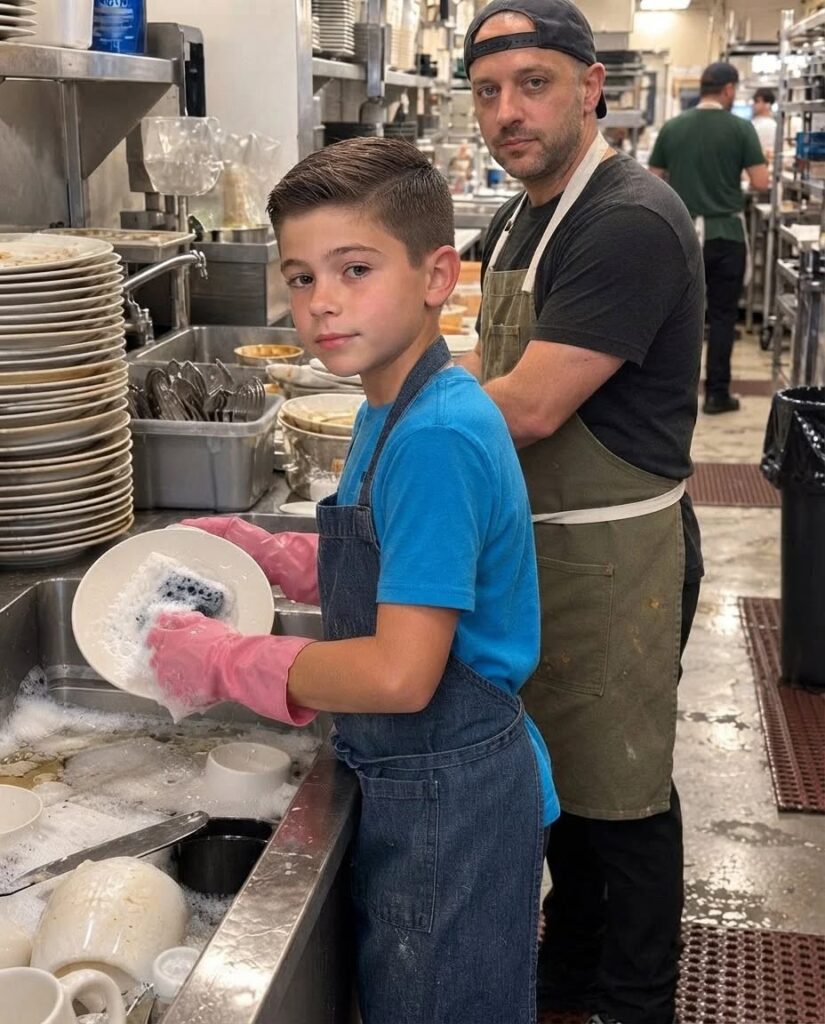
Instead, one evening he walked into the kitchen and announced that he’d gotten a Saturday job washing dishes at Sal’s diner.
“I want to buy the bike myself,” he said.
That was exactly the kind of thing Evan would do. His father, Marcus, had died suddenly three years earlier, and grief had changed our son in a way I hadn’t expected. Evan didn’t become angry or rebellious. He became responsible—far more responsible than a ten-year-old should have been. He stopped asking for things, started doing chores without being reminded and learned to recognize when money was tight.
It took me a long time to understand what had happened. Evan had seen me struggling after Marcus died and quietly decided he wasn’t going to become another problem I had to solve.
So I let him take the job, provided school came first.
Every Saturday he came home smelling like fryer oil and dish soap. His hands became dry from the hot water, but he never complained. Whenever I asked how the bicycle fund was going, his answer was the same.
“Getting there.”
Months passed.
Still no bicycle.
Eventually I started doing the math. Even after allowing for missed shifts and whatever Evan spent on snacks or other things, he should have been much closer to his goal than he claimed.
Then one night I passed his bedroom and saw him sitting on the floor counting cash.
When he noticed me, he immediately gathered the bills and shoved them into his backpack.
“What was that?”
“Bike money.”
“That looked like quite a bit of bike money.”
He shrugged. “Sal pays me in small bills.”
I knew he wasn’t telling me everything.
I didn’t immediately search his room or demand his backpack. Thirteen-year-olds are allowed some privacy, and I didn’t want grief to turn me into a mother who treated every secret as evidence of danger.
Then one Saturday he came home later than usual with mud on his jeans and a scrape on his face.
He told me he’d slipped near the creek.
Something about his explanation bothered me, but he insisted he was fine. When I asked where that week’s pay was, he became evasive.
“It’s safe.”
That was when my imagination started going places I didn’t want it to go.
Maybe someone older was taking his money. Maybe another kid was bullying him. Maybe he’d gotten involved in something he was afraid to tell me about.
A few days later, Sal called.
“I think you and I need to talk about Evan,” he said.
My stomach dropped.
“Is he in trouble?”
“No. Nothing like that.”
The relief lasted about two seconds.
“Then what’s happening?”
Sal hesitated.
“I think you should come by when you get a chance. There’s something he’s been doing with his pay that I don’t think you know about.”
I went directly after work.
Evan was still in the kitchen when I arrived. Sal brought me to a booth and explained that a woman named Carla sometimes came into the diner with her two young children. She’d recently lost her job and was going through a difficult separation. Sal occasionally gave the kids food when he knew she couldn’t afford much.
Evan had noticed.
Of course he had.
One Saturday, he’d seen Carla counting change before ordering something for the children. After his shift, he took part of his pay and quietly left it on her table.
She tried to give it back.
He refused.
A few weeks later, he did it again.
Sometimes it was twenty dollars. Sometimes thirty. Once, when he’d overheard that one of the children needed medication, he gave considerably more.
Sal had initially told him to be careful and had encouraged Carla not to rely on money from a child. But Evan kept finding small ways to help.
“That bike fund of his isn’t growing very quickly,” Sal said, “because every time he gets ahead, he sees somebody who needs something.”
I sat there trying to process what I’d heard.
When Evan finally came out of the kitchen and saw me, he immediately knew.
“Sal told you.”
“He did.”
His shoulders dropped.
“I was going to tell you.”
“When?”
He couldn’t answer.
I asked about the night he’d come home muddy.
That part had nothing to do with anything criminal or mysterious. A couple of older boys had been bothering him on his walk home and apparently knew he was paid in cash. Evan had tried to avoid them by cutting toward the creek, slipped on the bank and torn his jacket.
That frightened me far more than the money.
“You should have told me.”
“I knew you’d make me stop working.”
“I might have changed how you got home. That’s different.”
He stared at the floor.
Then I asked the question that mattered more.
“Why Carla?”
His answer came immediately.
“She reminded me of us.”
I stopped.
Evan looked at me.
“After Dad died.”
There are moments when you realize your child remembers things you desperately hoped they hadn’t noticed.
Evan remembered the groceries neighbors brought.
He remembered me sitting at the kitchen table with bills spread everywhere.
He remembered a woman from church helping us with heating costs during that first winter.
Most of all, he remembered how frightened I’d been while trying not to let him see it.
“When Carla came in with the kids,” he said, “she looked like you used to.”
I couldn’t speak.
“She’d count money before she ordered. Sometimes she’d say she wasn’t hungry and just get food for them.”
He shrugged.
“I knew what that meant.”
Then he said something that broke through every bit of composure I had left.
“I thought maybe it was our turn to be the people who help.”
I started crying.
Evan immediately looked worried, as though even my tears were another problem he needed to fix.
“Mom, I’m sorry. I really did want the bike.”
I laughed through the tears.
“I know.”
“I wasn’t lying about that.”
“I know.”
He looked down at his hands.
“But Dad would’ve helped them.”
That was when I understood what he had really been doing.
Marcus had been the kind of person who would stop to help someone change a tire or give away something he needed because another person needed it more. I’d told Evan those stories countless times after his father died.
My son had been listening.
“If I can’t have Dad here,” Evan said quietly, “I still want to be like him.”
I pulled him into my arms.
But I also told him something I wish I’d understood much earlier.
“You don’t have to become Dad.”
He looked confused.
“You’re thirteen, Evan. You’re allowed to want a bicycle. You’re allowed to spend money on yourself. And you’re definitely allowed to tell me when somebody is bothering you.”
“I know.”
“No. I don’t think you do.”
I held his face between my hands.
“Helping people doesn’t mean carrying everything alone.”
That became the real change after that day.
We didn’t tell Evan to stop caring about Carla’s family. But the adults started handling an adult problem. Sal helped Carla connect with someone who knew about local assistance programs, and through people we knew, she eventually found steadier work. I helped where I reasonably could too.
Evan could still give away some of his own money if he wanted.
He just couldn’t secretly make himself responsible for keeping another family afloat.
And Sal made sure he no longer walked home alone with cash in his pocket.
A few months later, on Evan’s birthday, there was a bicycle waiting for him.
Matte black.
Orange lettering.
The exact one.
He stared at it and then at me.
“Mom.”
“I know.”
“You didn’t have to buy this.”
“I know.”
He ran his hand across the handlebars.
“I was supposed to earn it.”
“You did earn money for it.”
“But I gave some of it away.”
“Yes.”
“So—”
“Evan.”
He stopped.
“Someone once helped us when they didn’t have to. You remembered that. Then you helped somebody else when you didn’t have to.”
I smiled.
“I’m allowed to do the same thing.”
He cried then, although he’d probably deny it today.
What happened with Evan taught me something I hadn’t understood about childhood grief.
After Marcus died, I’d worried constantly about what losing his father might do to my son. I watched for anger, withdrawal and all the obvious signs that he wasn’t coping.
I didn’t realize grief could push a child in the opposite direction.
Evan became too capable.
Too independent.
Too determined not to need anything.
His generosity was beautiful, but underneath it was still a thirteen-year-old boy who believed being good meant becoming as little of a burden as possible.
That’s the part we had to change.
Today, he still likes helping people. I hope he always does.
But I remind him that compassion isn’t measured by how much of yourself you’re willing to give away.
Marcus would have been proud of the money Evan gave Carla.
I’m certain of that.
But I think he would have been even more proud to see his son finally understand that having a good heart doesn’t mean you aren’t allowed to want something for yourself.
And yes, Evan rides that black-and-orange bicycle everywhere.
He earned that too.