By the time he was ten, he’d had years to observe us.
Ryan wasn’t a cruel husband. In some ways, that made our problems harder to explain. Our marriage hadn’t deteriorated through one enormous betrayal. It happened through hundreds of small adjustments. His career became the schedule around which everything else moved. I remembered appointments, packed bags, organized holidays and handled whatever he forgot. If something needed doing, eventually I would do it, and Ryan became so accustomed to that arrangement that I don’t think he even saw it anymore.
His company’s beach picnic was important to him because his boss, Lauren, would be there. Ryan was hoping for a promotion, and on the drive over he talked about wanting his coworkers to see him as relaxed and family-oriented. That morning I’d packed the sandwiches, drinks, towels, sunscreen and Mason’s football. When I asked Ryan to help me carry the heavy cooler, he glanced at his phone and said he’d start the car instead. Mason quietly grabbed the other handle.
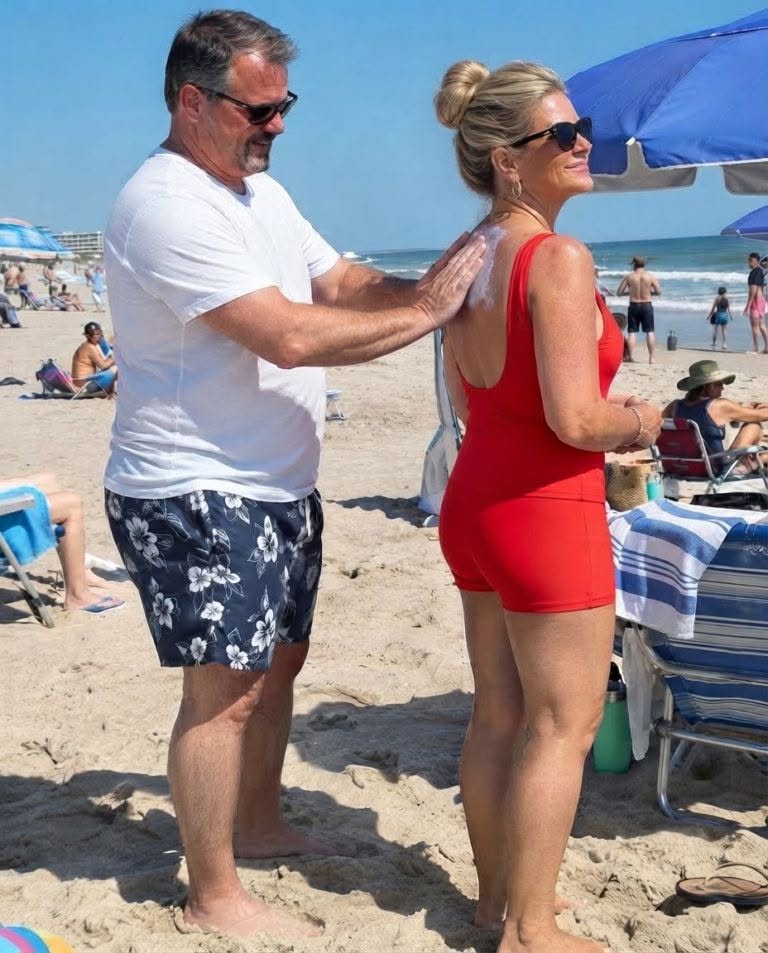
At the beach, Ryan walked ahead while Mason and I carried everything across the sand. We found his coworkers, unpacked and set up our spot. Once I changed into my swimsuit, I handed Ryan the sunscreen.
“Can you get the middle of my back? I can’t reach.”
He sighed. “Claire, I feel terrible. This heat is killing me.”
“It’ll take ten seconds.”
“My head hurts. I need to sit down.”
I didn’t argue. I covered what I could reach and put the bottle away.
About ten minutes later, Lauren arrived.
Ryan was out of his chair before she’d even finished saying hello. He offered to carry her bag. When she mentioned she’d forgotten sunscreen on her shoulders, he picked up our bottle and helped her. When the sun shifted, he moved the umbrella. Then he brought her a cold drink from the cooler I’d dragged across the beach.
I watched him for a while before asking quietly, “I thought you were sick.”
His expression hardened. “Don’t start.”
“You couldn’t help me for ten seconds.”
“She’s my boss, Claire.”
That answer somehow made it worse.
When I said so, he lowered his voice. “You’re overreacting. Please don’t embarrass me here.”
I walked away because I didn’t trust myself to continue the conversation without making exactly the scene he was worried about.
What I hadn’t realized was that Mason had heard us.
Later, Ryan stretched out in his chair and called, “Claire, can you bring me a cold water? I’m roasting.”
I started getting up automatically.
Mason touched my arm. “I’ll get it.”
He took a bottle from the cooler and walked toward his father. I thought he was going to hand it to him.
Instead, he opened it and poured the cold water straight over Ryan’s head.
Ryan shot upright. “Mason! What are you doing?”
Several people turned toward us. I was mortified.
Mason stood there holding the empty bottle.
“You said you were too sick to help Mom,” he said. “Then Lauren came and you weren’t sick anymore.”
“Mason—”
“You helped her with everything. Mom carried all our stuff, and then you told her she was embarrassing you.”
Ryan looked around and realized that some of his coworkers had heard enough to understand what was happening.
Mason finished with, “You should say sorry.”
I immediately stepped between them.
“Okay. That’s enough.”
I took the bottle from Mason and told him that pouring water on somebody wasn’t an acceptable way to handle being angry, even when he thought they were behaving badly. Then I looked at Ryan.
“But he’s not wrong about what he saw.”
For once, Ryan didn’t answer immediately.
Lauren looked profoundly uncomfortable. She said she hadn’t realized there had been an argument before she’d arrived and then wisely excused herself. Nobody applauded Mason. Nobody delivered a speech about what a remarkable child he was. The picnic gradually resumed because that’s what real gatherings do after an embarrassing family moment: people pretend not to be watching.
Ryan eventually came over and sat beside me.
“I’m sorry,” he said.
I waited.
“I shouldn’t have refused to help you and then jumped up the second Lauren arrived.”
“No.”
“And I definitely shouldn’t have told you that you were embarrassing me for pointing it out.”
I nodded.
He looked toward Mason, who was kicking his football near the water.
“I can’t believe he did that.”
“Neither can I.”
A few seconds passed.
Then I said, “But I’m more bothered that he felt he had to.”
Ryan looked at me.
“He’s ten. He shouldn’t be monitoring whether his father respects his mother. He shouldn’t feel responsible for defending me from you.”
That landed harder than the water had.
Ryan stared toward the ocean for a long time.
Finally he asked, “Has he been seeing this for a while?”
“Yes.”
His face changed.
Not dramatically. There was no instant transformation, no perfect realization that repaired eleven years of marriage in a single conversation. But for the first time in a long time, Ryan seemed less interested in explaining his intentions than in considering what his behavior actually looked like from outside himself.
On the drive home, he carried the cooler without being asked. I noticed, but I didn’t treat it as evidence that everything had changed. One helpful gesture couldn’t erase a pattern built over years.
Halfway home, with Mason asleep in the back seat, Ryan spoke.
“I saw you struggling with that cooler this morning.”
I turned toward him.
“I could’ve helped. I just assumed you’d handle it.”
“Yes.”
“And then when Lauren arrived, I wanted to look helpful.”
There it was.
Not an excuse. Just the truth.
He kept his eyes on the road. “I think I’ve been doing that for a long time. Putting effort into the things that other people can see and assuming you’ll take care of everything they can’t.”
That was closer to the problem than anything he’d said before.
“When did that happen?” he asked.
“I don’t know exactly. But at some point, everything outside our marriage became urgent and everything inside it became something you thought could wait.”
He nodded slowly.
We didn’t solve our marriage during that drive.
The next day we had a much longer conversation. There were more after that. Some went well. Others ended with one of us frustrated. Ryan had to learn that recognizing a pattern wasn’t the same as changing it, and I had to stop automatically picking up every responsibility he dropped.
Mason also received an apology—from both of us.
Ryan apologized for what he’d witnessed at the beach and for putting me in a position where our son felt he needed to intervene. I apologized for allowing Mason to become involved in an adult conflict, even unintentionally.
And yes, we addressed the bottle of water.
“You can’t dump water on people when they’re behaving badly,” I told him.
Mason considered this.
“Even if they really deserve it?”
“Even then.”
He looked disappointed by the rule but accepted it.
What stayed with me wasn’t the dramatic part everyone at the picnic saw. It wasn’t Ryan sitting there drenched while his coworkers tried not to stare.
It was something much quieter.
My ten-year-old had noticed a pattern I’d spent years explaining away.
He saw his father refuse to carry something because he knew I eventually would.
He saw him refuse a tiny favor for me and eagerly perform the same favor for someone he wanted to impress.
And he saw Ryan tell me I was the problem when I pointed out the contradiction.
Children notice those things.
They may not have the vocabulary to describe emotional neglect, unequal labor or a marriage in which one person has slowly become support staff for the other.
But they understand when someone’s words don’t match their actions.
Years earlier, Mason had looked at my hands around a dinner plate and told me they were too tight.
At ten, he noticed something else I had been holding onto for too long.
The lesson wasn’t that a child had saved our marriage.
He hadn’t.
What happened next was still Ryan’s responsibility and mine.
Mason had simply held up a mirror.
What we did after seeing ourselves in it was up to us.