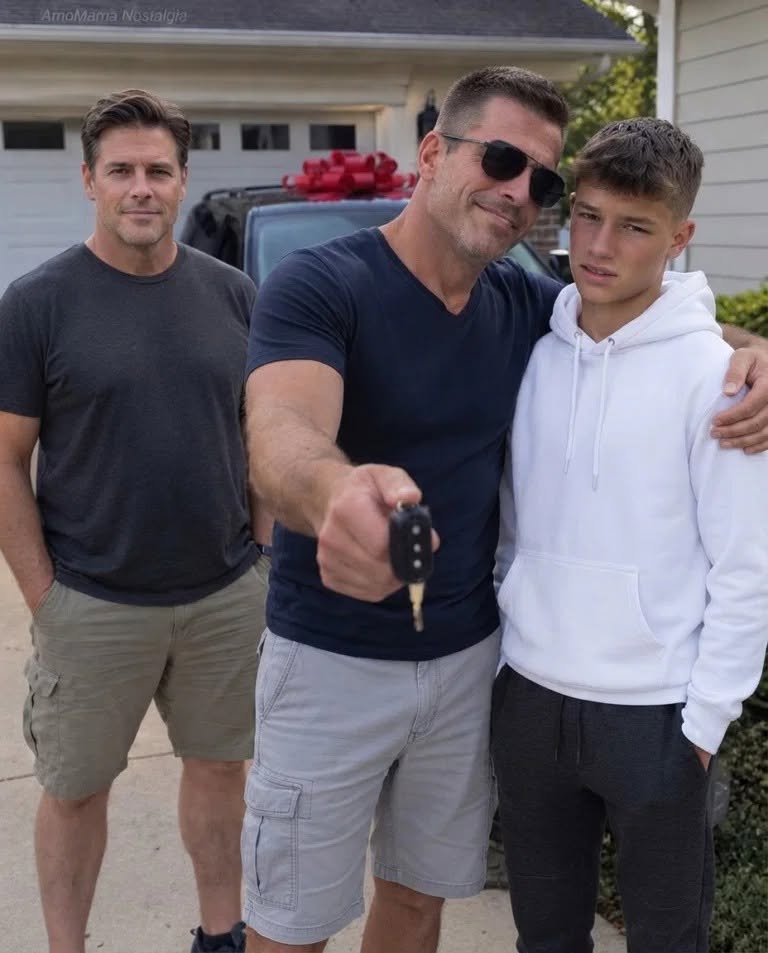
“Come on, son. He could never compete with this.”
He held out the keys.
For a few seconds, I stared at the car I’d secretly wanted for years.
Then I walked past him, went inside the house, and brought something else into the driveway.
A crooked wooden box my stepdad had made in his garage.
My biological father laughed when he saw it.
He stopped laughing when I opened it.
I hadn’t seen my father since I was three.
For most of my childhood, it was just Mom and me.
We weren’t desperately poor, but money was always there, hovering over everything.
I knew when the electric bill was late because Mom stopped buying coffee on her way to work.
I knew new sneakers meant no pizza that month.
I knew that if the refrigerator suddenly contained three different meals made from ground beef, ground beef had been on sale.
By thirteen, I’d learned something no kid should have to learn that early.
How to stop asking before your mother had to say no.
Then, when I was fifteen, Mom met Ray.
Ray wasn’t rich either.
He had two kids from his previous marriage.
Danny was eleven.
Cara was nine.
They stayed with us every other weekend, which meant our tiny house suddenly contained five people, three backpacks near the front door, wet towels everywhere, and approximately nine thousand dirty drinking glasses.
Ray paid child support.
Mom still worked overtime.
Nothing magically became easier financially.
But something else changed.
For the first time, Mom wasn’t carrying everything alone.
And neither was I.
Ray came to my football games.
Every single one.
That doesn’t sound remarkable until you understand that I wasn’t particularly good.
Most weeks, I spent more time warming the bench than playing.
One night, after a game in freezing weather, I found Ray waiting beside the fence.
“You know I played for about four minutes, right?”
“I know.”
“You sat out here for two hours.”
“Yep.”
“Why?”
He looked confused by the question.
“Because you were here.”
That was Ray.
He didn’t make speeches.
He didn’t constantly tell me how much he cared.
He just kept showing up.
When I nearly failed chemistry, Ray sat beside me at the kitchen table until almost midnight.
The problem was that he understood chemistry even less than I did.
After he gave me the third completely incorrect explanation of electron configuration, I dropped my pencil.
“You’re literally making this worse.”
“Probably.”
“Then why are you still here?”
He shrugged.
“Because parents don’t get to quit before their kids do.”
Parents.
He kept staring at the textbook.
I stared at him.
Ray didn’t even seem to realize what he’d said.
I did.
A few months later, he married Mom.
Not long after that, she accidentally told me about something that was supposed to be a surprise.
She and Ray had opened a college savings account for me.
“We can’t put much into it,” Mom warned.
“How much?”
“Whatever’s left.”
That answer told me everything.
Some months, “whatever’s left” wasn’t much.
Ray still had Danny and Cara to support.
There were bills.
Car repairs.
Groceries.
School expenses.
Life.
So I tried not to think about the account.
At school, everybody my age was obsessed with something else.
Cars.
One friend got his aunt’s old Honda.
Another got a pickup from his grandfather.
A girl in my English class received a used convertible for her birthday and spent an entire lunch period complaining because she’d wanted white and it was silver.
I took the bus.
Honestly, I didn’t complain.
When you grow up knowing exactly what things cost, you become good at convincing yourself you don’t need them.
Then I turned seventeen.
At seven that morning, somebody knocked on my bedroom door.
“Jake.”
I groaned.
“Jake.”
I opened one eye.
Ray was standing there.
“You’re awake.”
“You woke me up.”
“Same result.”
He was carrying a rectangular wooden box.
It wasn’t perfect.
One corner was slightly higher than the others.
There was a small sanding mark near the latch where he’d clearly made a mistake.
But the wood was dark and polished.
My initials had been burned into the lid.
J.M.
I sat up.
“You made this?”
“In the garage.”
“That’s what you’ve been doing out there?”
“Mostly.”
“For how long?”
“Six weeks.”
I opened it.
Inside was a stack of bank statements tied together with string.
I immediately recognized the account.
My college fund.
“Mom already told me.”
Ray sighed.
“Your mother has never successfully kept a secret.”
I smiled.
Then I noticed handwriting on the back of the first statement.
Ray’s handwriting.
Boots can wait — $40.
I frowned.
Then turned over another statement.
Brought lunch all week — $25.
Another.
Truck service next month — $60.
I looked at him.
“What is this?”
“Nothing.”
“You wrote on all of these.”
“Yeah.”
“Why?”
Ray suddenly looked uncomfortable.
“I was just keeping track.”
“Of what?”
He rubbed the back of his neck.
“I don’t know.”
“Ray.”
He sighed.
“I wanted you to see someday that even when we weren’t putting much in, we were still getting somewhere.”
I looked through the statements.
$80.
$20.
$15.
One month, only $5.
Then I reached one that made me stop.
Danny needed new glasses. I’ll make it up next month — $0.
I stared at it.
Danny was Ray’s biological son.
The following month read:
Made up last month + this month — $80.
I looked up.
“You didn’t have to do this.”
“Yeah.”
“Then why?”
“College is expensive.”
That wasn’t really an answer.
I kept going.
Some months Ray had skipped buying things for himself.
Work boots.
Lunches.
Repairs he’d wanted done immediately.
Not enormous sacrifices individually.
Twenty dollars here.
Forty there.
But month after month, they added up.
At the bottom of the box was a folded note.
I opened it.
Kid,
It isn’t enough yet.
We’ll keep going.
Ray.
That was all.
No dramatic speech.
No explanation.
Just:
We’ll keep going.
Mom yelled from downstairs.
“Birthday breakfast!”
Ray immediately headed toward the door.
“Perfect timing.”
“You’re just leaving?”
“There’s bacon.”
And he disappeared.
I stayed sitting on my bed.
Fourteen months of statements were spread across my blanket.
Not one month had passed without Ray writing something.
Even when the deposit was zero.
I closed the wooden box.
At that moment, it was the best birthday present I’d ever received.
Three hours later, somebody knocked on our front door.
Mom answered.
I was in the kitchen.
Then I heard her voice change.
“What are you doing here?”
A man answered.
“I came to see my son.”
I froze.
Ray came in from the garage.
Mom looked toward me.
Then slowly stepped aside.
The man on our porch was taller than I’d imagined.
Nice jacket.
Expensive watch.
Gray starting around his temples.
But I recognized him.
Mom had three old photographs of him in a box in her closet.
My father smiled.
“Look at you.”
I couldn’t answer.
“Happy birthday, son.”
Son.
Fourteen years without a birthday card.
Fourteen years without Christmas.
Fourteen years without a phone call.
And suddenly I was “son.”
“Why are you here?”
His smile weakened.
“I know I’ve got some explaining to do.”
“About fourteen years’ worth.”
Mom softly said my name.
But my father nodded.
“You’re right.”
Then his smile returned.
“But today’s not about excuses.”
He reached toward me.
“Today’s about you.”
His hand landed on my shoulder.
I nearly stepped backward.
“Come outside.”
“Why?”
“You’ll see.”
He walked toward the driveway.
Then I saw it.
The bow.
Huge.
Red.
And beneath it was a brand-new black car.
For several seconds, I genuinely didn’t understand what I was seeing.
Then my father held up a set of keys.
“Happy birthday.”
I stared at him.
“That’s mine?”
“Paid for.”
Mom stepped onto the porch.
Ray stood behind her.
His hands disappeared into his pockets.
My father noticed him.
And that’s when I understood something.
This wasn’t only a birthday present.
It was a performance.
My father held the keys higher.
“Go ahead.”
I didn’t move.
“Come on, son.”
Then he looked directly at Ray.
“Your stepdad could never compete with this.”
Ray looked down.
I looked through the open front door.
The wooden box was sitting on the kitchen table.
I stared at it.
Then the car.
Then the man who had been standing in my driveway for ten minutes after disappearing for fourteen years.
I walked straight past the keys.
“Ray.”
He looked up.
“Come here.”
He shook his head.
“This is between you and him.”
My biological father laughed.
“Smart man.”
I ignored him.
“Ray, please.”
That got him off the porch.
My father jingled the keys.
“What’s wrong? Don’t like black?”
I turned toward him.
“I want to ask you something.”
“Anything.”
“What position do I play?”
He smiled.
“Football.”
“What position?”
His smile remained.
But his eyes changed.
He glanced toward Mom.
She said nothing.
“I mean, come on. I haven’t exactly had time to catch up.”
“Okay.”
I nodded.
“What college am I applying to?”
His jaw tightened.
“Your mother kept me out of your life.”
Mom inhaled sharply.
I raised my hand.
“One more.”
Then I pointed toward Ray.
“What subject did I almost fail last year?”
My father stared at me.
“How would I know that?”
Exactly.
“You wouldn’t.”
He held the keys toward me again.
“Look, Jake, I know I’ve missed things.”
“Fourteen years.”
“I know.”
“Do you?”
“That’s why I’m here.”
He gestured toward the car.
“I’m trying to make things right.”
“With that?”
“It’s a pretty good start.”
Then he looked at Ray.
“Better than whatever he bought you, I’m guessing.”
I looked toward the house.
“Wait here.”
I went inside.
The wooden box was still on the kitchen table.
I picked it up.
When I returned, Ray’s face immediately changed.
“Jake.”
I ignored him.
My father looked at the box.
“What’s that?”
“My birthday present.”
He laughed.
Actually laughed.
“That’s what he gave you?”
Ray’s face turned red.
I opened the lid.
“No.”
I removed the bank statements.
“This is what he gave me.”
My father’s smile faded slightly.
I handed him the first statement.
He looked at it.
“Forty dollars?”
“Turn it over.”
He did.
Boots can wait.
I handed him another.
Brought lunch all week.
Then another.
Truck service next month.
His expression changed.
“What is this?”
“My college account.”
“Okay.”
“Mom and Ray opened it.”
I found the statement I wanted.
Danny needed new glasses. I’ll make it up next month.
Then I handed him the next one.
Made up last month + this month — $80.
I pointed toward them.
“Danny and Cara are Ray’s kids.”
My father said nothing.
“He pays child support.”
Silence.
“He helps Mom with the bills.”
Nothing.
“And every month, he still puts something aside for me.”
Ray finally interrupted.
“Jake.”
I turned.
“That’s enough.”
“No.”
I held up another statement.
“You needed work boots.”
“My boots were fine.”
“One of them has duct tape on it.”
“They’re comfortable.”
Mom laughed through her tears.
I turned toward my biological father.
Behind him sat a brand-new car.
It probably cost more than everything Ray had ever put into that college account.
I understood that.
My father understood it too.
He’d expected the number to matter.
But suddenly it didn’t.
“You bought that car with money you had.”
I lifted the statements.
“Ray is helping build my future with money he needed.”
My father’s face hardened.
“You think this man loves you more than your own father?”
I stared at him.
“You don’t know what position I play.”
His expression changed.
“Because I wasn’t allowed to.”
“You know where we live.”
“Jake—”
“You knew my birthday.”
He stopped.
“You found me today.”
Nothing.
“So don’t tell me there was no way to find me yesterday.”
His eyes moved toward Mom.
“You don’t understand what happened between your mother and me.”
“Then explain it.”
“This isn’t the time.”
“You had fourteen years to find one.”
Across the street, Mrs. Patterson had stopped pretending she wasn’t listening while watering her flowers.
I didn’t care.
My father pushed the keys toward me again.
“Take the car.”
I looked at them.
And I’ll admit something.
I wanted it.
Badly.
I’d wanted a car for years.
I imagined not standing at the bus stop in freezing rain.
Driving myself to football practice.
Picking up friends.
Freedom.
And this wasn’t some twenty-year-old hand-me-down.
It was beautiful.
Black paint.
Perfect interior.
Brand new.
For one second, seventeen-year-old me wanted those keys more than almost anything.
Then I thought about the box.
Boots can wait.
Brought lunch all week.
Truck service next month.
Five dollars.
Fifteen.
Forty.
Month after month.
Nobody watching.
No giant bow.
No audience.
Just Ray.
My father held the keys closer.
“You deserve something nice.”
I reached out.
And took them.
Relief appeared on his face.
Then I took his hand.
Placed the keys back into his palm.
And closed his fingers around them.
“I’ve wanted a car for two years.”
I looked at Ray.
Then back at my father.
“But I wanted a dad for fourteen.”
Nobody moved.
My father’s face went blank.
“You’re choosing him?”
“No.”
I shook my head.
“He chose me.”
My father looked at Ray.
But Ray didn’t look victorious.
He looked miserable.
Because that’s who Ray was.
He didn’t want to win.
He hadn’t even known there was a competition until another man arrived and announced one.
“You’re seventeen,” my father said. “You don’t understand everything.”
Then he turned toward Mom.
“You’ve done a hell of a job turning him against me.”
Mom stepped off the porch.
“No.”
Her voice was quiet.
“I spent years doing the opposite.”
My father stared at her.
“So don’t blame me now.”
“What are you talking about?”
Mom wiped her cheek.
“When Jake was little, I made excuses for you.”
I looked at her.
She continued.
“Maybe the birthday card got lost.”
My chest tightened.
“Maybe you didn’t have our new number.”
She looked at me.
“Maybe work kept you away.”
I’d heard all of those.
I hadn’t realized she’d invented them.
“Eventually,” she continued, “he got old enough to understand I was lying.”
My father said nothing.
Mom looked directly at him.
“I never kept you away.”
His face changed.
“You don’t get to blame me because another man did what you repeatedly chose not to do.”
My father looked at me.
“The car will still be here if you change your mind.”
“No.”
“What?”
“It won’t.”
I pointed toward it.
“You’re taking it.”
He stared at me for several seconds.
Then he walked toward the car.
The first thing he did was rip the enormous red bow off the hood.
For some reason, that’s the detail I remember most.
He threw it into the back seat.
Then he got behind the wheel.
And drove away.
The neighbors suddenly became extremely interested in their lawns.
Mom went inside.
I turned around.
Ray was already walking away.
“Where are you going?”
“Kitchen.”
“Why?”
“Dishes.”
Of course.
Ten minutes after my biological father tried buying his way back into my life, Ray was standing at the sink washing syrup off our birthday-breakfast plates.
I placed the wooden box on the counter.
“You know we own a dishwasher.”
“Don’t trust it.”
“You repaired it.”
“Exactly.”
He pointed toward it.
“I know who worked on it.”
I laughed.
He kept washing.
“Ray.”
“What?”
“Look at me.”
“Busy.”
“You’re washing a clean plate.”
He looked down.
Then placed it in the drying rack.
“Next plate.”
That’s when I understood.
He was trying not to cry.
Naturally, I decided to make that impossible.
“Thank you.”
“For what?”
“The box.”
“Sure.”
“And the account.”
“Your mom puts money into it too.”
“I know.”
“And we’re nowhere close to paying for college, so don’t start applying to some castle.”
“Ray.”
He stopped scrubbing.
“You didn’t have to do any of that.”
“Yeah.”
“Then why?”
“College isn’t cheap.”
“No.”
I shook my head.
“Why?”
For once, Ray didn’t have a joke.
He stared into the sink.
Then shrugged.
“Because you’re my kid.”
Three words.
That was all.
Not “stepson.”
Not “basically my son.”
My kid.
He said it like it was obvious.
Like he’d settled the question a long time ago and couldn’t understand why I was still asking.
I hugged him.
Ray completely froze.
We weren’t a hugging family.
Then his wet hands awkwardly landed against my back.
“You’re getting dishwater on me.”
“You started this.”
I laughed.
So did he.
A month later, Ray finally bought new work boots.
I went with him.
Naturally, he reached for the cheapest pair.
“No.”
He looked at me.
“What?”
“Get those.”
I pointed toward the better pair.
“Those are expensive.”
“Your feet deserve something nice.”
He gave me a look.
“Don’t start.”
I smiled.
The college account kept growing.
Slowly.
Some months, there was $100.
Other months, $20.
But after I told Ray his notes about everything he’d sacrificed made me feel guilty, he stopped writing about himself.
Instead, he started writing about me.
Passed chemistry somehow — $50.
Scored a touchdown — $30.
Then one month:
Proud of you, kid — $100.
I kept that statement.
I kept the wooden box too.
My biological father eventually contacted me again.
Not immediately.
And the next time, there was no car.
There was no red bow.
There was no speech about competing with Ray.
Our relationship didn’t magically repair itself.
Fourteen years don’t disappear because someone finally comes back.
But he never insulted Ray in front of me again.
Maybe he’d finally understood why.
The most expensive birthday present anyone had ever offered me disappeared down our street before dinner.
The wooden box stayed.
And years later, I understood what I’d really been given that morning.
Ray hadn’t given me a box.
Or even a college account.
He’d given me proof.
Proof that love isn’t always measured by how much someone spends.
Sometimes it’s measured by what they were willing to go without.
A pair of work boots postponed another month.
Lunch packed instead of bought.
A truck repair delayed.
A freezing football game where I barely touched the field.
Chemistry homework from a man who understood chemistry even less than I did.
None of those things would’ve looked impressive beneath a giant red bow.
Together, they were worth more to me than any car.
My biological father came back calling me “son” loudly enough for the whole neighborhood to hear.
Ray never needed to.
He’d spent nearly two years proving it when nobody was watching.
Then, standing over a sink full of dishes, he finally put it into three simple words.
“You’re my kid.”
And by then, I already knew I was.