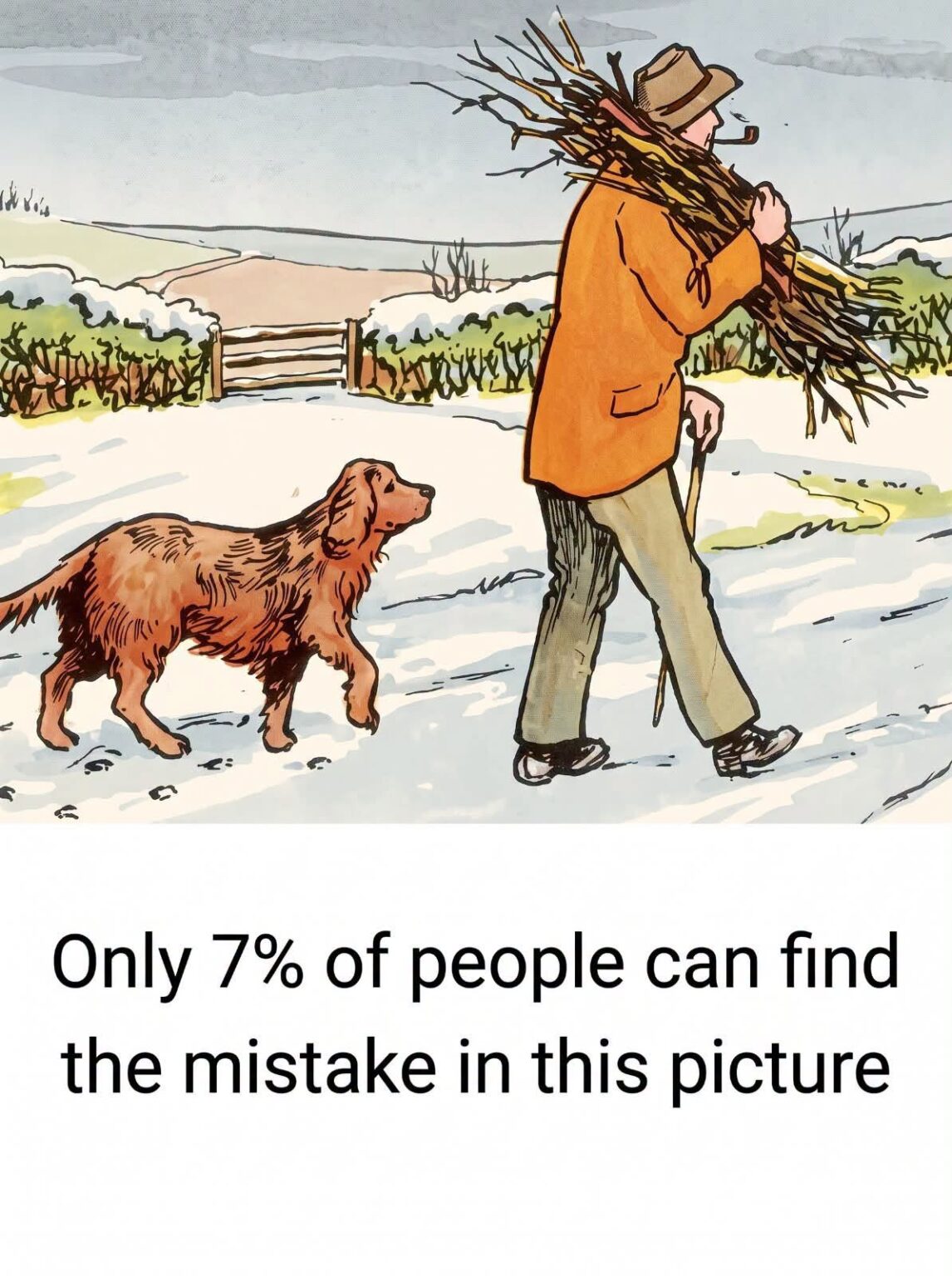
Don’t spend too much time examining the man’s clothes, the fence or the bundle he’s carrying.
Instead, look at the snow.
Then compare what you see around the dog with what you see around the man.
Got it?
The Answer: The Man Isn’t Leaving Footprints
The dog has clearly left paw prints behind as it walks through the snow.
The man, however, appears to have left no footprints at all.
That’s the mistake.
If the snow is soft enough to record the dog’s paw prints, we would ordinarily expect the man’s shoes to leave visible tracks as well. Yet the snow behind him appears undisturbed.
Why Is It So Easy to Miss?
The puzzle works because the overall scene feels completely natural.
Your brain quickly recognizes the important elements: a man, a dog, snow and a countryside path. Once the scene makes sense as a whole, you’re less likely to examine whether every individual detail follows the same logic.
The footprints are also less visually interesting than the people and objects in the picture, so your attention is naturally drawn elsewhere.
Only when you compare the man and dog directly does the contradiction become obvious:
Dog walking through snow = paw prints.
Man walking through the same snow = no footprints.
And once you’ve noticed it, it’s difficult not to see it.
How Quickly Did You Find It?
If you spotted the missing footprints immediately, you were paying close attention.
If you spent your first few seconds examining the fence, the man’s cane, his clothes or the wood he was carrying, that’s exactly what puzzles like this are designed to make you do.
A useful trick with similar observation puzzles is to compare related details rather than simply searching for something that “looks strange.” Check footprints, shadows, reflections, directions, repeated objects and anything else that should logically correspond with something nearby.
Sometimes the mistake isn’t hidden at all.
It’s simply something that should be there—but isn’t.
So before showing the answer to someone else, give them the picture and ask just one question:
Can you find the mistake in 15 seconds?