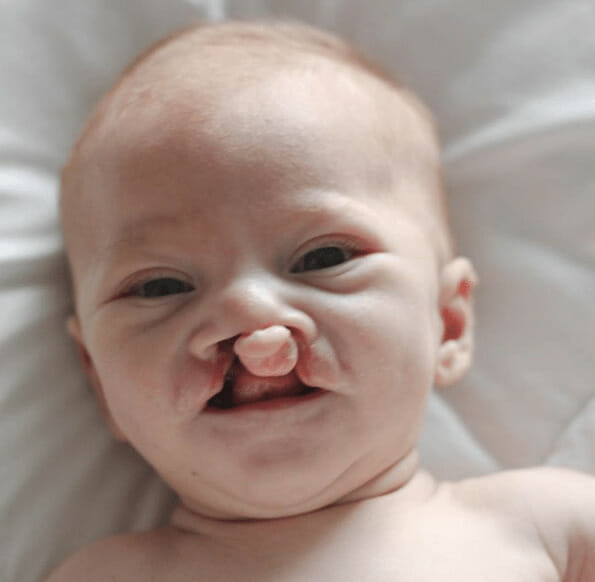
Their pregnancy suddenly looked different from what they had imagined.
But one thing didn’t change.
They already loved their son.
According to reports published after Brody’s birth, Sara and Chris said doctors discussed their options with them after the prenatal diagnosis, including whether they wanted to continue the pregnancy.
For the couple, the answer was clear.
They wanted Brody.
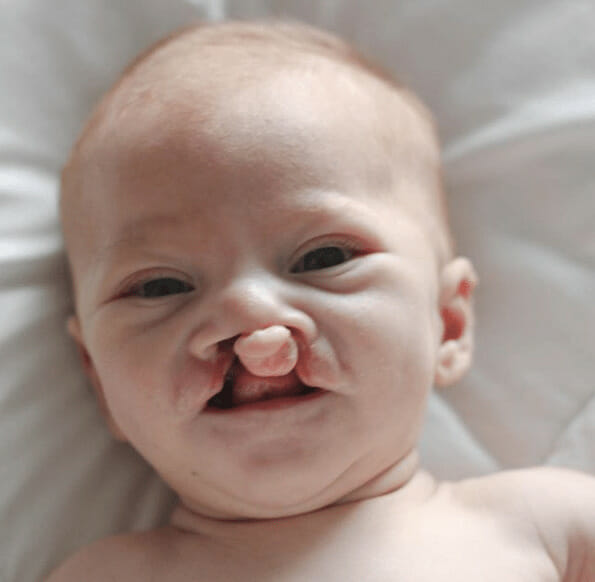
His appearance didn’t change that.
Neither did knowing that he could require specialized medical care after birth.
Instead of hiding his condition, Sara and Chris decided they wanted to do something else.
They wanted people to see him.
They wanted to share his photographs.
And they wanted other families facing a cleft diagnosis to know they weren’t alone.
Sara later explained that she wanted to help change what people expected newborn and first-year photographs to look like.
Brody didn’t have to look like every other baby to be proudly celebrated by his parents.
He was their son.
And they thought he was beautiful.
Brody was born on October 7, 2016.
His bilateral cleft lip and palate were visible, just as the prenatal scans had indicated.
Contemporary news reports also said Brody had a rare chromosome 9 deletion that required additional medical monitoring.
But his parents didn’t hide him from the world.
Like countless proud new parents, they shared pictures of their baby online.
Most people responded with love.
Others weren’t nearly as thoughtful.
When Brody was about three months old, Sara encountered a comment that stopped her.
Someone asked what was “wrong” with her son’s face.
It would have been easy to respond angrily.
Sara chose another approach.
She educated the person about cleft lip and palate.
She later explained that this was the example she wanted to set for Brody.
One day, he would be old enough to answer people’s questions himself.
Sara wanted him to grow up knowing that he could advocate not only for himself, but also for younger children with cleft conditions who might not yet have a voice.
Her decision transformed an insensitive question into an opportunity to teach.
Then, only hours later, Sara experienced the opposite side of human nature.
She was having dinner with Brody and friends when their server approached the table.
Someone at another table had left something for her.
At first, Sara didn’t know what to expect.
The server handed her a folded piece of paper.
Inside was a check.
Sara looked at the amount.
$1,000.
Then she noticed the short message written with it.
“For your beautiful baby.”
The stranger didn’t ask for recognition.
There was no long speech.
Just a gift from one person who had seen Brody and apparently wanted his mother to know that her baby was beautiful.
Sara was overwhelmed.
The money was put toward Brody’s medical expenses.
And for a family navigating appointments, procedures and uncertainty, the gesture represented something beyond its financial value.
A stranger had chosen kindness.
Brody subsequently underwent surgery to repair his cleft.
Contemporary reports said his early operation went well, with doctors reshaping his lip and palate and his parents hoping the procedure would make feeding easier.
His treatment journey wasn’t necessarily finished with one operation.
Children born with cleft lip and palate can require care from a multidisciplinary medical team as they grow.
A cleft lip develops when the tissue forming the upper lip doesn’t completely join during early fetal development.
A cleft palate occurs when tissue forming the roof of the mouth doesn’t completely join.
A child can have one condition or both.
A bilateral cleft lip means the cleft affects both sides of the upper lip.
The condition isn’t simply cosmetic.
Depending on the type and severity, children with orofacial clefts can experience difficulties involving feeding and speech, as well as increased risks of ear infections, hearing difficulties and dental problems.
Surgery is an important part of treatment for many children, and additional procedures may be needed as they grow.
The causes aren’t fully understood in most cases.
Researchers believe cleft lip and palate generally result from a combination of genetic and other factors rather than one simple cause.
And the condition is far from unheard of.
Current CDC estimates indicate that approximately one in every 1,031 babies born in the United States has cleft lip with or without cleft palate, while about one in 1,563 is born with cleft palate alone.
Those figures also help explain why families such as Brody’s have emphasized awareness.
Some parents receive the diagnosis during pregnancy.
Others don’t learn about certain forms of cleft palate until after birth.
Either way, families may suddenly find themselves learning about surgeons, feeding techniques, speech development, dental care and other issues they never expected to navigate.
That’s why Sara wanted Brody’s photographs to be seen.
Not because she wanted people to feel sorry for him.
Quite the opposite.
She wanted people to understand that a child with a visible difference should still be celebrated.
Brody’s story eventually reached people far beyond his family’s immediate circle.
Messages of encouragement arrived.
Other families affected by cleft lip and palate connected with them.
People offered prayers and support.
And that anonymous $1,000 check became one of the most memorable moments of the family’s early journey.
There is something particularly powerful about the contrast.
One stranger looked at Brody’s photograph and focused on what seemed different.
Another stranger looked at the same little boy and apparently saw something else entirely.
A beautiful baby.
For Sara and Chris, Brody’s diagnosis never changed his worth.
It simply changed some of the medical challenges their family would need to face.
And rather than hide those challenges, they chose to talk about them.
Their son’s early story became one of surgeries and medical appointments, but also advocacy, education and unexpected kindness.
Brody didn’t need to fit somebody else’s definition of what a newborn should look like to deserve photographs proudly shared by his parents.
He didn’t need to wait until after surgery to be called beautiful.
And perhaps that’s why the stranger’s tiny handwritten message resonated so strongly.
It said in only four words what Sara and Chris had believed from the beginning:
“For your beautiful baby.”