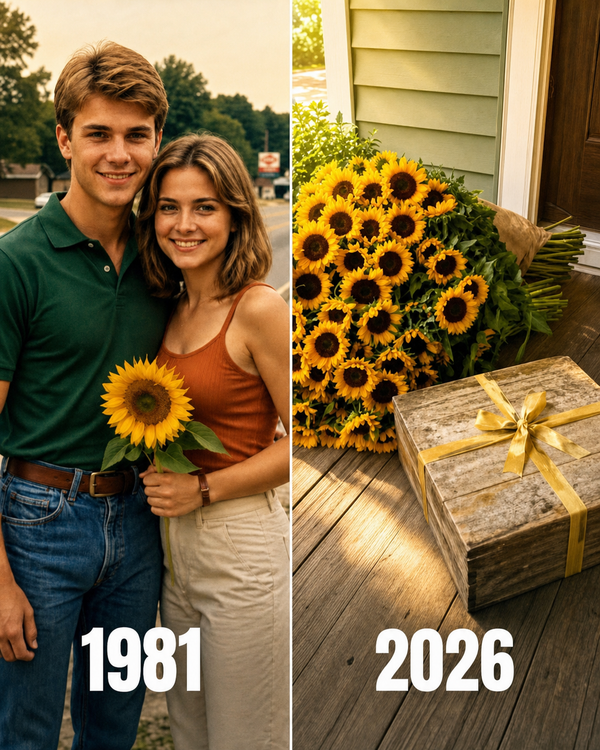
That boy was Danny, and the promise had lived in her memory alone for forty-five years, tucked away like something too sacred to speak aloud. Now it was sitting on her porch, impossible and undeniable, and she had no idea yet what else waited behind the flowers.
A Promise Made at Fifteen
She and Danny had grown up three houses apart, best friends long before either of them understood what love meant. That closeness deepened into something more the summer they turned fifteen, the kind of summer that felt like it would never end.
One afternoon, walking past a roadside flower stand, she joked about growing old and being forgotten. “When I turn sixty,” she told him, “I’ll be an old woman nobody bothers buying flowers for.”
Danny stopped walking. He looked genuinely offended. “Then I’ll bring you sixty sunflowers,” he said. “One for every year.” When she teased that he’d forget her by then, he held out his hand and made her shake on it. “I mean it,” he told her. “Sixty sunflowers. I promise.”
They believed age and memory would be the only things that promise ever had to survive. Then came the Fourth of July, and a fireworks accident sparked a fire during a neighborhood celebration. Danny never made it home. He was fifteen years old.
Years of Settling
She never told a soul about the sunflower promise — not her parents, not her friends, not the man she eventually married. It felt too fragile to share, and she assumed there was no one left alive who even knew it existed.
She married, raised two children, and told herself she had built a good life. But her marriage fell short of the fairy tale she had once imagined. She forgave infidelities again and again, choosing the familiar over the frightening unknown of being alone.
It took her until fifty-seven to finally walk away. By the time her sixtieth birthday approached, she expected nothing more than a quiet dinner with her children. She had made peace, she thought, with being the kind of woman nobody bought flowers for anymore.
Sixty Sunflowers on the Porch
She counted them under her breath, moving down the row in disbelief. Fifty-eight, fifty-nine, sixty. Exactly sixty. Her knees nearly gave out, and she lowered herself onto the top step, certain this could not be coincidence — and certain, too, that it could not be real.
Tucked behind the largest bundle of stems sat a weathered wooden box, tied with a faded yellow ribbon. She carried it inside with both hands, set it on the kitchen table, and sat down before her legs could betray her again.
It took three tries before the knot came loose. Inside, resting on old cloth, was a single folded note. She recognized the messy handwriting instantly. The first line read: If you’re reading this, I kept my promise after all.
Tears blurred the ink before she could read another word. For a moment, grief turned sharp and angry — who would take the one pure memory she had left and twist it into a cruel joke, when nobody but her had ever known about that promise?
The Knock at the Door
Three slow, deliberate knocks sounded at her front door. The note slipped from her fingers to the floor. She rose on unsteady legs, crossed the room, and pulled the door open with a shaking hand.
A man stood on her porch, older than she remembered but unmistakable — the shape of his eyes, the set of his jaw. For one dizzying moment, the resemblance to Danny fooled her completely. Then reality caught up.
“You’re Danny’s brother,” she whispered. “I am,” he said. “I’m sorry to frighten you like this.” She let him into the kitchen, where the note still lay on the table.
He explained that their mother had passed away that spring, and while clearing out her house, he’d found a shoebox of Danny’s things tucked in the back of a closet. Inside it was the note — the promise written down, her name, her birthday, the years carefully counted out.
“He was fifteen,” she said softly. “He meant it,” his brother answered. “That was Danny.” He told her that Danny had talked about her constantly, that he’d wanted to marry her, and that after finding the note, he couldn’t simply put it back in the box. So he looked up her address and decided to keep the promise himself.
She finally read the note all the way through — a boy promising a girl the world in the currency of flowers. For forty-five years she’d believed that promise lived only in her memory. She had been wrong.
“I’m sixty years old,” she told him, “and I’m just realizing that a boy who died at fifteen loved me more honestly than the man I gave most of my adult life to.” His brother said nothing. He simply let her sit with it, then told her, “You remembered it now. That’s what matters.”
A Birthday, Reclaimed
That evening her children arrived to a kitchen filled with flowers. Before she could explain, her ex-husband appeared uninvited in the doorway, smirking at the blooms and asking who she’d begged for them.
For the first time, she felt only calm. “Nobody begged,” she told him. “A boy promised me these when I was fifteen. He kept his word better in death than you ever did in life.” When he accused her of being dramatic, she answered quietly, “You came to remind me I was small. But I’m not that woman anymore.”
She asked him to leave, and this time, no fear rose up to stop her. He turned and walked out.
She gathered the sunflowers into her arms and understood something at last: Danny’s love had never asked her to hurt, never made her smaller. For decades she had confused endurance with love, believing suffering was the price of not being alone.
She divided the stems among her children and the two friends who had carried her through the divorce. “You stood beside me while I rebuilt myself,” she told them. She kept one flower for herself. “And this one,” she said, “is proof I finally know what I deserve.”
That night, she placed her last sunflower in a glass of water by the window. The past, she realized, had not come back to hold her down. It had come to set her free.