I didn’t tell my family how much I earned.
I definitely didn’t tell them how much I’d saved.
By twenty-eight, I had $67,000 set aside and had spent eight months looking for my first investment property.
Eventually, my agent Marcus found a brick duplex on Caldwell Street.
It wasn’t glamorous. It had been built in 1962, the hardwood floors upstairs needed refinishing, and several fixtures looked almost as old as the building.
But the structure was solid, the numbers worked, and the downstairs tenants, Ben and Yolanda, wanted to stay.
We negotiated the price to $276,000.
I closed in October.
For the next four weekends, I practically lived in the vacant upstairs unit.
I sanded floors, painted walls, replaced fixtures and learned that every “quick Saturday project” actually required Saturday, Sunday and at least one emergency trip to the hardware store.
By February, it was finally ready.
My property manager, Gretchen, was preparing to advertise the upper apartment for rent.
Then my mother’s birthday arrived.
I was driving toward Greensboro when my phone buzzed.
Motion detected.
The alert came from a camera covering one of the entrances.
I assumed Gretchen had stopped by.
Then another alert appeared.
I pulled over and opened the live feed.
My sister was standing outside my duplex.
Dileia had a key.
Beside her was a couple I’d never seen before.
I watched her unlock the door and gesture for them to follow her inside.
For several seconds, I simply stared at my phone.
Dileia didn’t live there.
She wasn’t my property manager.
I’d never given her permission to enter.
I called Gretchen first.
“Did you give my sister access to the duplex?”
“No.”
“Did anyone?”
“Not through me.”
I contacted police and reported that someone had entered my property without permission and appeared to be showing it to strangers.
Then I turned the car around.
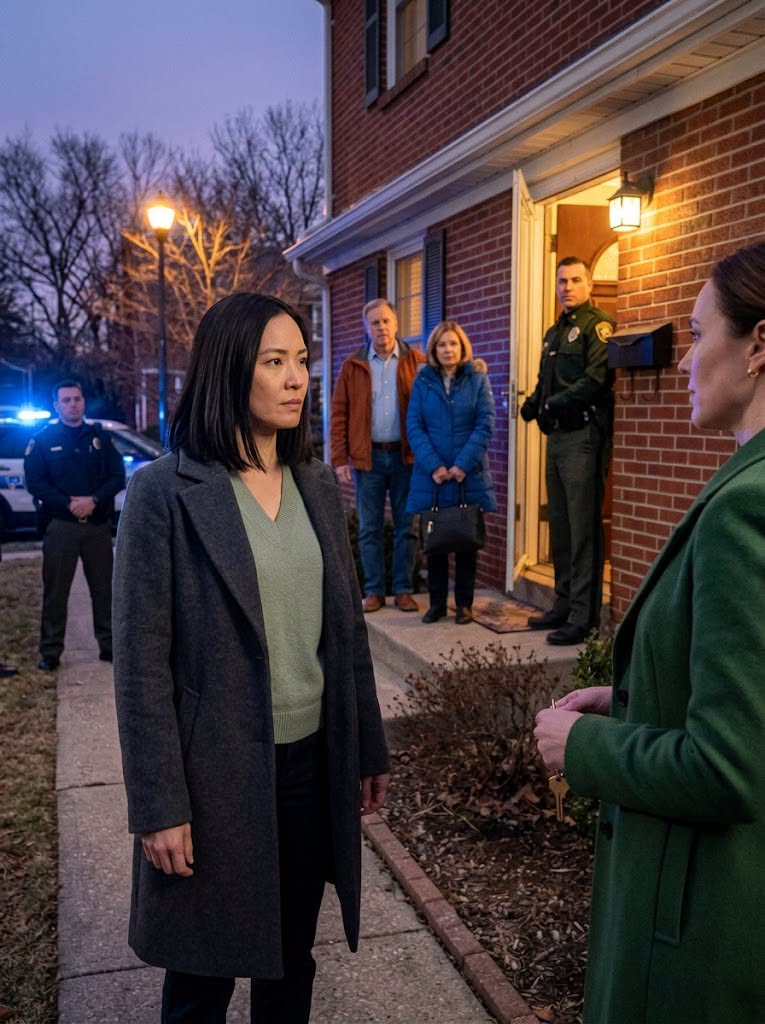
By the time I reached Caldwell Street, officers were already there.
Dileia was outside with the couple.
Everyone was talking at once.
I provided identification and explained that I owned the duplex and that Gretchen managed the rental. The officers documented the situation while ownership and access could be verified through the appropriate records.
Then the couple explained why they were there.
Their names were Greg and Sandra.
They believed they were viewing a property that might be available for purchase.
Dileia had presented herself as someone authorized to market the duplex.
My duplex.
She had photographs.
She knew enough details about the property to make the story sound legitimate.
Greg showed me the online listing.
There was my building.
There was my kitchen.
There were the floors I’d spent an entire weekend refinishing.
And there was a price.
$310,000.
I felt something inside me go completely still.
“You listed my property for sale?”
Dileia immediately changed the subject.
She said she’d only been “exploring possibilities.”
Then she said I’d gotten a good deal and could make a profit.
Finally, she said the sentence I should have expected.
“We could split it.”
I actually laughed.
“Split what?”
“The profit.”
“You own zero percent of this building.”
She rolled her eyes.
“You don’t have to make everything about money.”
That was the moment I understood exactly what was happening.
My sister had entered a building I owned, photographed it without my permission, advertised it as though she had authority over it and brought prospective buyers inside.
Yet somehow, in her version of events, I was being greedy.
I turned to Greg and Sandra.
“You didn’t do anything wrong. I’m sorry you got dragged into this.”
They left.
I didn’t continue arguing with Dileia.
There was nothing useful left to discuss.
Gretchen arranged to have the locks changed, and we reviewed how Dileia might have obtained access. I preserved the security footage, screenshots of the listing and every message I could obtain concerning the attempted showing.
The fraudulent listing was reported to the platform.
Then I called a real-estate attorney.
That decision caused more family drama than the unauthorized listing itself.
My mother called repeatedly.
Her message was always some variation of the same idea.
She’s your sister.
I knew that.
Being my sister explained why I had once trusted her.
It didn’t give her an ownership interest in my duplex.
My attorney sent Dileia a formal letter stating that she had no authority to enter, advertise, market or represent herself as acting on behalf of the property.
Because Dileia held a real-estate license, the situation was potentially more serious than an ordinary family disagreement. Her attorney could advise her about any professional consequences, while mine focused on protecting me and documenting what had happened.
My mother hated that lawyers were involved.
“Families shouldn’t communicate through attorneys,” she told me.
“Families shouldn’t list each other’s houses for sale either.”
She went quiet.
My father called later.
He sounded genuinely upset rather than angry.
He said Dileia had told them she’d only been trying to help me see an opportunity.
So I gave him the timeline.
I bought the duplex.
I paid for it.
I renovated it.
I hired the property manager.
Dileia entered without permission.
She brought strangers inside.
She represented herself as having authority she didn’t have.
“I don’t need you to stop loving her,” I told him. “But I’m not going to pretend this was a misunderstanding so everyone can feel comfortable again.”
That became my boundary.
I wasn’t asking my parents to choose between their daughters.
I was asking them to stop requiring one daughter to absorb the consequences of the other’s behavior.
Dileia eventually hired her own attorney.
Strangely, I was relieved.
Once lawyers were communicating, the emotional arguments became less important.
The listing disappeared.
Dileia formally acknowledged that she had no ownership interest or authority concerning the property and agreed not to enter or represent it again without my written permission. The financial issues were resolved separately rather than turning into another family negotiation.
There was no dramatic courtroom victory.
I didn’t need one.
I needed my property protected.
By April, Gretchen found a graduate student named Josephine to rent the upper unit.
The first time I stopped by after she moved in, she told me how much she loved the hardwood floors.
“You restored these?”
“Unfortunately.”
She laughed.
I looked around the apartment.
A few months earlier, I’d stood in that same room covered in sawdust, wondering whether buying a duplex had been the smartest decision of my life or the beginning of a financial disaster.
Now someone was paying rent to live there.
Downstairs, Ben and Yolanda were still happy.
The mortgage was getting paid.
The building was doing exactly what I’d bought it to do.
My parents eventually stopped asking me to “undo” everything with Dileia.
Our family relationships changed.
Some became more distant.
But something unexpected happened too.
I stopped feeling guilty about boundaries.
That summer, I returned to Caldwell Street because Josephine had reported a minor maintenance issue.
Afterward, I stood outside and locked the front door.
The new brass key turned smoothly.
My phone buzzed.
It was Marcus.
Triplex just listed. Numbers might work for you. Want me to send the analysis?
I looked back at the duplex.
For years, my family had treated independence as proof that I needed less consideration than everyone else.
I’d finally stopped seeing it that way.
Being capable didn’t mean people were entitled to what I’d built.
Being family didn’t create ownership.
And protecting something I’d worked for didn’t make me selfish.
I texted Marcus back.
Send it.