I had one daughter.
Clara.
She was ten and had a spinal condition that required a rigid orthopedic brace for much of the day. Managing it correctly wasn’t particularly complicated once you were trained, but it required attention, patience and regular medical follow-up.
When I married Victoria, she promised she understood that Clara came first.
I believed her.
That belief is still difficult to forgive myself for.
On Christmas Eve, I came home several days earlier than expected.
A snowstorm had made the final part of the journey miserable, but I imagined Clara’s face when I walked through the door.
Instead, the house was almost completely dark.
No Christmas music.
No television.
No Clara.
I found Victoria in the living room talking on her phone.
Then I saw my daughter.
She was on the floor near the wall.
At first I thought she’d fallen.
Then I saw what had been done to her brace.
Additional ties had been wrapped around it in a way that wasn’t part of her treatment, restricting her movement and preventing her from removing it normally.
“Dad?”
Her voice was barely above a whisper.
I dropped everything.
Victoria jumped up.
“Alexander, wait. She had an episode.”
I knelt beside Clara.
“What episode?”
Victoria started explaining that Clara had become uncontrollable and she’d needed to keep her from hurting herself.
I looked at my daughter.
“Did your doctor tell Victoria to do this?”
Clara shook her head.
That was enough.
I didn’t interrogate either of them.
I didn’t threaten Victoria.
And I didn’t try ripping the brace apart myself.
I called emergency services.
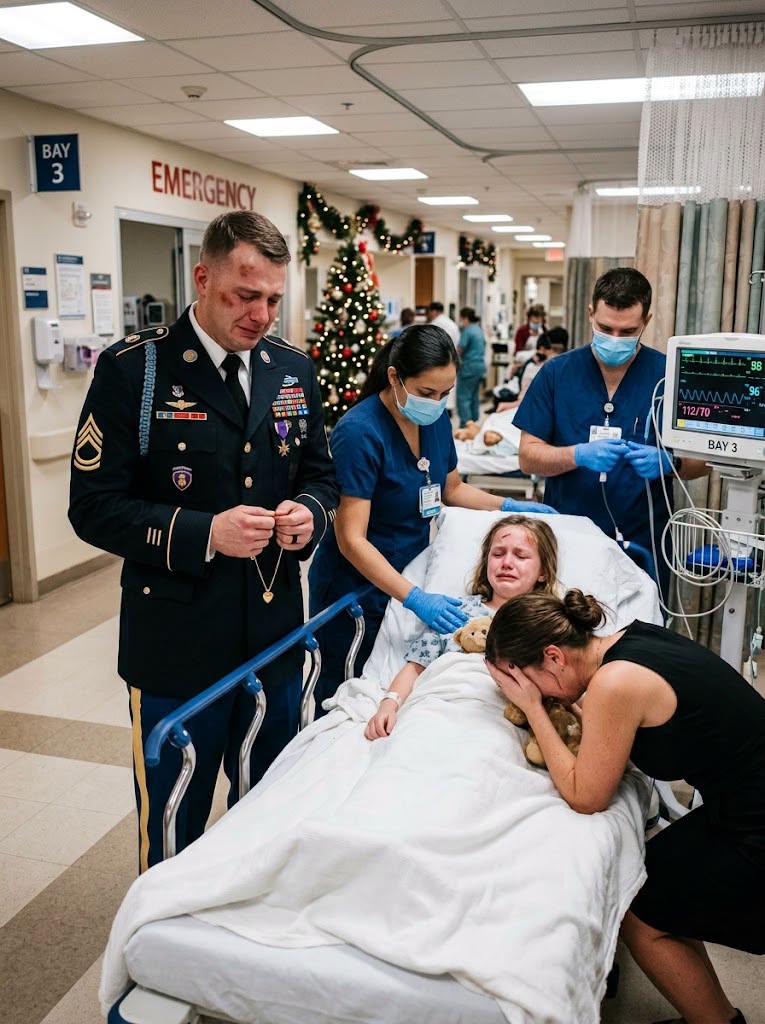
Paramedics examined Clara and transported her to the hospital. I went with her.
Victoria tried to follow.
Police were already being contacted.
At the emergency department, medical staff carefully removed the additional restraints and examined Clara for injuries. They documented marks on her body and checked whether the brace itself had been fitted or used improperly.
I sat beside her bed feeling increasingly sick.
“How long has this been happening?”
A nurse gently stopped me.
“Let us have the right people talk to her.”
She was correct.
I wanted answers immediately.
Clara needed something more important.
She needed adults who weren’t going to make her tell the same frightening story over and over again.
Hospital staff contacted the appropriate child-protection authorities, and law enforcement became involved because of what had been found.
Eventually, Clara was interviewed by professionals trained to speak with children.
What emerged was worse than I’d allowed myself to imagine.
The Christmas Eve incident hadn’t been the first.
According to Clara, Victoria had repeatedly used her brace as punishment. Sometimes she tightened or altered it unnecessarily. Other times she restricted Clara’s movement when she became frustrated with her.
Victoria had also told her not to complain to me.
“Dad works because taking care of you is expensive,” Clara remembered being told.
That sentence destroyed me.
I’d spent years accepting dangerous contracts because I thought earning more money meant protecting my daughter.
Meanwhile, my absence had made it harder for me to see what was happening inside my own house.
Clara had tried to preserve evidence.
Not with some sophisticated spy device.
She had an old tablet.
A few times, she’d positioned it in her bedroom and recorded audio or video when she expected Victoria to come in.
The recordings weren’t a complete record of what had happened, and nobody treated them as automatic proof of every allegation.
But some captured interactions that investigators considered important.
They also showed something I hadn’t expected.
Clara had tried to tell me.
In one recording, Victoria became angry after discovering Clara had drafted a message describing how frightened she was.
I checked my accounts.
The message had never reached me.
That hurt almost as much as anything else.
Victoria arrived at the hospital insisting the entire situation had been misunderstood. She said Clara sometimes resisted medically necessary care and accused me of reacting emotionally because of my military background.
I didn’t argue with her in the hallway.
There was nothing to gain from it.
The doctors had their observations.
Investigators had Clara’s statements.
The devices and messages could be preserved and examined properly.
For once in my life, I didn’t need to control the situation.
I needed to let the evidence speak.
I didn’t go home with Victoria that night.
Neither did Clara.
Temporary protective arrangements were put in place while the investigation continued.
The following months were nothing like the clean revenge story people imagine when they hear what happened.
There was no dramatic recording of Victoria announcing an evil plan.
No arrest triggered by me pressing play in a crowded hospital.
There were interviews.
Medical records.
Photographs.
Digital evidence.
Statements from people who had interacted with Clara.
Investigators also examined whether Victoria had misrepresented Clara’s medical needs to me and to others.
Some things Clara remembered couldn’t be independently verified.
Others could.
That distinction mattered.
Eventually, prosecutors pursued charges based on the evidence they believed they could prove. Victoria’s criminal case proceeded separately from our divorce and from the decisions concerning Clara’s safety.
I stopped caring about the maximum possible punishment.
I wanted accountability.
But more than that, I wanted my daughter back.
Not physically.
She was already beside me.
I wanted the Clara who didn’t watch an adult’s hands whenever they approached the straps on her brace.
That took longer.
I ended the overseas work.
Not because I suddenly believed a parent must never travel, but because my life had changed and I had the financial ability to make another choice.
I started doing security and cybersecurity consulting locally.
For the first time in years, I knew who helped Clara get ready in the morning.
Me.
I knew when her appointments were.
I attended them.
I learned every adjustment on her brace instead of assuming another adult would handle it correctly.
Most importantly, Clara learned that the brace itself wasn’t the enemy.
It was medical equipment intended to help her.
Her doctors reviewed her treatment and made changes based on her condition and progress. Whether she would eventually stop needing it wasn’t something I could promise her.
So I didn’t.
A year later, Christmas Eve looked very different.
Snow covered the windows again.
Music played in the kitchen.
Clara was standing beside our Christmas tree wearing the brace her medical team had fitted for her.
She handed me the silver star.
“You do it,” she said.
“Absolutely not.”
She laughed.
“You’re taller.”
“Exactly. Which means putting the star up myself would be cheating.”
I brought over the small step stool.
Clara climbed carefully while I stood beside her.
“Got you,” I said.
“I know.”
She placed the star on top.
For a moment, neither of us moved.
A year earlier, I’d thought my job was to provide enough money that Clara would always be protected.
I understand it differently now.
Providing matters.
But protection also means being present enough to notice.
Listening when something doesn’t make sense.
Accepting that a child shouldn’t need courtroom-quality evidence before a parent takes her fear seriously.
I couldn’t change the months when Clara had needed me and I hadn’t known.
What I could change was everything that came afterward.
The Christmas tree lights reflected in the window.
Clara stepped down and reached for my hand.
This time, when she said she knew I had her, I knew exactly what she meant.