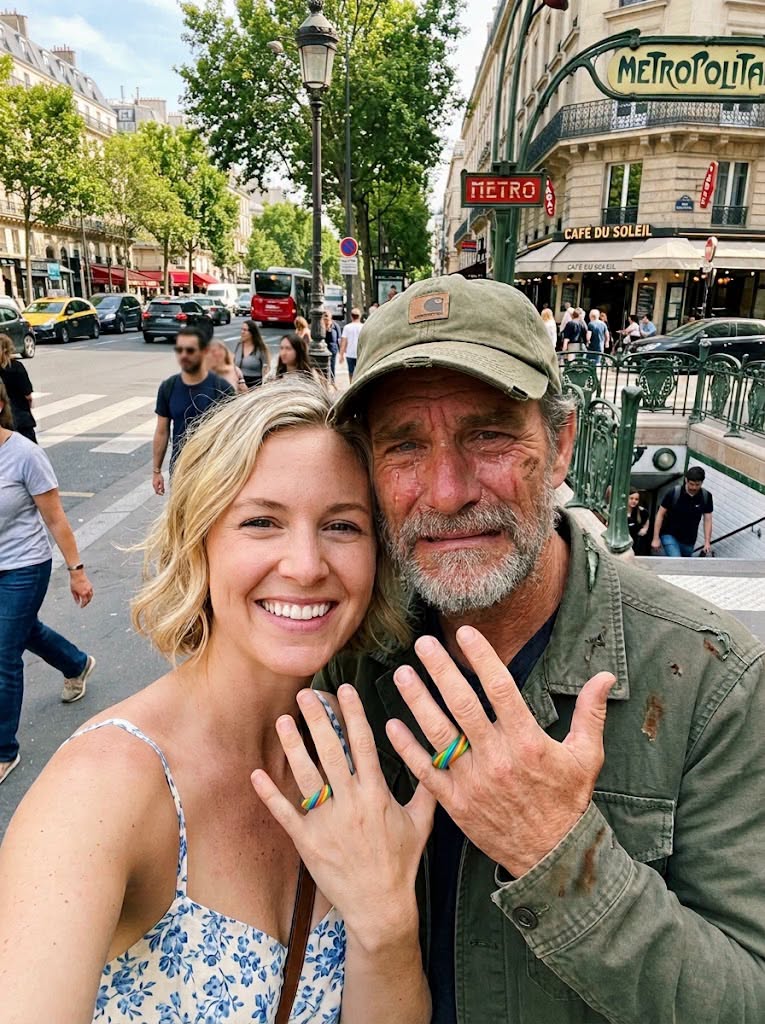
He also knew I liked fixing things.
Then one Tuesday, I saw a new cardboard sign beside him.
Liver failure. Not much time left.
I sat down.
Larry told me his condition had worsened and that he would soon be entering hospice care. Then, with the same calm voice he used to discuss the weather, he asked me to marry him.
I laughed because I thought he was joking.
He wasn’t.
“Why?”
Larry said he didn’t have close family and didn’t want to die feeling as though nobody legally belonged to him.
It sounded heartbreaking.
It also sounded like a problem.
And problems were something I understood.
I asked questions about identification, paperwork and whether he was certain. He was mentally clear and absolutely certain.
So I did what I always did.
I turned his loneliness into a task.
Within days, we were standing inside a courthouse.
There were no flowers.
No rings.
No guests.
Just Larry wearing the cleanest shirt he owned and me standing beside him wondering how my Tuesday-morning coffee routine had somehow led to this.
The ceremony lasted only minutes.
When the clerk asked Larry to sign, he stared at the marriage certificate for an unusually long time.
“You okay?” I whispered.
He smiled.
“Perfect.”
I didn’t understand why that moment mattered so much to him.
Not yet.
Larry spent most of the following three weeks in hospice.
I brought him socks, toiletries, clean clothes and whatever else I thought he needed.
Every visit began the same way.
“What can I get you?”
Usually Larry answered, “Nothing.”
So I’d suggest things.
A better blanket?
Different food?
Another pillow?
Did he need me to call somebody?
Eventually he’d shake his head.
“Just sit down.”
So I sat.
Sometimes we talked.
Sometimes he slept while I answered emails beside him.
Once, I realized I’d spent nearly an hour doing absolutely nothing except holding his hand.
It felt strangely uncomfortable.
Larry seemed perfectly content.
He died three weeks after our wedding.
I arranged what needed arranging and attended his funeral believing I’d fulfilled the strange promise we’d made to each other.
Less than a week later, an envelope arrived.
My name was written across the front in Larry’s shaky handwriting.
I smiled when I saw it.
Then I opened the letter.
The first sentence was:
I’m sorry I lied to you.
Larry explained that his final arrangements hadn’t depended on marrying me.
Those details could have been handled without a wife.
He knew that.
He had given me a practical reason because he knew how my mind worked.
If he’d simply said, I’m lonely and I want to know what being someone’s husband feels like before I die, he was afraid I’d say no—or worse, say yes because I pitied him.
I was furious.
Then I turned the page.
Larry told me to go back to the courthouse where we’d married and ask for Margaret.
I almost didn’t.
Eventually, curiosity won.
Margaret was an older woman working near the records counter.
“I’m looking for someone who knew Larry,” I said.
Her expression changed immediately.
“Larry?”
I gave his full name.
Then I added, awkwardly, “I was his wife.”
Margaret stared at me.
Her eyes filled with tears.
“You’re her.”
Before I could ask what she meant, she came around the counter and hugged me.
That’s when I learned that Larry hadn’t always been the man outside my subway station.
He’d worked in that courthouse for twenty-eight years.
Much of his career had been spent around marriage records and civil ceremonies.
After retirement, his life had gradually unraveled. His health deteriorated. Financial problems accumulated. He became increasingly isolated and, eventually, lost stable housing.
Former coworkers had tried to stay in contact, Margaret said, but Larry was proud.
Once his circumstances became bad enough that he needed serious help, he withdrew instead.
“He didn’t want us seeing him like that,” she said.
Margaret took me to the small ceremony room.
I recognized it immediately.
“This is where you married him?”
“Yes.”
She smiled.
“He came here the day before.”
Larry had apparently sat in that room for nearly an hour.
“He was terrified,” Margaret said.
“Of marrying me?”
“No. Of finally being the one getting married.”
She explained something I’d never known about him.
Over the years, Larry had helped with countless marriage licenses and ceremonies. When couples arrived alone and local procedure required or allowed someone to serve as a witness, Larry was often willing to help where appropriate.
He loved weddings.
Not the expensive kind.
The nervous couples.
The elderly people marrying late in life.
The young people who couldn’t stop smiling.
The couples who arrived without anyone else beside them.
“He hated seeing people feel alone on a day that mattered to them,” Margaret said.
Yet Larry himself had never married.
For decades, he’d watched other people’s names appear beside the word spouse.
His never had.
Until me.
Before I left, Margaret handed me a copy of our marriage certificate.
Larry had asked her to keep it for me.
I walked back to the subway station and bought two black coffees without thinking.
Then I sat in Larry’s old spot and opened the rest of his letter.
He told me the truth.
He hadn’t married me for paperwork.
He married me because, before he died, he wanted to know what it felt like for someone to choose him.
Not as a charity case.
Not as a homeless man.
Not as somebody who needed rescuing.
As a husband.
Then came the part that hurt.
Larry thanked me for the socks.
The food.
The toiletries.
The phone calls.
The endless practical things I’d done.
But he wrote that his favorite moments were the ones when I stopped doing things for him.
When I sat beside his hospice bed.
When I held his hand.
When neither of us spoke.
You always thought love meant finding something broken and making it better, he wrote.
Sometimes there is nothing to fix. Sometimes someone just doesn’t want to be alone while it’s happening.
I read that sentence three times.
I’d spent years believing my usefulness was one of my best qualities.
Someone had a problem?
I solved it.
Someone was struggling?
I found resources.
Someone was sad?
I searched for something that might make them happier.
Even with Larry, I’d approached suffering like a checklist.
Coffee.
Socks.
Housing numbers.
Hospice supplies.
Funeral arrangements.
I hadn’t understood that sometimes what he wanted most was the one thing I couldn’t organize.
Company.
His final paragraph was short.
You didn’t fail to save me. You were my wife for three weeks. I wanted you to know those were three very good weeks.
I cried harder than I had at his funeral.
A man carrying an old backpack eventually approached the bench.
“Anyone sitting there?” he asked.
My instinct appeared immediately.
Was he hungry?
Did he need coffee?
Money?
A shelter?
I almost started asking.
Instead, I moved Larry’s letter.
“No. Go ahead.”
He sat.
After a while, I introduced myself.
His name was Jeremy.
That was all I learned.
I didn’t ask what had happened to him.
I didn’t try to determine what he needed.
We simply sat while hundreds of commuters hurried past us.
Eventually, I tasted the second black coffee I’d bought for Larry.
I hated black coffee.
I’d been buying it for him for two years and had somehow never once considered that.
I walked back to the kiosk.
“Can I get some cream in this?”
When I returned, Jeremy had shifted slightly to leave room for me.
I sat down.
Larry’s letter and our marriage certificate rested beside me.
For once, I wasn’t checking the time.
I wasn’t solving anything.
I wasn’t rescuing anyone.
I was simply sitting in the place where I’d met my husband, drinking coffee the way I actually liked it.
Larry had spent twenty-eight years helping people begin marriages.
Ours lasted twenty-one days.
For a long time, I thought that made it less real.
Eventually, I understood the lesson he’d left me.
Not everything meaningful has to last.
And not everyone we love needs us to save them.
Sometimes they just need us to stay.