Charles lived very differently.
His suite was on the top floor. He could afford private nursing assistance, expensive tea and meals prepared specifically for him.
Yet almost every afternoon, he came downstairs carrying his chessboard.
That’s how we became friends.
Charles was a widower with three adult children. I had lost my husband years earlier. Neither of us was searching for romance.
We played chess.
Then we started drinking tea while we played.
Then Charles began bringing jazz records.
Eventually, there were afternoons when neither of us remembered to finish the game.
Charles rarely discussed money. When he did, it was usually because his children had called.
“They’ve started talking about my estate as though I’m already dead,” he once told me.
“Then stop discussing your estate and move your knight,” I said.
Charles stared at me.
Then he laughed.
“You’re the only person here who talks to me like that.”
“That’s because you’re about to lose.”
I won that afternoon.
Our friendship continued for nearly two years.
Then Charles became seriously ill.
His eldest son, Douglas, arrived with attorneys and began pushing for changes to his father’s care arrangements. He wanted Charles transferred to another facility and argued that the family needed greater authority to make medical decisions.
But Charles was still capable of making his own decisions.
He refused.
After one particularly unpleasant meeting, I found him exhausted in his room.
“Sit with me,” he said.
I did.
Then he asked me something completely unexpected.
“Would you marry me?”
I thought he was joking.
He wasn’t.
Charles explained that he’d already spoken privately with his attorney about his medical directives and estate planning. Marriage would not magically give me unlimited control over his medical care, and he intended to document his wishes properly regardless.
But he wanted me beside him.
He trusted me to advocate for what he wanted if he became unable to speak for himself.
More importantly, he said, he loved me.
“Charles, everyone will think I’m marrying you for your money.”
“I know.”
“Your children already hate me.”
“Two of them disliked you before I proposed.”
I laughed despite myself.
Then he took my hand.
“You’ve known for years that I have money, and you’ve never asked me for anything except to stop cheating at chess.”
“You do cheat.”
“Then marry me and spend the rest of my life proving it.”
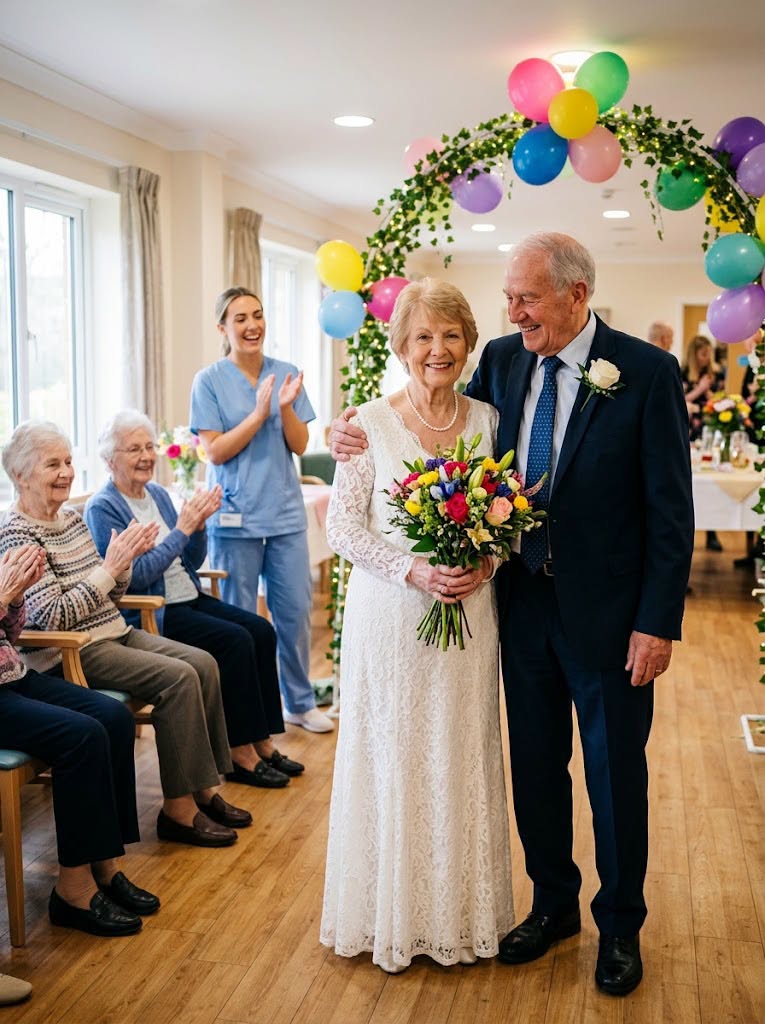
Three days later, we were married in the small chapel at Whispering Pines.
There was no grand wedding.
A few friends from the facility attended. Charles’s longtime attorney was there. Beatrice, his daughter, came quietly and hugged me afterward.
Douglas did not.
For the next two years, Charles and I had what I can only describe as a beautiful old marriage.
We moved into his larger suite together.
We listened to jazz.
I read history books aloud when his eyesight worsened.
He drank tea that cost more than some of my old grocery bills, and I continued telling him it wasn’t worth the money.
Whenever he felt strong enough, we returned to the courtyard.
Same elm tree.
Same chessboard.
His sons continued questioning the marriage and occasionally threatened to challenge decisions surrounding his affairs. Charles responded by making sure his lawyers documented his capacity, wishes and estate plans carefully.
He didn’t want me fighting his children after he died.
He wanted the paperwork to speak for him.
Beatrice was different.
She visited occasionally and seemed genuinely relieved that her father wasn’t alone.
Once, as we walked toward the elevator, she stopped.
“Thank you for loving him when nobody needed anything from him.”
I didn’t understand why she looked so sad when she said it.
Later, I would.
Charles died peacefully two years after our wedding.
I was holding his hand.
A jazz record was playing quietly beside us, and I sang along badly enough that, had he still been able to complain, I’m certain he would have.
After the funeral, I assumed my life at Whispering Pines would change immediately.
The suite belonged to Charles’s estate. I had never considered it mine.
I started packing.
A week later, his attorney came to see me.
“Before you move anything,” he said, “there’s something Charles wanted you to know.”
He placed a folder on the table.
What I learned inside that room changed everything I thought I knew about my husband.
Charles hadn’t merely been a wealthy resident of Whispering Pines.
Through companies and trusts he’d controlled for years, he was the principal owner of the property.
I stared at the attorney.
“Charles owned this place?”
“Yes.”
“Why didn’t he tell me?”
“He wanted your relationship with him to remain separate from it.”
There was more.
Whispering Pines had always maintained a mixture of private-pay residents and residents whose care depended partly on public programs and other assistance.
That model was becoming increasingly valuable—and increasingly vulnerable.
Douglas had been advocating for redevelopment.
His proposal would have converted much of the property into higher-priced private accommodation. The economics were straightforward: luxury units generated more revenue.
But they would also have reduced the number of places available to people like me.
Charles had opposed the plan.
Beatrice had quietly helped him review documents and understand what her brothers were proposing.
Suddenly, her sadness made sense.
She hadn’t been secretly plotting against her family.
She’d been caught between them.
Then the attorney handed me another document.
Charles had restructured ownership before his death.
He hadn’t simply left Whispering Pines to me.
That would have made no sense.
Instead, the property and operating interests designated in his plan had been placed into a structure intended to preserve the facility’s long-term mission. Independent professionals and community representatives would share responsibility for governance, and legal restrictions limited how the protected assets could be sold or repurposed.
Most importantly, the plan required the facility to preserve a meaningful commitment to residents who could not afford luxury care.
Douglas couldn’t simply inherit the property and convert everything into expensive suites.
Neither could I.
That was intentional.
Then I saw my name.
Charles had given me a permanent position within the governing structure, subject to the rules he’d established.
My job wasn’t to own Whispering Pines.
It was to have a voice in protecting what it was supposed to be.
I started crying.
There was also financial provision for me as his surviving spouse, separately structured so that my personal security didn’t depend on controlling the facility.
That distinction mattered.
Charles had protected me.
But he hadn’t handed me hundreds of vulnerable people’s homes and told me to do whatever I wanted with them.
Instead, he’d created a system designed to survive all of us.
His attorney handed me one final letter.
Charles had written it months before his death.
He told me that he’d watched how I treated people long before we fell in love.
I knew which residents needed company.
I thanked the kitchen workers.
When someone new arrived frightened and confused, I sat with them.
When I had very little myself, I still shared what I could.
But the letter didn’t say he’d married me because I’d passed some secret test.
He’d married me because he loved me.
The responsibility came afterward.
He wrote that loving me had convinced him there was someone who understood what he’d gradually come to believe about Whispering Pines:
A home for elderly people should remain a home even when maximizing its profits would require becoming something else.
Douglas challenged parts of Charles’s estate planning.
I expected that.
Lawyers handled it.
The governing structure didn’t depend entirely on me winning a family argument, and that was precisely why Charles had established it carefully before his death.
Life at Whispering Pines continued.
Some private suites remained expensive.
Some residents still received assistance.
Budgets still had to balance. Staffing was difficult. Every ideal eventually encountered a spreadsheet.
I learned quickly that protecting people required more than good intentions.
But whenever decisions became difficult, I remembered what Charles had actually entrusted to me.
Not a fortune.
A voice.
I still go into the courtyard most afternoons.
The elm tree is there.
So is our old chess table.
Sometimes I bring two cups of tea before remembering I only need one.
I sit in Charles’s chair now.
Not because I inherited his place.
Because I spent the final years of his life beside him and finally understood what he’d been trying to preserve.
Charles once worried that his children saw Whispering Pines only as an asset.
I had once seen it only as the place I could afford to live.
He taught me that it could be something else entirely.
A community.
A responsibility.
A promise that growing old without great wealth shouldn’t mean becoming disposable.
Then I set up the chessboard.
Charles isn’t there to make the first move anymore.
So I make it for him.