Apparently, that wasn’t enough to deserve a chair in his café.
But the moment he realized who the stranger was, everything changed.
And that was the part I couldn’t forget.
My name is Carol.
I’m seventy-four years old, and until eighteen months ago, I’d spent nearly half a century waking up beside the same man.
Frank and I were married for forty-seven years.
That particular afternoon would have been our wedding anniversary.
I still visited his grave regularly.
Usually, I brought flowers.
And usually, Benny came with me.
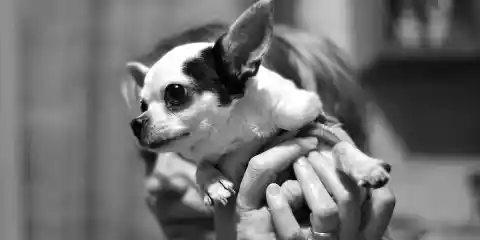
Benny was my fourteen-year-old Chihuahua.
Blind.
Missing four teeth.
Slightly crooked.
And, according to certain people, not particularly attractive.
I thought he was beautiful.
I’d adopted him eight months earlier.
At the shelter, I’d walked past puppies bouncing against their kennel doors until I reached one tiny old dog sitting quietly in the corner.
“That’s Benny,” the volunteer told me.
“He’s blind?”
“Mostly.”
Benny heard our voices and stood.
His entire body began trembling.
The volunteer sighed.
“People keep choosing the puppies.”
I crouched beside his kennel.
Benny pressed his nose against the bars.
“He cries when people walk away,” she added.
That was it.
I understood him.
I’d spent months discovering how quiet a home becomes when someone you love doesn’t come back.
“I’ll take him.”
The volunteer blinked.
“You don’t want to meet the others first?”
“No.”
I looked at Benny.
“This one’s mine.”
Benny didn’t cure my grief.
That’s not how grief works.
But he gave me something to care for when caring about myself felt difficult.
He slept against my hip.
Followed my voice around the apartment.
Barked when dinner was late.
And every morning, he waited beside the bathroom door as though I’d been missing for several years instead of six minutes.
That afternoon at the cemetery, Benny stood beside my shoe while I arranged flowers near Frank’s grave.
“Don’t eat those.”
Benny ignored me.
“Those cost twelve dollars.”
He began chewing faster.
I sighed.
“Frank would’ve loved you.”
His tail tapped my ankle.
“He would’ve fed you bacon behind my back and then claimed you found it somewhere.”
For a while, I simply sat there.
Forty-seven anniversaries.
Then suddenly none.
Eventually, I stood.
Too quickly.
The world shifted sideways.
I grabbed the car door.
Benny pressed against my ankle.
“I’m fine.”
That was something I’d started saying automatically after Frank died.
I’m fine.
Even when I wasn’t.
I’d skipped lunch.
Driving while dizzy seemed like a bad idea, so I looked across the street.
There was a café.
A chalkboard stood outside.
DOGS WELCOME.
Perfect.
Inside, a golden retriever slept beneath a table near the window.
I relaxed.
Benny and I wouldn’t be a problem.
A young waitress approached.
“Oh, look at him!”
Benny turned toward her voice.
“He’s adorable.”
“He’d be very flattered if he could see you.”
She laughed.
“I’m Mary. What can I get you?”
“Just a small coffee, please.”
“Absolutely.”
“How much?”
“$4.25.”
I opened my purse.
Then a man’s voice came from behind the counter.
“That’s all?”
I looked up.
A man in his forties was watching me.
“Excuse me?”
“That’s all you’re ordering?”
“Just coffee.”
He glanced at the tables.
“You’re planning to sit?”
“For a few minutes.”
I didn’t understand why I suddenly felt as though I needed permission.
“I’m feeling a little lightheaded.”
Mary immediately looked concerned.
“Would you like some water?”
“Yes, please.”
Then the man looked down at Benny.
“The dog can’t stay.”
I glanced toward the golden retriever.
“I’m sorry?”
“Pet-friendly seating has a thirty-dollar minimum.”
I stopped reaching for my wallet.
“A what?”
“Thirty-dollar minimum.”
I looked toward the chalkboard outside.
“It doesn’t say that.”
“I’m telling you now.”
Mary went strangely quiet.
“I’m Christopher. I own this place.”
My first instinct was to apologize.
That embarrassed me later.
But after Frank died, I’d developed this habit of trying to take up as little space as possible.
Don’t inconvenience anyone.
Don’t ask for help.
Don’t become the lonely old woman everyone has to worry about.
“All right,” I said quietly. “We’ll leave.”
Then I looked at the golden retriever.
“But that dog is allowed.”
“The owners ordered lunch.”
“So it isn’t really a dog rule.”
Christopher’s expression hardened.
“I decide what kind of atmosphere I want in my café.”
Benny pressed closer to my shoe.
I should have walked out.
Then Christopher looked at him.
“Your dog is old.”
I stared at him.
“Excuse me?”
“He’s old. He’s unattractive. Frankly, he looks like he’s barely hanging on.”
Mary looked horrified.
Christopher continued.
“Animals like that can make customers uncomfortable.”
I bent down and lifted Benny.
His tiny body was trembling.
“He’s fourteen,” I said. “That isn’t a character defect.”
Christopher crossed his arms.
“Spend thirty dollars or take him somewhere else.”
Something inside me changed.
I wasn’t embarrassed anymore.
I was angry.
“I came inside because your sign says dogs are welcome.”
“They are.”
“Apparently only attractive dogs belonging to customers who spend enough money.”
“Lady, I’m not debating this.”
“Neither am I.”
I turned toward the door.
Two steps.
That’s as far as I got.
The room tilted.
My knees weakened.
Someone caught my elbow.
“Easy.”
A man I’d noticed standing nearby steadied me.
He was older, perhaps in his sixties, wearing a dark coat.
“Are you all right?”
“I’m fine.”
The words escaped automatically.
Then I stopped.
No.
I wasn’t.
“Actually, I’m dizzy.”
He guided me toward a chair.
“Do you need an ambulance?”
“No. I skipped lunch. I just needed somewhere to sit until it passed.”
“What’s your name?”
“Carol.”
“I’m Steven.”
Mary hurried over with water.
Before she reached me, Christopher called from behind the counter.
“She was leaving.”
Steven turned.
Christopher added:
“With her ugly dog.”
The entire café seemed to become quiet.
Steven stared at him.
Then he looked at Benny.
Then back at Christopher.
“Your name is Christopher, correct?”
Christopher straightened.
“Yes.”
Steven’s expression became strangely calm.
“Tell me something.”
Christopher waited.
“Does the name Victoria mean anything to you?”
Christopher’s face drained of color.
“What?”
“Victoria.”
He stared at Steven.
Then recognition hit.
“You’re…”
“Steven.”
Christopher swallowed.
“Victoria’s father?”
“Yes.”
Christopher immediately stepped forward.
“Sir, there’s been a misunderstanding.”
Steven looked around.
“I’ve been standing here for several minutes.”
“You came in near the end.”
“I heard enough.”
Christopher rubbed his hand over his mouth.
“I didn’t realize who you were.”
Steven became very still.
That sentence seemed to bother him more than anything else.
“I see.”
Christopher tried again.
“I mean—”
“I came here for coffee.”
Steven paused.
“And because I wanted to meet the man my daughter intends to marry.”
Victoria.
Christopher’s fiancée.
Suddenly, Christopher looked at me differently.
“Ma’am.”
He pulled out a chair.
“Please sit.”
Ten seconds earlier, he’d wanted me gone.
Now he was arranging the chair himself.
“Mary, bring her coffee.”
Mary didn’t move.
“And something to eat.”
Then he looked at Benny.
“Bring some water for the dog.”
I almost laughed.
Mary placed a glass in front of me.
Then, very quietly, she said:
“There isn’t a thirty-dollar minimum.”
Christopher froze.
“Mary.”
She looked directly at him.
“There isn’t.”
That hurt more than I expected.
Because until then, some part of me had wondered whether perhaps I’d misunderstood.
Maybe there really was an obscure policy.
Maybe I’d overreacted.
Maybe I was causing trouble.
No.
Christopher had invented the rule.
For me.
He disappeared behind the counter.
A few minutes later, he returned carrying coffee, a sandwich and a small bowl of water.
He placed them in front of me.
“On the house.”
“I didn’t order a sandwich.”
“You said you felt dizzy.”
“I did.”
“Then please eat.”
I looked at him.
Then at Steven.
Then back at Christopher.
“Would you be doing this if Steven hadn’t walked in?”
Christopher didn’t answer.
Steven remained silent.
Finally, Christopher said:
“I shouldn’t have spoken to you like that.”
“No.”
He looked relieved, as though he thought that ended it.
Then I added:
“You shouldn’t have thought about me like that.”
His expression changed.
“Carol—”
“You saw an old woman ordering one coffee.”
I held Benny closer.
“And an old dog you didn’t like looking at.”
Christopher sighed.
“Running a café isn’t easy.”
“I imagine not.”
“People order one drink and sit for hours. Dogs take up space. I’ve got rent, wages, food costs—”
“I know what things cost.”
He stopped.
“My Social Security check is mostly gone before I’ve bought groceries.”
I nodded toward the door.
“But I’d been inside your café for two minutes.”
Christopher said nothing.
“You didn’t ask how long I planned to stay.”
Nothing.
“You looked at me and decided I wasn’t worth the chair.”
He exhaled.
“Can we put this behind us?”
“I don’t think I can.”
“I apologized.”
“You apologized after learning who Steven was.”
Christopher frowned.
“We don’t need to turn one unpleasant interaction into something bigger.”
“You invented a rule because you didn’t like the customer standing in front of you.”
I looked at Benny.
“That was already bigger than an unpleasant interaction.”
Christopher turned toward Mary.
“Mary, please.”
She shook her head.
“She’s right.”
“Stay out of this.”
“You made up the rule.”
Before he could respond, the bell above the café door rang.
A woman entered while looking at her phone.
“Chris? Sorry. Parking was—”
She stopped.
“Dad?”
Steven smiled.
“Hello, sweetheart.”
She rushed over and hugged him.
“What are you doing here?”
“I thought I’d surprise you.”
“You definitely did.”
Then she noticed Christopher.
“What happened?”
“Nothing.”
Christopher answered too quickly.
“It’s been a difficult afternoon.”
The woman’s smile disappeared.
Steven looked at me.
“Victoria, this is Carol.”
Victoria followed his gaze.
Then she noticed Benny.
“Oh.”
Her expression softened instantly.
“Look at you.”
She crouched.
I raised one hand.
“He’s blind.”
She stopped immediately.
“Can I pet him?”
“Let him smell you.”
Victoria held out her fingers.
Benny sniffed them.
Then pressed his head against her hand.
She smiled.
“Hello, Benny.”
Christopher shifted.
“Vic, we’ve already dealt with this.”
She stood.
“Dealt with what?”
“Nothing you need to worry about.”
Steven spoke.
“You should hear it.”
Christopher’s jaw tightened.
“Steven—”
“From Carol.”
Everyone looked at me.
My old instinct returned.
Don’t cause trouble.
Don’t make things worse.
“It’s really…”
I stopped.
Frank would’ve hated that.
He’d spent forty-seven years telling me to stop apologizing for things that weren’t my fault.
“No.”
I straightened.
“Actually, it isn’t nothing.”
Victoria waited.
“I came in because I was dizzy.”
I explained the coffee.
The supposed thirty-dollar rule.
The golden retriever.
Then Christopher calling Benny old and unattractive.
Victoria closed her eyes.
“Christopher.”
“It was a judgment call.”
Her eyes opened.
“You promised me.”
Something changed in the room.
Christopher looked uncomfortable.
“This isn’t the same.”
“It sounds exactly the same.”
Victoria turned toward me.
“Please continue.”
I did.
When I finished, she looked at Christopher.
“You called her dog ugly?”
“I was frustrated.”
“You told me you were done doing this.”
“Doing what?”
“Deciding how people deserve to be treated based on how much money they have.”
Christopher glanced toward Steven.
“I’m running a business.”
“And I was trying not to faint,” I said.
Victoria looked toward Mary.
“Has this happened before?”
Mary hesitated.
Christopher immediately said:
“Don’t involve my employees.”
Mary put down the cup she was holding.
“I’ve seen him rush people out for ordering one drink.”
Christopher glared at her.
“But I’ve never heard him invent a dog policy before.”
Victoria’s face fell.
Christopher rubbed his forehead.
“Vic, please. Can we discuss this privately?”
“No.”
“Why?”
“Because Carol shouldn’t have to disappear so you can rewrite what happened to her.”
Steven finally spoke.
“I came here because Victoria told me how proud you were of this café.”
Christopher looked at him.
“She said you wanted to expand.”
Victoria frowned.
“Dad?”
Steven nodded.
“I hadn’t told either of you.”
Christopher’s attention sharpened.
“I was considering helping.”
Victoria stared at her father.
“With the expansion?”
“Yes.”
Christopher went completely still.
Steven continued.
“I wanted to see the business myself first.”
Christopher’s eyes moved toward me.
Then toward the sandwich.
The coffee.
Benny’s water.
I noticed.
So did Victoria.
“You didn’t know that,” I said.
Christopher looked at me.
“Know what?”
“That Steven might invest.”
“No.”
“But you recognized him.”
“We’d spoken before. I’d seen pictures.”
I nodded.
“So when you realized who he was, I suddenly became worth feeding.”
Christopher looked away.
That was the moment Victoria removed her engagement ring.
Christopher stared at her hand.
“Victoria.”
She placed the ring on the counter.
“You’re ending our engagement because of a stranger?”
“No.”
Her voice remained calm.
“I’m ending it because this isn’t about a stranger.”
He stared at her.
“I’ve talked to you about this before.”
“Vic—”
“I told you I couldn’t build a life with someone who decides who’s worthy of respect based on what they wear, what they spend or what they can do for you.”
“I said I’d work on it.”
“And today you showed me you haven’t.”
Christopher looked toward Steven.
“And I suppose the investment is gone too?”
Steven nodded.
“Yes.”
Christopher’s face twisted.
Then he turned toward me.
“You’ve cost me everything.”
I stared at him.
“No.”
He stopped.
“I ordered coffee.”
Nobody moved.
“You chose everything that happened afterward.”
For the first time that afternoon, Christopher had nothing to say.
Victoria picked up her bag.
Steven touched my shoulder.
“Are you feeling better?”
“A little.”
“You should eat.”
I looked at the sandwich.
Then at him.
“Will you let me buy you lunch?”
My automatic answer was already forming.
No, thank you. I’m fine.
Then I stopped myself again.
“No.”
Steven looked surprised.
Then I smiled.
“I mean, I’m not fine.”
He laughed.
“Actually, I’m hungry.”
“Good.”
Victoria smiled.
“Then we’re eating.”
She sat beside her father.
Mary brought another sandwich.
“This one really is on the house.”
I looked toward Christopher.
He nodded.
For once, I accepted something without wondering whether accepting kindness meant owing somebody later.
We ate.
Nobody discussed investments.
Nobody discussed broken engagements.
Instead, Steven asked about Frank.
“Forty-seven years?” he said.
“Forty-seven.”
“That’s remarkable.”
“Some of them were even happy.”
Victoria laughed.
I told them about Benny.
How nobody wanted him.
How he’d cried when people walked away.
How I’d recognized something in him.
Eventually, Christopher approached the table again.
His expression was different.
Not frightened.
Not defensive.
Just tired.
He looked at me.
“I shouldn’t have treated you that way.”
This time, he wasn’t looking at Steven.
Or Victoria.
“I was cruel.”
I waited.
“And you didn’t deserve it.”
“Thank you.”
That was all I said.
Forgiveness wasn’t something he was entitled to because he’d finally apologized correctly.
But I could acknowledge the apology.
When it was time to leave, I picked Benny up.
Near the door stood the chalkboard.
DOGS WELCOME.
I stopped.
Then turned toward Christopher.
“If you’re going to keep that sign…”
He looked at me.
“Mean it.”
He held my gaze.
“I will.”
I nodded.
“Good.”
The following morning, Benny and I returned to the cemetery.
I brought fresh flowers.
This time, I stood up carefully after placing them beside Frank’s grave.
“See?”
I looked toward his headstone.
“Learning.”
Benny settled against my shoe.
“You missed quite an afternoon yesterday.”
The wind moved gently through the grass.
“I nearly fainted.”
I smiled.
“You would’ve hated that.”
Benny nudged my ankle.
“I got thrown out of a café.”
Technically, I hadn’t.
But Frank would’ve appreciated the dramatic version.
“Then I met a nice man, watched an engagement end, almost destroyed a business investment without actually doing anything, and got a free sandwich.”
Benny sneezed.
“Exactly.”
For months, I’d visited that grave and told Frank how much I missed him.
How lonely the apartment felt.
How strange it was making decisions without asking what he thought.
That morning, I told him something different.
“I stood up for myself yesterday.”
My voice became quieter.
“Not very gracefully.”
I rested my hand on Benny’s back.
“But I did.”
The silence didn’t feel empty.
It felt familiar.
And somewhere in that silence, I could almost hear Frank telling me the same thing he’d told me for forty-seven years.
Stop apologizing.
Take up some space.
I smiled.
“I think you’d be proud.”
Benny leaned harder against my ankle.
I looked down.
People had passed him over because he was old.
Because he was blind.
Because younger, prettier dogs were easier to choose.
Christopher had looked at both of us and made essentially the same calculation.
Too old.
Not attractive enough.
Not spending enough.
Not worth the space.
But dignity doesn’t come with a minimum purchase.
Kindness isn’t something people should have to qualify for.
And a person’s value doesn’t increase because someone important walks into the room and reveals they’re watching.
I bent down and picked Benny up.
“All right, handsome.”
His tail moved.
“Let’s go home.”
As I walked toward the car, I realized something.
For eighteen months, I’d been trying so hard not to burden anyone that I’d slowly started believing needing something made me a burden.
A chair.
A glass of water.
A little patience.
Basic respect.
None of those things were unreasonable.
And maybe that was the real lesson Christopher accidentally gave me.
The next time somebody tried to make me feel small simply because I couldn’t offer them enough money, status or usefulness, I wouldn’t wait for a stranger named Steven to appear.
I’d remember that afternoon.
I’d remember Frank.
I’d remember the old blind Chihuahua tucked safely against my chest.
And I’d speak for myself.