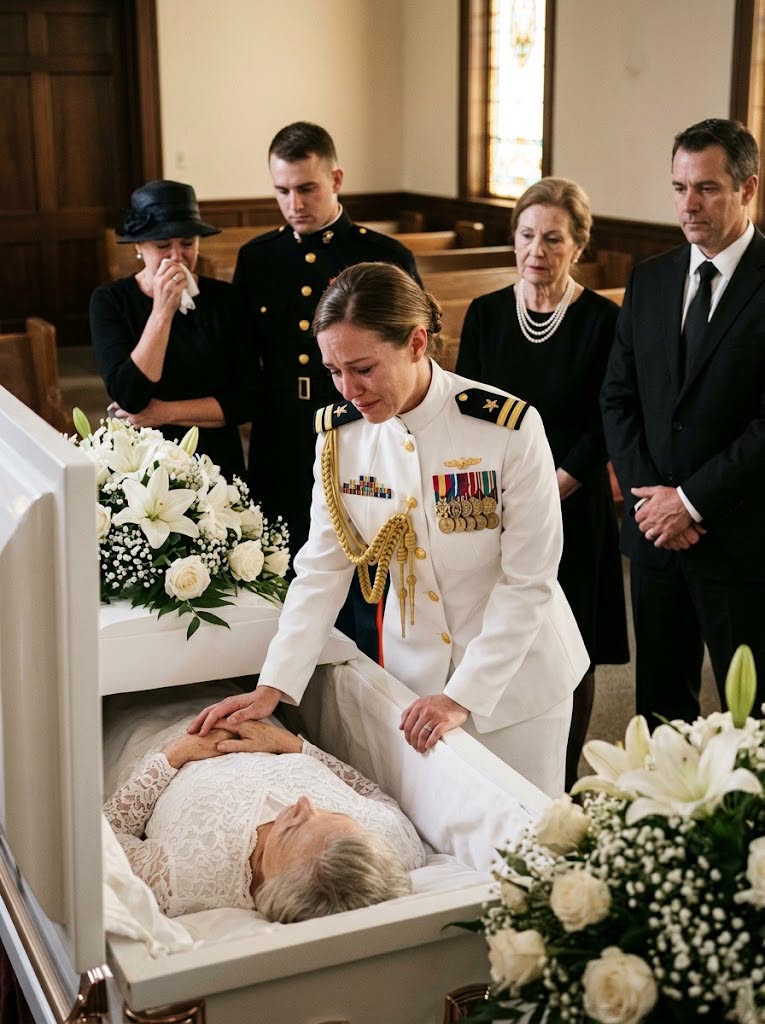
I remembered demanding to know which hospital had treated her. Maxwell gave vague answers. I remembered asking for medical records and being told I wasn’t authorized to receive anything over the phone. I remembered his mother, Beatrice, accusing me of turning Penelope’s death into another custody battle.
Most of all, I remembered being told that because of the circumstances surrounding her condition, the family wanted a closed casket.
Nothing felt right.
But grief makes you doubt your own instincts.
Then, standing alone beside that casket before the memorial began, I heard something.
At first I thought it was part of the ventilation system.
Then it came again.
A tiny sound.
“Mommy?”
I stopped breathing.
I opened the casket.
Penelope was inside.
Alive.
For several seconds, my mind couldn’t process what my eyes were seeing. She was pale and barely responsive, but when I touched her face, her eyes opened.
Her wrists had been loosely secured beneath the blanket.
I screamed for help.
Everything after that happened quickly.
Funeral-home employees called 911. Paramedics arrived. Police separated everyone who had been present, including Maxwell and Beatrice.
I rode with Penelope to the hospital.
Doctors wouldn’t speculate about what had happened until they had examined her properly. They treated her dehydration and monitored her breathing while toxicology testing and other examinations were ordered.
I sat beside her bed holding her hand.
Eventually, Penelope whispered something that terrified me.
“Daddy said I had to sleep.”
I didn’t ask her anything else.
The investigators had already warned me not to repeatedly question her. A child who might have been abused or deliberately drugged needed to be interviewed by professionals trained to avoid influencing her memory.
So I waited.
And slowly, the story I’d been told began collapsing.
There had been no hospital death.
The documents Maxwell had shown relatives weren’t what he’d represented them to be. Investigators also learned that the memorial arrangements had been made unusually quickly and largely through information supplied by Maxwell himself.
The funeral home had believed it was receiving remains that had already been appropriately handled and documented elsewhere. How Penelope had actually been placed inside the casket became one of the central questions of the investigation.
Then doctors found evidence that she’d been exposed to medication that had not been prescribed for her.
That changed everything.
Maxwell obtained an attorney.
So did Beatrice.
I learned almost nothing from them directly after that.
What I learned came gradually through my own lawyers and the investigation.
Maxwell was in severe financial trouble.
His businesses had accumulated debts I knew nothing about, and some of his lenders were already pursuing him.
Then there was Penelope’s trust.
My father had established it years earlier to pay for her education and future needs. Maxwell couldn’t simply take the money because Penelope died; independent trustees controlled it, and its terms governed what happened to the assets.
But investigators found communications suggesting Maxwell had been searching for ways to gain access to money connected to Penelope and had repeatedly asked questions about the trust, guardianship expenses and reimbursements.
My attorneys also discovered something that hurt almost as much as the hospital room.
For years, Maxwell had portrayed me in our custody disputes as an absent mother whose demanding career made me unreliable.
I had spent three years wondering whether I’d somehow failed Penelope.
Now investigators were reviewing whether some of the information used against me had been exaggerated or manipulated.
Still, none of that answered the question that haunted me.
How could a father put his own child inside a casket?
The criminal investigation took months.
There was no single recording in which everyone conveniently explained the entire scheme.
Instead, detectives built the case from ordinary pieces.
Phone records.
Financial documents.
Prescription records.
Security footage.
Messages.
Statements from people who had interacted with Maxwell in the days before the memorial.
Medical evidence from Penelope.
Some evidence supported allegations against Beatrice as well. Other suspicions couldn’t be proved.
Prosecutors ultimately charged the people they believed the evidence justified charging.
I stopped needing every horrifying rumor to be true.
What had happened to Penelope was enough.
She spent days in the hospital before doctors were comfortable releasing her.
The physical recovery came faster than the emotional one.
For weeks, she wouldn’t sleep with her bedroom door closed.
She hated darkness.
If I left the room unexpectedly, she panicked.
So we started small.
A night-light.
An open door.
A chair beside her bed.
Therapy with someone experienced in childhood trauma.
No promises that she’d “forget all about it.”
No pressure to be brave.
Just safety repeated often enough that eventually her body might begin believing it.
My father blamed himself because he’d created the trust.
“You were trying to give her a future,” I told him. “You didn’t cause this.”
We nevertheless reviewed everything with independent attorneys and trustees. Any financial structure involving Penelope would have safeguards that didn’t depend on one parent controlling access.
The custody proceedings were handled separately from the criminal case.
Once Penelope was safe with me under temporary orders, the family court reviewed what had happened and what arrangements were appropriate going forward.
I didn’t ask the court for revenge.
I asked for safety.
Months later, I arrived at one of Penelope’s therapy appointments and found her sitting at a little table with crayons scattered around her.
“Look, Mommy.”
She held up a drawing.
There were two figures holding hands beneath an enormous yellow sun.
One was tall.
One was tiny.
Behind them she’d drawn a black square.
In front of them was nothing except grass, flowers and blue sky.
“Who’s that?” I asked, pointing to the two figures even though I already knew.
“Us.”
“And where are we going?”
Penelope considered the question.
“Outside.”
I had spent months surrounded by lawyers, doctors, investigators and court documents. I had wanted answers to questions no mother should ever have to ask.
But looking at that drawing, I understood what mattered most now.
Penelope didn’t need to become the child who exposed a criminal conspiracy.
She didn’t need to be brave enough to confront the people who had frightened her.
She was six.
Her job was to draw pictures, complain about vegetables, learn to read and eventually sleep without wondering whether somebody would lock the door.
My job was simpler.
Believe her.
Protect her.
And make sure that whatever happened in the courts, she never again had to earn the right to feel safe.
I took her drawing home and put it on the refrigerator.
Two people walking toward the sun.
For Penelope, that was enough of an ending.
For me, it was the beginning.