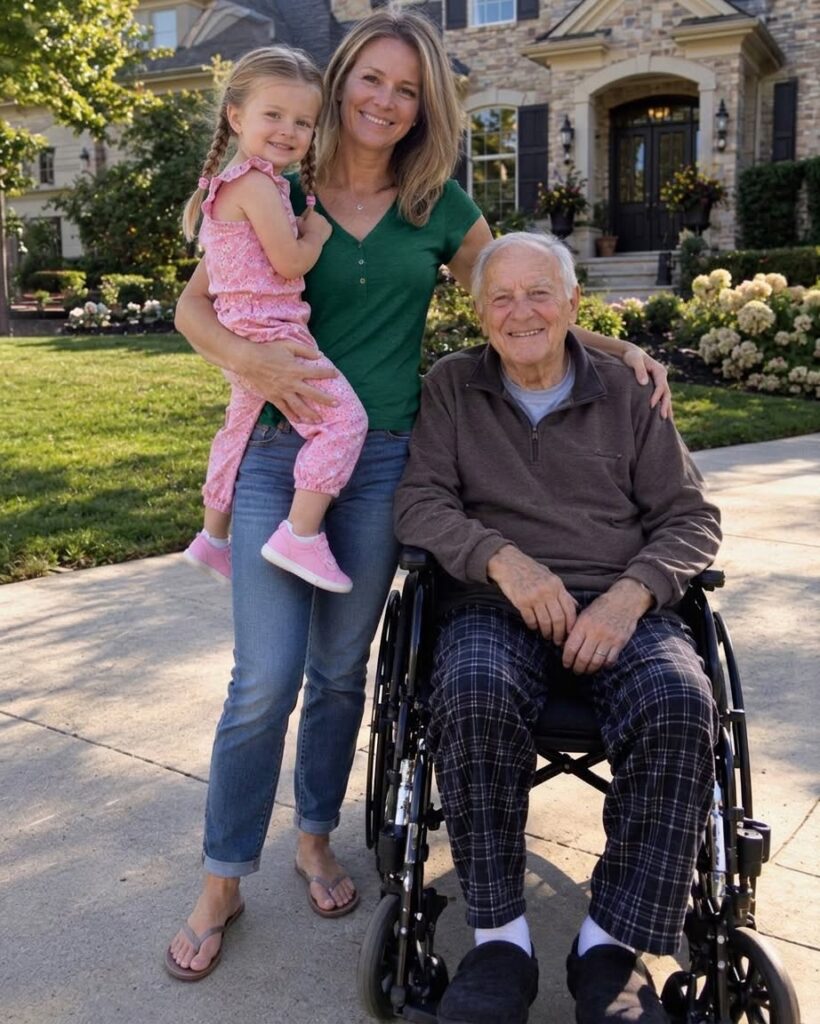
For five years, I’d been Richard’s wife.
I’d cared for him as his health failed.
I’d pushed his wheelchair through the garden.
I’d brought him coffee every morning.
I’d held his hand when he died.
And now his lawyer was telling me that the enormous estate where my daughter and I had built our lives belonged to someone else.
Then he pushed a thick envelope across the table.
Richard’s handwriting was on the front.
NORA.
“There is something he left specifically for you.”
“What?”
The lawyer’s expression softened.
“The truth.”
I didn’t understand.
Not until I opened the envelope and a thirty-year-old photograph fell into my lap.
Richard was in it.
Much younger.
Standing outside a children’s shelter.
And in his arms was a terrified five-year-old girl.
Me.
I stopped breathing.
But to understand why that photograph changed everything, you have to understand why I married Richard in the first place.
And it wasn’t because I was in love with him.
It was because I was terrified my daughter and I were about to become homeless.
My life had always seemed shaped by bad luck.
I grew up in foster care.
I don’t remember my biological parents well enough to miss specific things about them.
What I remember is moving.
Trash bags filled with clothes.
Unfamiliar bedrooms.
Adults telling me I’d be safe somewhere and then, months later, sending me somewhere else.
Eventually, I stopped unpacking completely.
Why bother?
Nothing stayed mine for long.
Between placements, I sometimes ended up in shelters.
I hated them.
The noise.
The unfamiliar beds.
The feeling that your entire existence had been temporarily placed somewhere until another adult decided what to do with you.
At one of those shelters, I met Tom.
We were children.
Tom had been in the system almost as long as I had.
But somehow, he hadn’t become bitter.
He made jokes about everything.
The terrible food.
The squeaky beds.
The adults who used words like “transition” when they really meant, “You’re moving again.”
He called me Stray.
I hated it.
“You’re like a stray kitten,” he’d say.
“Stop calling me that.”
“You keep following me.”
“Because you’re stealing my crackers.”
He’d grin.
“Maybe that’s why I like you.”
Years passed.
Placements changed.
Somehow, Tom and I kept finding each other.
When we both aged out of foster care, we stayed in touch.
Eventually, he asked me on a real date.
Three months later, we were married.
People told us we were rushing.
Maybe we were.
But when you’ve spent your entire childhood being told nothing is permanent, finding one person who wants to stay feels different.
We didn’t have money.
Tom worked as a mechanic.
I worked in a store.
Our apartment was small enough that you could hear the refrigerator from the bedroom.
The couch came from a thrift shop.
Half our plates didn’t match.
We didn’t care.
We had a home.
Our home.
Then Emily was born.
The first night we brought her home, Tom barely slept.
Every time Emily made a noise, he leaned over her crib.
“Is she breathing?”
“Yes.”
Five minutes later:
“Still breathing?”
“Yes, Tom.”
“Just checking.”
I watched him hold her against his chest.
And for the first time in my life, I understood what family was supposed to feel like.
One morning, I looked across the kitchen at him.
He was holding Emily while trying to make toast one-handed.
“This feels like a dream.”
Tom smiled.
“That’s because I’m extremely handsome.”
“Obviously.”
Then I became serious.
“One wrong move and I’m going to wake up without you.”
His smile disappeared.
“Hey.”
He reached across the table.
“You’re stuck with me.”
A month later, we were sitting in a doctor’s office.
The doctor adjusted his glasses.
“Your husband has cancer.”
The room went completely still.
Tom squeezed my hand.
“How bad?”
The doctor’s hesitation answered before his words did.
“It’s aggressive.”
I looked at Tom.
He looked at me.
And I made a promise.
“We’re fighting.”
Tom nodded.
“Together.”
And we did.
We fought with everything we had.
Doctors.
Specialists.
Medication.
Travel.
Procedures.
Eventually, an experimental treatment with terrible odds.
Every time someone gave us a number, I ignored the part telling me how unlikely survival was and focused on the tiny percentage saying it was still possible.
That tiny percentage became my religion.
Our savings disappeared.
Then our emergency fund.
Then the credit cards filled.
Then came loans.
I didn’t care.
Money could be replaced.
Tom couldn’t.
At night, after he fell asleep, I’d go into the bathroom and cry into a towel so he wouldn’t hear me.
By morning, I was cheerful again.
“We’ve got this.”
Tom always knew I was lying.
He never called me on it.
One year after his diagnosis, I sat beside him as his breathing slowed.
He was barely conscious.
I held his hand.
“You can rest.”
His eyes opened.
For just a moment, he smiled.
Then Tom was gone.
I was thirty years old.
Emily was still little.
And suddenly, I was exactly what I’d spent my entire life fearing I’d become.
Alone.
After the funeral, I sat at our kitchen table surrounded by bills.
Emily played on the floor beside me.
Hospital.
Credit card.
Rent.
Electricity.
Medication.
Loan.
Another hospital bill.
I added the numbers three times because I kept believing I’d made a mistake.
I hadn’t.
Without Tom’s income, I couldn’t afford rent, daycare and the debt.
Something had to change.
Fast.
I began applying for jobs.
That’s when I found the advertisement.
HOUSEKEEPER WANTED.
Private estate.
Full-time.
Excellent salary.
The owner was a wealthy elderly man named Richard Whitmore.
I’d heard the name.
Most people in town had.
Richard had made his fortune decades earlier and lived in an enormous estate outside town.
I didn’t understand why someone living in a house that size needed only one housekeeper.
But desperation doesn’t ask many questions.
I applied.
A few days later, Emily and I arrived for the interview.
Richard was waiting in his study.
He was elegant.
Silver hair.
Tailored suit.
Expensive shoes.
But when he saw Emily, his expression softened immediately.
“You must be Nora.”
“Yes.”
“And who’s this young lady?”
“Emily.”
I hesitated.
“My daughter. I’m sorry I brought her. I couldn’t afford daycare.”
Richard crouched slightly.
“Emily.”
She hid behind my leg.
“Excellent judgment,” he said. “I wouldn’t trust me either.”
I almost smiled.
Then he straightened.
“If you accept the position, I’ll arrange childcare.”
I stared at him.
“You don’t need to do that.”
“I know.”
Something about the answer bothered me.
People didn’t do things for me simply because they could.
Not in my experience.
We began the interview.
Then Richard asked about my background.
I mentioned foster care.
“An orphan?”
“Basically.”
“Where were you placed?”
I shrugged.
“Too many places to remember.”
“Your first placement?”
“There was a shelter here in town.”
I told him the name.
Richard froze.
Only for a second.
But I noticed.
“What?”
“Nothing.”
He studied my face.
Then looked away.
“Forgive me. You seemed familiar.”
“Have we met?”
“I don’t think so.”
He changed the subject.
I accepted the job.
And almost immediately, Richard began doing things I didn’t understand.
My position was much easier than the advertisement suggested.
A company handled major cleaning.
I organized errands, supervised contractors and kept track of maintenance around the estate.
Richard hired a nanny named Ruth for Emily.
But Ruth often joked that she wasn’t sure why she was there.
Because Richard adored my daughter.
I’d walk into a room and find one of the wealthiest men in the county crawling across the carpet while Emily rode on his back.
“What’s happening?”
Emily would yell:
“Grandpa lion!”
Richard would roar.
“Help me, Nora. I’ve been captured.”
Other days, he’d sit at Emily’s plastic tea table with pink ribbons clipped into his gray hair.
I once took a picture.
“If that photograph ever leaves this house,” he warned, “you’re fired.”
“You look beautiful.”
“Immediately fired.”
For the first time since Tom died, I laughed without feeling guilty afterward.
Richard was strange.
Generous.
Lonely.
And kind.
Every morning he asked:
“How are you, Nora?”
“Fine.”
“Do you need anything?”
“No.”
He never believed me.
But he didn’t push.
Then one afternoon, my landlord called.
I stepped into the pantry.
“I’ve given you enough time.”
My heart sank.
“Please.”
“You’re behind again.”
“I have a steady job now.”
“You said that last month.”
“Most of my first checks went toward medical debt.”
“Nora—”
“I can pay part now.”
I lowered my voice.
“My husband died. I have a little girl. Please. Just give me another month.”
The landlord sighed.
“You have thirty days.”
“What?”
“After that, I’m changing the locks.”
The call ended.
I pressed the phone against my chest.
Thirty days.
I knew exactly what homelessness felt like.
I knew the smell of shelters.
The plastic mattresses.
The bags containing everything you owned.
I would not let Emily grow up that way.
Then I heard a floorboard creak.
I turned.
Nobody was there.
I wiped my face and returned to work.
Several weeks later, I arrived at Richard’s estate and immediately knew something was different.
Flowers filled the entrance hall.
Candles had been lit.
Soft music played.
I found Richard in his study wearing a dark suit.
“Are people coming?”
“Not exactly.”
He looked nervous.
I’d never seen Richard nervous.
“Nora, sit down.”
“What happened?”
“Nothing.”
He took my hand.
Then the seventy-two-year-old man slowly lowered himself onto one knee.
My mouth fell open.
“Richard?”
“I know.”
He laughed nervously.
“This looked easier in my head.”
“What are you doing?”
“Asking you something I should probably be too old and sensible to ask.”
Then his expression became serious.
“Nora, marry me.”
I couldn’t speak.
“I care about you.”
He glanced toward the hallway, where Emily was laughing with Ruth.
“And that little girl has somehow turned my house upside down.”
“Richard…”
“I know I’m much older.”
“Thirty-seven years.”
“Thank you for doing the arithmetic.”
“This is insane.”
“Possibly.”
He smiled.
“But I’m asking anyway.”
I didn’t answer that day.
I went home.
I looked at the eviction notice.
Then at Emily sleeping.
Richard was seventy-two.
I was thirty-five.
Was I in love with him?
Not the way I’d loved Tom.
I knew that.
But Richard could give Emily everything I’d never had.
A stable home.
Good schools.
Food.
Safety.
A childhood where she never had to wonder where she’d sleep next month.
Two days later, I gave Richard my answer.
“Yes.”
He didn’t cheer.
Didn’t celebrate.
He simply closed his eyes.
For a moment, he looked relieved.
Then he slipped the ring onto my finger.
“Thank you.”
I didn’t understand why those words sounded so emotional.
For the next five years, I waited for the price of my decision.
It never came.
Richard never pressured me into sharing his bedroom.
He never demanded affection.
He never asked Emily to call him Dad.
He simply gave us a home.
More importantly, he gave us himself.
He taught Emily chess.
“Think before you move.”
“But that’s boring.”
“Most good decisions are.”
He attended school events.
Helped with homework.
Read bedtime stories.
When Emily developed a high fever one winter, I woke at three in the morning and found Richard beside her bed.
“You should’ve woken me.”
“You were exhausted.”
“You’re seventy-five.”
“And?”
“You need sleep too.”
He shrugged.
“I’ve had plenty.”
Eventually, I stopped waiting for some hidden motive.
There wasn’t one.
I loved Richard.
Not romantically.
Not the way I’d loved Tom.
It was something quieter.
He became the father I’d never had.
And sometimes, when I caught him watching me and Emily, I wondered whether we’d become the family he’d never had.
By our fifth year of marriage, Richard’s health was failing.
I brought him coffee every morning.
When his legs became too weak, I pushed his wheelchair into the garden.
We talked about Emily.
Flowers.
Books.
Anything except death.
One morning, Richard took my hand.
“You’re going to be all right.”
“Don’t.”
“You will.”
“Richard.”
He squeezed my fingers.
“You’ve always been stronger than you think.”
A few weeks later, he died.
I cried beside his bed.
Losing him didn’t feel like losing a wealthy husband.
It felt like becoming an orphan again.
After the funeral, practical reality returned.
Emily and I lived in Richard’s house.
I was his legal wife.
Naturally, I assumed the estate would pass to me.
The following afternoon, Richard’s attorney arrived.
He placed his leather briefcase on the table.
“Nora, there’s something we need to discuss.”
I sat.
He removed several documents.
Then he said:
“Richard’s estate does not pass to you.”
I stared at him.
“What?”
“The house, land and principal assets were committed to charitable purposes years before your marriage.”
My heart began pounding.
“So Emily and I have to leave?”
“Eventually, yes.”
I couldn’t breathe.
The old panic returned instantly.
No home.
No security.
No place that was mine.
Had I been stupid?
Had Richard known exactly what I’d feared and let me believe something that wasn’t true?
Then the lawyer pushed an envelope toward me.
“He knew this conversation would frighten you.”
I looked at Richard’s handwriting.
“He also knew you’d probably misunderstand what he did.”
“What did he do?”
The attorney leaned back.
“You never really knew who Richard was.”
My hands trembled as I opened the envelope.
A photograph slipped onto the table.
It was faded.
Richard was probably in his forties.
He stood outside a building surrounded by adults and children.
I recognized the building.
The shelter.
My first shelter.
Then I saw the little girl in Richard’s arms.
Tangled brown hair.
Oversized sweater.
Terrified eyes.
I touched the photograph.
“No.”
The lawyer said nothing.
“That isn’t…”
My voice disappeared.
It was me.
Five years old.
Richard had held me thirty years before I walked into his study asking for a job.
Beneath the photograph was a letter.
My dear Nora,
If you’re reading this, I’m gone.
And you’re probably angry.
Fair enough.
But before you decide I’ve played one final cruel trick on you, let me explain.
My estate was promised long before you returned to my life.
Returned.
I read that word again.
Richard explained that decades earlier, he’d funded renovations at the shelter where I’d briefly lived.
He’d visited when the work was completed.
Someone had taken a photograph that day.
Richard holding one frightened little girl.
Me.
He hadn’t known my full name.
Hadn’t known where foster services eventually sent me.
I’d simply become one child among many he’d encountered through years of charitable work.
Until my interview.
When I mentioned the shelter, something clicked.
My face.
My eyes.
My name.
Richard went searching through old records and photographs.
And he found me.
The little girl he’d held.
I kept reading.
I should have told you.
But then I overheard your telephone conversation with your landlord.
You were terrified.
Not for yourself.
For Emily.
And I realized that underneath everything you’d survived, part of that frightened five-year-old girl was still waiting for someone to tell her she could stay.
I covered my mouth.
Tears dropped onto the page.
Richard had heard the landlord call.
The floorboard.
I’d thought nobody was there.
He had been.
Then came the sentence that changed the meaning of his proposal.
You would never have accepted money from me.
You would have thanked me, packed your bags and tried to survive alone.
So I offered something I hoped you might accept.
Family.
I started crying.
Richard continued.
You may wonder whether I truly loved you.
I did.
Just not in the way you probably thought a husband was supposed to love his wife.
By then, I could barely see.
You became the daughter I never had.
Emily became the granddaughter I never expected.
And if I had told you that before asking you to marry me, I knew your pride would have sent you running.
I laughed through my tears.
He was right.
Then Richard explained the estate.
The mansion wasn’t mine.
He’d never intended it to be.
After his death, it would be transformed into a residential and educational home for children connected to the same foster and shelter system that had once cared for me.
The house where Emily had learned chess would become a home for children who had never known permanence.
I wasn’t angry anymore.
Then I reached the final page.
There is, however, something my lawyer hasn’t told you yet.
Years before meeting you again, I established a separate family trust.
I never married.
I never had children.
For decades, the fund remained untouched.
Until you.
I stopped.
The lawyer quietly slid another document toward me.
I looked at the number.
Then looked again.
“What is this?”
“The trust.”
“All of it?”
“Yours and Emily’s.”
The amount was more money than I could understand.
Enough to buy a home.
Pay every remaining debt.
Send Emily to college.
Enough that neither of us would ever again have to wonder where we’d sleep.
I returned to Richard’s letter.
Everything in that trust now belongs to you and Emily.
Buy a home.
Not a mansion unless you truly want one.
Buy something warm.
Something with a garden.
Give Emily her own room.
And Nora, please unpack your boxes.
That sentence destroyed me.
Please unpack your boxes.
Richard had understood.
As a foster child, I’d spent years keeping part of myself ready to leave.
Even as an adult, I never completely stopped.
Then came his final words.
You may believe I rescued you twice.
Once as a frightened child and once as a frightened mother.
You are wrong.
Holding a scared little girl for a photograph thirty years ago did not save her.
And giving you money now does not make me your savior.
You and Emily gave an old man something his money never managed to buy.
You made my house noisy.
You put toys in rooms that had been silent for decades.
You laughed at my terrible jokes.
Emily put ribbons in my hair.
You argued with me.
You worried about me.
You stayed.
You gave me a family.
Thank you for letting me be yours.
Love,
Richard
I pressed the letter against my chest and cried until I couldn’t anymore.
Months later, Emily and I moved.
Not far.
I bought a modest house with a garden.
Emily chose a bedroom with a window overlooking the backyard.
On moving day, I stood in my new bedroom surrounded by cardboard boxes.
For several minutes, I simply stared at them.
Then I remembered Richard’s words.
Please unpack your boxes.
So I did.
Every one.
The following year, Richard’s old estate reopened.
The polished mansion I’d once been terrified to touch had been transformed.
Bedrooms.
Classrooms.
Counseling rooms.
A library.
A huge playroom.
And gardens where children could run.
Near the entrance was a small plaque honoring Richard.
Emily held my hand while we read it.
Then she noticed another photograph displayed inside.
The old shelter picture.
Richard.
And the five-year-old girl in his arms.
“Mom?”
“Yes?”
“That’s you?”
I nodded.
She studied it.
“Did Grandpa Richard know you when you were little?”
“For one day.”
Emily thought about that.
“Then he found you again.”
I looked at the photograph.
“I suppose we found each other.”
Outside, children were running across the lawn of the house where I’d once worked.
Richard had given his mansion to children who needed somewhere safe.
And to the frightened little girl he’d held thirty years earlier, he’d given something even more important.
Not wealth.
Not rescue.
Permission to finally believe that home didn’t have to disappear.
I’d spent most of my life feeling like the stray kitten Tom used to tease me about.
Passed from place to place.
Always expecting the next goodbye.
Tom had been the first person who taught me what it felt like to be chosen.
Richard taught me something different.
Sometimes family doesn’t arrive in the form you expect.
Sometimes it finds you decades apart.
Sometimes it looks like a husband.
Sometimes it looks like an elderly boss drinking imaginary tea while your daughter puts pink ribbons in his hair.
And sometimes the person you believe you’re marrying for security has been quietly trying to give you something money alone never could.
A reason to finally unpack your boxes.
And stay.