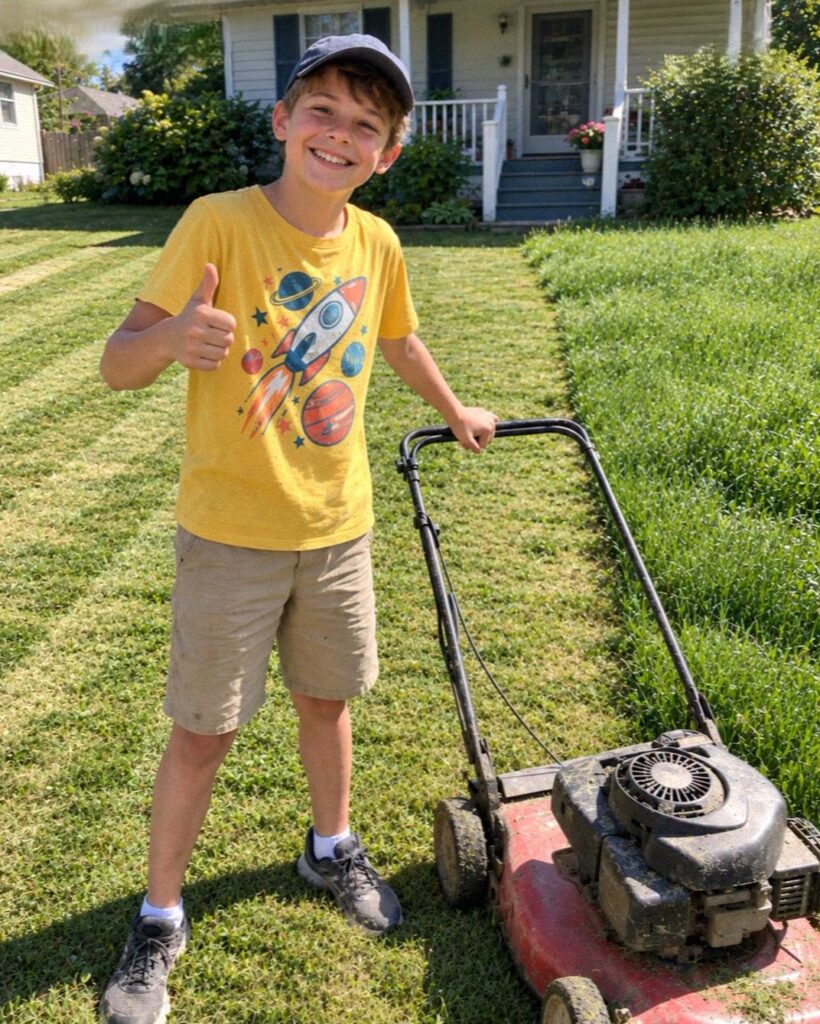
My stomach dropped.
Because he was.
And until that moment, I’d been incredibly proud of him for it.
Justin isn’t one of those children parents describe as perfect while everyone else quietly rolls their eyes.
He’s twelve.
He forgets homework.
He leaves wet towels on his bedroom floor.
He somehow believes an empty cereal box belongs back in the pantry.
He can spend twenty minutes looking for something that’s directly in front of him.
But Justin has always had a good heart.
That summer, I discovered just how good.
A few days after school ended, I looked through the kitchen window and saw him pushing our old lawn mower down the sidewalk.
“Justin!”
He stopped.
“Where are you going?”
“Mrs. Hall’s.”
“With our lawn mower?”
He looked at the mower.
Then at me.
Apparently, he found that question ridiculous.
“She needs help.”
Mrs. Hall lived four houses away.
She was seventy-eight and stubborn enough to regard aging as a personal insult.
Justin had apparently seen her struggling to mow her lawn in nearly ninety-degree heat.
So he’d offered.
When he returned an hour later, his shirt was soaked with sweat.
“She tried to pay me twenty bucks.”
“Did you take it?”
His expression was almost offended.
“Mom.”
That was the entire answer.
The next morning, Justin appeared at breakfast with a question.
“Do you think there are other old people around here who need their lawns done?”
I shrugged.
“Probably.”
He nodded as though I’d just confirmed something extremely important.
And that was how my son’s summer project began.
Two or three times a week, Justin pushed our ancient mower through the neighborhood looking for people who could use some help.
I gave him rules.
His phone stayed charged.
He told me where he was going.
He didn’t enter strangers’ houses.
And if anything made him uncomfortable, he came home.
Justin agreed.
Mostly.
Within a few weeks, people knew him.
“The lawn kid.”
Mrs. Hall told Mrs. Patterson.
Mrs. Patterson told Mr. Lewis.
Soon Justin had his own little route.
Most people tried to pay him.
Sometimes he’d accept lemonade.
Occasionally cookies.
Money?
Almost never.
I was ridiculously proud of him.
What I didn’t understand was that somewhere along the way, mowing lawns had become something more.
And Justin hadn’t told me.
Toward the end of August, with school only days away, he came downstairs one Thursday morning wearing his work clothes.
“One last yard.”
“Whose?”
“Dorothy’s.”
I vaguely recognized the name.
“Where does Dorothy live?”
“The blue house near the end of Hawthorne.”
“Be home by lunch.”
Justin gave me a dramatic salute.
“Yes, Commander.”
He came home about an hour later.
Nothing seemed unusual.
He showered.
Made two grilled cheese sandwiches.
Complained that I’d burned the bread even though he’d made them himself.
Then I forced him to organize his school supplies.
It was painfully ordinary.
Until two police cars stopped outside.
I looked through the window.
My stomach dropped so hard I grabbed the counter.
“Justin.”
He looked up from his notebooks.
“What?”
“Stay here.”
Naturally, he followed me.
Two officers were already walking toward the front door.
I opened it before they knocked.
“Can I help you?”
The older officer looked past me.
“Ma’am, is your son the boy who’s been mowing lawns around this neighborhood?”
Every horrible possibility entered my mind at once.
Had someone accused him of stealing?
Had he broken something?
Gone somewhere he shouldn’t?
Justin stepped beside me.
“That’s me.”
The officer looked at him.
“What’s your name?”
“Justin.”
“Have you been visiting a small blue house near the end of Hawthorne Street?”
Justin’s expression changed.
“Dorothy’s?”
The officers exchanged a glance.
“Yes.”
My hands started shaking.
“What’s happened?”
The younger officer addressed Justin.
“How well do you know Dorothy?”
“I mow her yard.”
“Anything else?”
Justin hesitated.
And that hesitation scared me more than the police cars.
“What else, Justin?”
He looked at me.
“Just little stuff.”
“What little stuff?”
The older officer pulled out his phone.
“We found these inside Dorothy’s kitchen.”
He showed me several photographs.
They were pictures of handwritten notes taped around the room.
JUSTIN COMES TUESDAY.
ASK JUSTIN ABOUT THE MAILBOX.
JUSTIN KNOWS WHERE THE GARDEN KEY IS.
I stared at the screen.
Then at my son.
“Justin?”
He shifted his weight.
“She forgets stuff sometimes.”
My stomach tightened.
“You knew?”
“I didn’t know knew.”
“What does that even mean?”
The officer lowered his phone.
“Dorothy was found several blocks from home this morning.”
Justin’s entire face changed.
“What?”
“She was confused. She couldn’t tell us where she lived.”
“Is she okay?”
“She’s safe.”
Justin immediately relaxed.
I didn’t.
A woman my son had been quietly helping all summer had wandered away from home.
And somehow my twelve-year-old’s name was taped all over her kitchen.
“What exactly have you been doing over there?”
Justin sighed.
“The first time I went, she didn’t answer the door.”
“So you left?”
“No. I mowed the front.”
Of course he did.
“The next week she answered.”
“And?”
“She asked me to do the backyard.”
“Okay.”
“Then she needed the trash can brought back.”
He started counting on his fingers.
“And sometimes groceries got left on the porch, so I’d move them closer to the door.”
“What else?”
“Move flowerpots. Get the mail if she forgot. Change the batteries in her lantern.”
“You went inside?”
“Not really.”
My voice sharpened.
“Justin.”
“Sometimes the kitchen.”
I closed my eyes.
“Why didn’t you tell me?”
He genuinely looked confused.
“Because nothing happened.”
That wasn’t comforting.
The younger officer intervened.
“We’re not saying Justin did anything wrong.”
“Then why are you here?”
“We’re trying to locate Dorothy’s family.”
He looked at Justin.
“And your son may know something that helps.”
Justin was already reaching for his shoes.
“Then let’s go.”
I stared at him.
“You are twelve.”
“And Dorothy’s lost.”
That was the whole argument as far as Justin was concerned.
Twenty minutes later, I was standing inside Dorothy’s kitchen.
Once I knew to look, I saw the notes everywhere.
TAKE PILLS WITH BREAKFAST.
TRASH WEDNESDAY.
CAROLINE PHONE NUMBER BESIDE PHONE.
FEED BIRDS.
JUSTIN TUESDAY.
Justin moved around the kitchen carefully.
“Birdseed is in there.”
He pointed toward a cabinet.
“She feeds them every morning.”
The officer turned.
“How do you know?”
“Dorothy told me.”
Justin looked toward the wall phone.
“Caroline’s her niece.”
“You know Caroline?”
“No.”
“Then how do you know that?”
“Dorothy told me.”
He crossed toward the counter.
“Her important papers are in a green folder.”
I stared at him.
“Justin.”
“What?”
“How do you know where Dorothy keeps her important papers?”
“She couldn’t reach them once.”
Something inside me shifted.
Until that moment, I’d pictured Dorothy as one more elderly neighbor on Justin’s lawn route.
Now I understood that their lives had begun overlapping in small, ordinary ways.
He knew where she kept birdseed.
He knew which day her trash went out.
He knew where the garden key belonged.
He knew which plant she didn’t want him mowing near.
And apparently, Dorothy had begun using my son as part of the system that helped her remember her own life.
The officers found Caroline’s phone number.
She answered on the third ring.
When she arrived, she came through the front door crying.
“Where is she?”
The officer explained that Dorothy was physically safe and had been taken for evaluation.
Then Caroline saw Justin.
She stopped.
“You’re Justin?”
He nodded.
“Yeah.”
Something uncomfortable crossed her face.
“You’re twelve.”
“Also yeah.”
She looked at me.
“Why was a twelve-year-old managing my aunt’s house?”
My spine stiffened.
“He wasn’t.”
“There are notes everywhere with his name.”
“I didn’t know about them.”
Caroline stared at me.
“You didn’t know?”
“No.”
Before the conversation could turn into an argument, Justin interrupted.
“Dorothy didn’t want anybody to know.”
Caroline turned.
“What?”
“She didn’t like people checking on her.”
“What do you mean?”
Justin rubbed his palms against his shorts.
“She said people make a big deal out of everything.”
Caroline slowly sat down.
Justin explained that sometimes neighbors knocked and Dorothy watched through the curtains until they left.
“She thought people were trying to make her move.”
Caroline covered her face.
“Oh God.”
When she finally looked up, her eyes were red.
“She has been forgetting things.”
Nobody spoke.
“Appointments. Conversations.”
Her voice shook.
“She’d repeat questions, but whenever I mentioned it, she’d get angry.”
Justin went strangely still.
I noticed.
“What?”
He stared at the floor.
“Nothing.”
“Justin.”
He swallowed.
“One time she asked my name three times.”
Caroline looked at him.
“And she kept trying to pay me.”
“What do you mean?”
“I’d finish mowing and she’d give me money.”
“That doesn’t sound unusual.”
“No.”
Justin hesitated.
“She’d pay me. Then ten minutes later she’d try to pay me again.”
My chest tightened.
“I thought she was just being stubborn.”
Then he remembered something else.
“One time she watched m