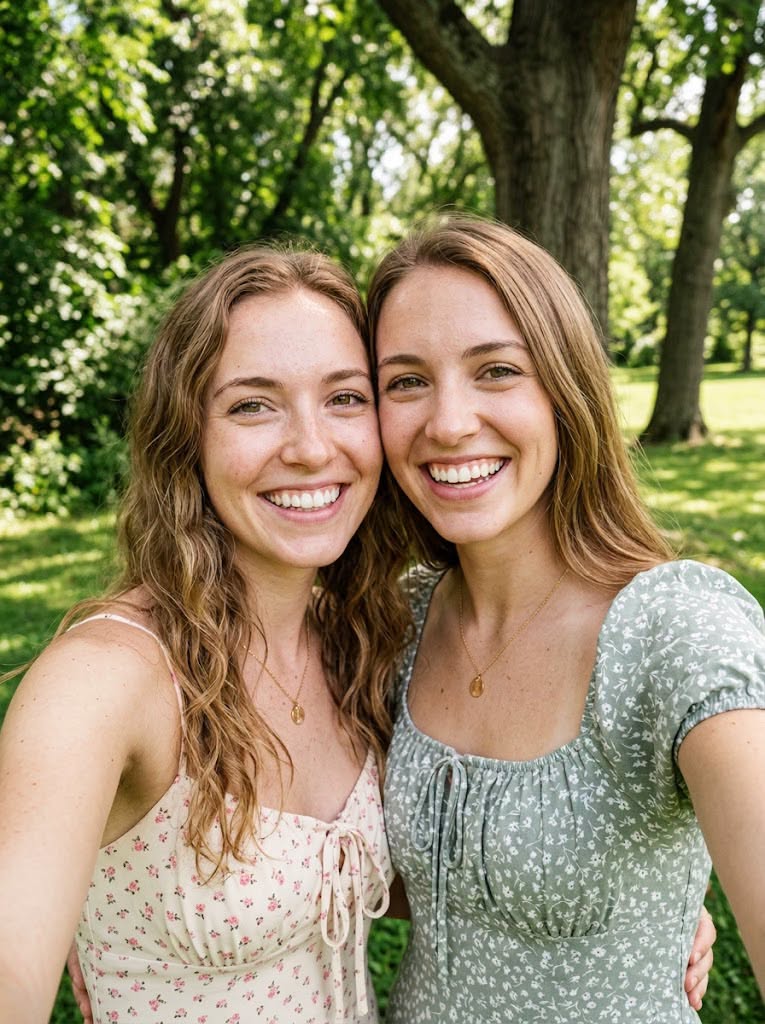
“My sister?”
“Gemma.”
I gripped the kitchen counter.
“My sister died ten years ago.”
There was a long silence on the other end.
The receptionist apologized and started checking the information, but I’d already stopped listening.
Gemma had disappeared after a highway accident near Rochester when we were twenty-two. Her badly damaged car was recovered after leaving the road during a storm, but she wasn’t found with it. Searches continued for weeks before investigators concluded she’d most likely died somewhere beyond the immediate crash site.
Eventually, my family held a funeral without a body.
I spent the rest of my twenties learning how to exist without the person who had existed beside me since before either of us could remember.
Now someone was telling me she was sitting in a dentist’s office less than twenty minutes away.
I drove there barely conscious of the road.
When I pushed through the clinic doors, I saw a woman sitting alone in the corner.
Her hair was shorter.
There were lines around her eyes that hadn’t existed at twenty-two and a faint scar running along her jaw.
But then she looked up.
Green eyes.
My eyes.
“Elise.”
My knees nearly gave out.
I didn’t hug her.
I couldn’t.
“Prove it.”
She started crying.
I asked questions nobody could have prepared her for. What did we call the dent beside my childhood bed?
“The moon crater.”
Who broke Grandma’s porcelain vase during the blizzard?
Gemma looked down.
“I did. You helped me hide the pieces behind the furnace.”
I stared at her.
Ten years of grief collided with the impossible fact that my sister was sitting six feet away.
I should have felt only joy.
Instead, I was furious.
She had survived the crash.
In the immediate aftermath, Gemma had suffered a head injury and significant confusion. She’d been found some distance from the wreck and taken for medical treatment without identification. Because of a series of failures and incomplete information, she wasn’t immediately connected to the missing woman authorities were searching for.
That explained the beginning.
It didn’t explain ten years.
Her memory returned gradually.
Within months, she knew her name.
She knew mine.
She knew where we’d grown up.
And she still didn’t come home.
“You knew?”
We were sitting in my car when she admitted it.
“For most of it.”
I turned toward her.
“You let us bury you.”
“I didn’t know about the funeral until later.”
“That makes it better?”
“No.”
“Mom didn’t sleep properly for years. Dad drove back to Rochester every spring because he thought maybe somebody had missed something. I spent ten years thinking my twin sister died alone in the rain.”
“I know.”
“No, Gemma. You don’t get to say that.”
She didn’t argue.
Her apartment was only two towns from Minnetonka.
That almost hurt more than anything else.
She hadn’t disappeared to another country. She hadn’t been living beyond our reach.
She had built a life almost beside us.
Her apartment was warm and full of plants. Photographs covered one wall—birthdays, vacations, people I’d never met.
Ten years of my sister’s life.
I wasn’t in a single picture.
Then she admitted she’d found me online four years earlier.
“You watched me?”
“Sometimes.”
She’d seen my wedding photographs. Pictures with our parents. Vacations. Christmas dinners.
“You knew exactly where we were.”
“Yes.”
“And you still didn’t contact us.”
Gemma cried.
She told me that before the accident, she’d spent her entire life feeling as though she existed only as one half of us.
The twins.
Matching dresses.
Matching birthday cakes.
Matching activities.
Teachers confusing our names. Relatives comparing our grades, our weight, our personalities, our boyfriends.
Even when we became adults, people still introduced us as a pair.
After the accident, once Gemma began recovering, nobody around her knew she had a twin.
Nobody compared her to me.
For the first time, she said, she discovered who she was when nobody expected her to be half of something.
At first, she told herself she’d contact us when she was stronger.
Then another month passed.
Then a year.
Eventually, returning meant admitting she’d consciously allowed us to believe she was dead.
Every year made the next phone call harder.
“So you just kept watching us grieve?”
“I was afraid.”
“So were we.”
That night, I called our parents.
Gemma begged me to wait.
I refused.
She had made the decision for all of us for ten years. I wasn’t going to help her extend it.
My mother’s reaction was almost impossible to listen to.
First disbelief.
Then anger.
Then a sound I’d never heard her make before.
A few days later, our parents came to Gemma’s apartment.
Mom held her so tightly that Gemma could barely move. Dad stood several feet away crying before finally walking over and putting his arms around both of them.
For a little while, it looked like the reunion everyone imagines when a missing person comes home.
Then reality arrived.
Mom began talking about Christmas.
Our birthday.
Family photographs.
She mentioned buying matching sweaters like she used to.
Gemma suddenly stood.
“I can’t do this.”
The room went silent.
She explained what she’d told me.
She loved us. She had missed us. She knew what she’d done was terrible.
But she was terrified that coming home meant becoming “Elise and Gemma” again instead of simply Gemma.
My mother was devastated.
I was angry all over again.
But for the first time, I understood something I hadn’t understood in the car.
Gemma hadn’t stayed away because she didn’t love us.
She had stayed away because she’d confused disappearing with becoming independent.
Understanding it didn’t excuse what she’d done.
That distinction became important.
Our father eventually said it best.
“We can be grateful you’re alive and furious that you stayed away. Nobody has to choose one.”
So we didn’t.
There was no instant forgiveness.
Gemma started therapy. Eventually, I did too.
We began meeting for lunch without our parents. No matching clothes. No recreating childhood photographs. No expectation that ten missing years could be repaired by pretending they hadn’t happened.
I learned that Gemma hated olives now.
She learned that I’d stopped drinking coffee.
She worked in graphic design. She loved gardening. She’d become afraid of driving in heavy rain.
I told her about my marriage, my work and all the moments when I’d instinctively reached for my phone to tell her something before remembering she was dead.
Sometimes we laughed.
Sometimes one of us cried.
Sometimes I became angry about something she’d missed and went home early.
Gemma didn’t disappear when that happened.
That mattered.
Three weeks into our strange new relationship, we stopped at a bakery.
For most of my life, I’d bought things in pairs without thinking.
Two pastries.
Two souvenirs.
Two versions of anything I thought Gemma would have liked.
The habit had continued after her death.
I looked through the display.
“One blueberry scone,” I said.
Then I turned toward Gemma.
She smiled.
“And I’ll have the chocolate croissant.”
We sat outside in the afternoon sun with two completely different pastries between us.
For ten years, I’d believed learning to live without my twin was the hardest thing I’d ever have to do.
I was wrong.
The harder task was learning how to have her back without demanding that either of us become the girls we’d been before the accident.
Gemma didn’t need to disappear to become her own person.
And I didn’t need to lose my sister in order to become mine.
For the first time in our lives, we weren’t two halves trying to make one whole.
We were simply two women sitting across from each other.
Sisters.
Twins.
And finally, separate people.