Gabriel interpreted that exhaustion as victory.
His attorney suggested Clara’s emotional state had become increasingly unstable during pregnancy. Gabriel sat quietly while the argument was made, occasionally glancing toward Samantha.
Judge Beatrice Holloway wasn’t prepared to approve Clara’s proposed property waiver that morning. Clara was heavily pregnant, significant financial disclosures remained incomplete, and the court still had questions about what she was surrendering.
Then the hearing was interrupted.
Something had happened outside the courtroom.
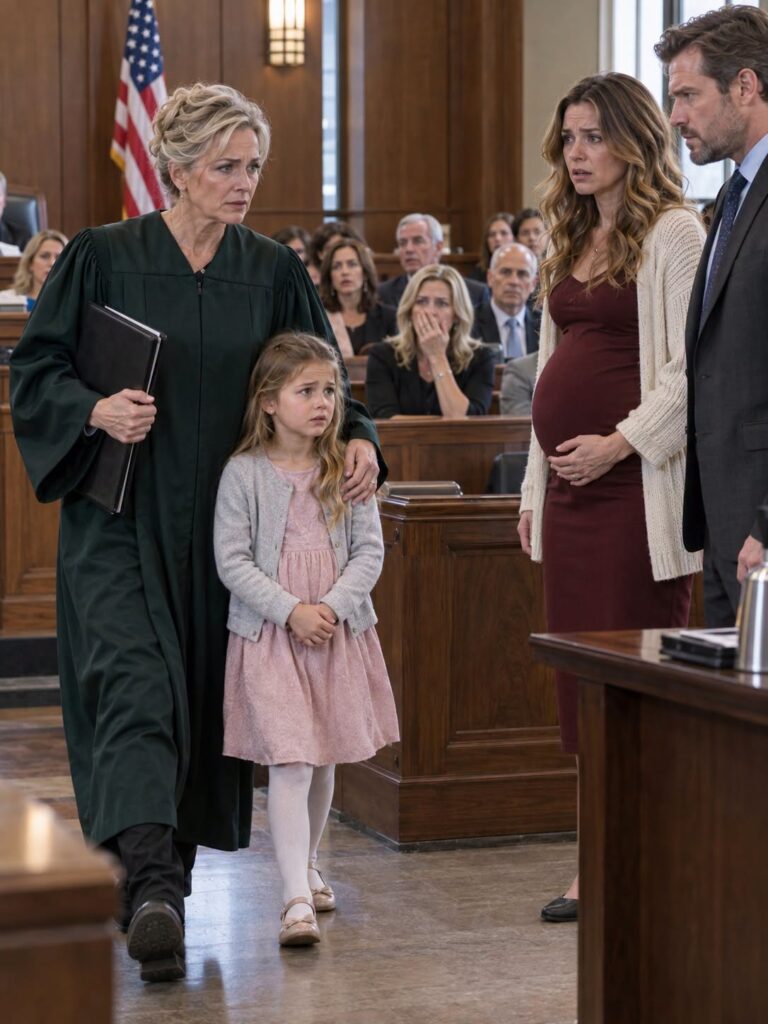
A six-year-old girl had arrived at the courthouse with Gabriel’s sister, Eleanor.
Her name was Violet.
Gabriel’s daughter.
And for most of Violet’s life, Clara had been the closest thing she’d had to a mother.
Gabriel had told Clara that Violet was staying with Eleanor while the divorce was being handled.
She wasn’t.
Eleanor had learned only that morning that Violet had actually been staying at Samantha’s apartment.
Clara left the courtroom as soon as she was permitted and found Violet sitting with a courthouse employee, clutching her faded stuffed rabbit, Barnaby.
The moment Violet saw Clara, she ran toward her.
“Why are you here?” Clara whispered.
Violet began crying.
What followed wasn’t a dramatic interrogation in front of a crowded courtroom. Once concerns were raised about Violet’s treatment, the adults stopped questioning her and contacted the appropriate authorities.
Professionals trained to speak with children handled what came next.
But Violet had brought something with her.
A damaged pink tablet.
On it were several recordings.
Nobody played them theatrically in open court. Clara’s attorney made sure the device was preserved and provided through the appropriate channels.
The recordings became important later.
They appeared to capture conversations between Gabriel and Samantha about the divorce, including discussions of money Gabriel didn’t want disclosed. There were references to moving business interests, withholding documents and making Clara believe fighting him would leave her financially ruined.
Investigators would eventually need records to determine whether those conversations reflected actual fraud.
But they gave Clara’s attorneys something they hadn’t had before.
Specific places to look.
The divorce hearing was postponed.
Clara immediately withdrew her willingness to surrender her financial claims.
Her attorneys requested complete disclosures and sought temporary orders designed to prevent disputed assets from being transferred while ownership could be determined.
Then the financial investigation began.
Accountants discovered that Gabriel had moved interests connected to one of his businesses through an entity called Crestview Enterprise. Transactions that had previously been described as business liabilities required much closer examination.
There was also a storage unit.
Samantha, realizing that Gabriel had misrepresented several things to her as well, obtained her own attorney. Through counsel, she provided messages and information about documents Gabriel had stored away from the marital home.
None of that made Samantha innocent of everything.
It simply meant her involvement had to be determined from evidence rather than Clara’s anger over the affair.
The most painful investigation concerned Violet.
According to information she provided during properly conducted interviews, she’d been frightened and isolated while staying at Samantha’s apartment. Gabriel had also prevented her from communicating freely with Clara.
Eleanor later explained how she’d found her.
Violet still had an old smartwatch that could send limited messages. She’d managed to contact her aunt, and Eleanor went to get her before bringing her to the courthouse because she knew Gabriel was there.
Clara couldn’t simply become Violet’s legal parent that afternoon.
Violet was Gabriel’s biological daughter, and decisions about her safety and custody required a separate process.
But Clara made one thing clear.
“If she needs somewhere safe, she has one.”
The following months dismantled much of what Gabriel had spent years building.
Not because a judge declared him guilty during a divorce hearing, but because records began contradicting his explanations.
Forensic accountants traced hundreds of thousands of dollars through accounts and entities that hadn’t been properly disclosed. Documents recovered during the investigation helped reconstruct transactions, while electronic records and messages provided additional context.
Some assets Gabriel had described as heavily indebted were worth considerably more than he’d represented.
Clara also discovered that documents relating to money inherited from her late mother had been withheld from her. Her attorneys pursued those assets separately and established what remained her individual property.
Gabriel denied intentionally concealing marital wealth.
Eventually, however, investigators developed evidence serious enough for prosecutors to bring charges involving financial misconduct and falsified records.
The divorce and criminal proceedings moved on separate tracks.
So did Violet’s case.
Clara gave birth to her son, Lucas, in the middle of all of it.
For several weeks, her world became very small.
Feed Lucas.
Sleep when possible.
Attend meetings with attorneys.
Make sure Violet knew none of this was her fault.
Clara had once imagined justice as a single courtroom moment when Gabriel would finally be exposed in front of everyone.
Reality was slower.
It was bank statements.
Interviews.
Hearings.
Parenting evaluations.
Financial reports.
Months of waiting.
Eventually, Gabriel’s criminal case was resolved based on the charges prosecutors could actually prove. The financial consequences were substantial, and the divorce court divided marital property using the corrected financial information rather than the incomplete picture Gabriel had originally presented.
Clara’s separate inheritance was recognized according to the documentation her attorneys recovered.
Violet’s future required even more care.
Gabriel’s legal problems did not automatically erase his parental rights. The family court considered the evidence concerning her safety separately, and Clara continued caring for Violet under arrangements approved through that process.
Much later, when Violet’s long-term legal status was finally settled, Clara was able to pursue making permanent what had already been true emotionally for years.
Violet was her daughter.
Not because Gabriel had lost everything.
Because Clara had stayed.
More than a year after the morning at the courthouse, Clara sat behind the house watching Violet draw with chalk while baby Lucas crawled determinedly after Barnaby.
Violet suddenly looked up.
“Do you remember when I came to court?”
Clara did.
She remembered being eight months pregnant and ready to surrender almost everything because she’d mistaken exhaustion for peace.
She remembered Gabriel sitting across from her, confident that she no longer had enough strength to question him.
Most of all, she remembered a frightened little girl appearing with a battered pink tablet and a stuffed rabbit.
Violet hadn’t magically solved the case.
She hadn’t sent her father to prison or handed Clara a fortune.
She had done something much more important.
She had told the truth.
And because Clara finally stopped surrendering long enough to listen, that truth had somewhere safe to land.