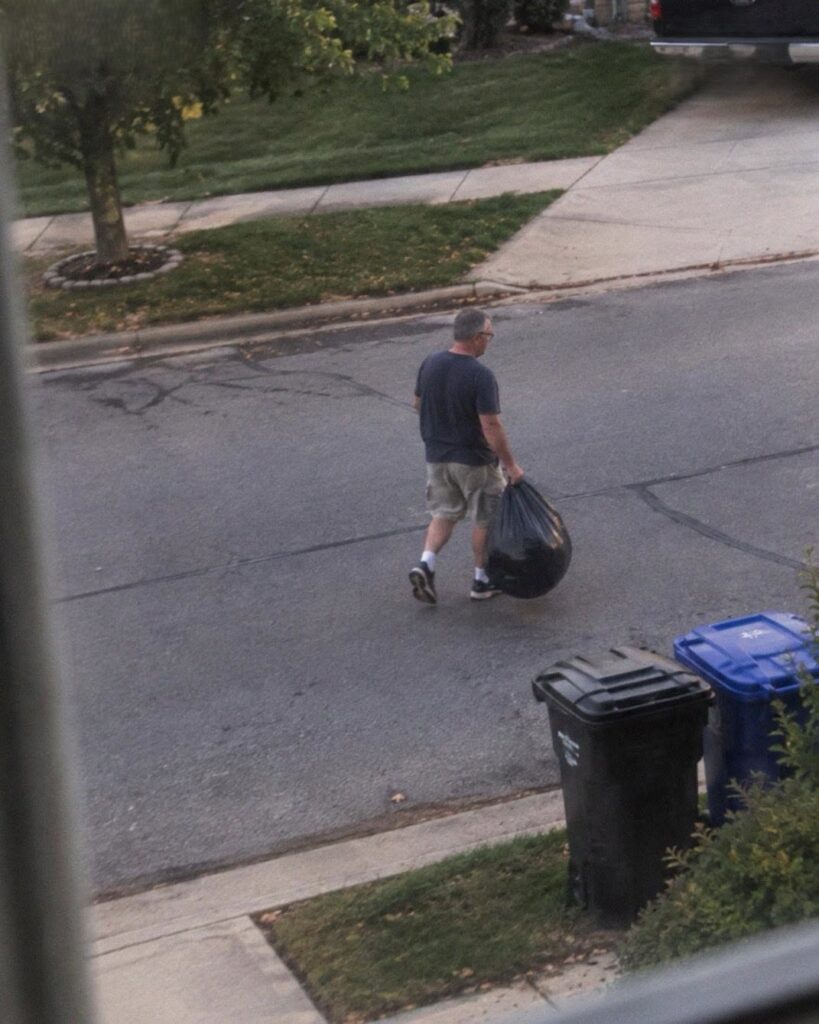
Suddenly, he was a man facing unbearable hardship.
I’d caught him balancing cereal boxes, milk cartons and empty containers on top of an overflowing kitchen trash can rather than simply taking the bag outside.
So when Robert stood up after dinner one Monday evening, tied the garbage bag and said, “I’ll take this out,” I actually laughed.
He looked at me.
“What?”
“Who are you?”
He frowned.
“What are you talking about?”
“And what have you done with my husband?”
Normally, that would’ve earned at least a smile.
Instead, Robert picked up the bag.
“I’ve got it.”
Then he walked out the back door.
I didn’t think much about it.
Until Tuesday.
At exactly 9:30 p.m., Robert stood from the couch.
“I’ll take the trash.”
I looked toward the kitchen.
“There are two banana peels and a coffee filter in there.”
“I’ll do it anyway.”
Now that was suspicious.
But I said nothing.
Robert disappeared outside.
Five minutes passed.
Then ten.
Almost fifteen minutes later, he returned.
“What took so long?”
He didn’t look at me.
“Bin lid was stuck.”
“Our bin?”
“Yes.”
“The same bin we’ve owned for seven years?”
He gave me a strange look.
“How many bins do you think we have?”
I laughed.
But something about his answer bothered me.
The next evening, I watched.
At exactly 9:30, Robert removed another half-full garbage bag from the kitchen.
I waited until the back door closed.
Then I hurried upstairs.
From our bedroom window, I could see most of the driveway.
Robert walked toward the garbage bins.
Then straight past them.
I moved closer to the glass.
He passed our garage.
Passed the hedge.
And disappeared into the narrow alley running behind our neighbors’ properties.
I stood there holding the curtain.
What was he doing?
Twelve minutes later, he returned.
Without the garbage bag.
When he came upstairs, I was sitting in bed pretending to read.
He changed his clothes.
Brushed his teeth.
Asked whether I’d remembered to call the plumber.
Normal.
Completely normal.
Except my husband had just carried our garbage into an alley.
After twenty-nine years of marriage, you learn someone’s rhythms.
You know how they clear their throat before telling you something unpleasant.
How they move around the kitchen.
Which cupboard they open without thinking.
How their face changes when they’re hiding something.
And Robert was hiding something.
Thursday night, I decided to find out what.
At 9:30, right on schedule, he stood.
“I’ll take the trash.”
“Thanks.”
He tied the bag.
I waited thirty seconds after the door closed.
Then I put on my shoes and followed him.
Robert never looked back.
He walked past our bins and continued into the alley.
I stayed far enough behind that he wouldn’t hear me.
He stopped beside an old detached garage two houses down.
Then he opened the garbage bag.
My heart started pounding.
He reached inside.
But instead of pulling out garbage, he removed a small brown paper package.
I recognized the bags.
We kept a stack of them in the upstairs hall closet.
Before I could understand what was happening, someone stepped from behind the garage.
A woman.
She had bright blue hair and a long dark coat.
Young.
Much younger than Robert.
Maybe thirty.
My stomach dropped.
Robert handed her the package.
She took it.
Then she said something that made everything worse.
“She still doesn’t know?”
Robert shook his head.
“Not yet.”
“How long are you going to keep doing this?”
“Until Saturday.”
I stepped backward.
My heel landed on an empty plastic bottle.
CRACK.
Robert spun around.
The woman froze.
For half a second, nobody moved.
Then Robert said my name.
“Diane.”
I stared at him.
Then at her.
Then at the package in her hands.
“What is going on?”
Robert took a step toward me.
“Please let me explain.”
I almost laughed.
“That’s usually what people say when they’re doing something they shouldn’t.”
“It’s not what you think.”
“That’s another one.”
The woman looked increasingly uncomfortable.
Robert lowered his voice.
“Can we please go home?”
“No.”
“Diane.”
“I followed my husband into an alley and watched him pull a secret package out of our garbage and hand it to a woman I’ve never seen before.”
Robert closed his eyes.
“And then I heard the two of you discussing how long you could keep something from me.”
I folded my arms.
“So we’re going to have this conversation right here.”
The woman suddenly looked as though she might cry.
Robert turned toward her.
She shook her head.
“No. It’s okay.”
Then she looked directly at me.
“I’m Claire’s daughter.”
Everything inside me stopped.
“What?”
“My mother was Claire.”
For a moment, I genuinely thought I’d misunderstood her.
Claire was my younger sister.
Claire had been dead for twenty-three years.
I stared at the woman.
At first, all I could see was the blue hair.
Then I started noticing everything underneath it.
The narrow chin.
The shape of her mouth.
The slight upward tilt at the corners of her eyes.
Claire’s eyes.
“Oh my God.”
The woman swallowed.
“My name is Amelia.”
I knew that name.
Of course I knew it.
The last time I’d seen Amelia, she was seven years old.
She’d been standing in her father’s driveway holding a stuffed rabbit beneath one arm.
I’d waved from my car.
She hadn’t waved back.
At the time, I assumed she was confused.
Grieving.
Her mother had just died.
I didn’t know that would be the last time I’d see her for more than two decades.
“Amelia?”
She nodded.
My knees suddenly felt weak.
I turned toward Robert.
“You found her?”
“I found her online.”
“When?”
He hesitated.
That hesitation immediately told me I wasn’t going to like the answer.
“Robert.”
“About six weeks ago.”
My shock turned into anger so quickly it frightened even me.
“Six weeks?”
“I can explain.”
“You’ve known where my sister’s daughter was for six weeks?”
Amelia stepped forward.
“Please don’t blame him for everything.”
I looked at her.
“All of what?”
Her eyes dropped toward the brown package.
I’d almost forgotten about it.
Then I recognized it properly.
One of the bags from our closet.
“What is in there?”
Amelia opened it.
She removed a photograph.
I knew it immediately.
Claire and me at the lake.
Teenagers.
She was wearing that ridiculous yellow swimsuit she loved, and I had my arm around her shoulders.
The photograph had been inside a box in my closet for years.
Amelia pulled out another.
Claire sitting on our mother’s porch.
A baby on her lap.
Amelia.
Then came an old birthday card.
A letter.
A little silver picture frame.
I looked at Robert.
“You’ve been taking these from our house?”
“One batch at a time.”
“In garbage bags?”
He looked embarrassed.
“I needed a reason to leave the house without you asking what I was carrying.”
Despite everything, I nearly laughed.
“So after twenty-nine years of avoiding the trash, you suddenly became the most enthusiastic garbage man in America?”
Amelia made a tiny laughing sound.
Then covered her mouth.
Under any other circumstances, I would’ve laughed too.
Instead, one question was pounding inside my head.
“Why?”
Neither answered.
“Why didn’t you tell me?”
Amelia looked down at the photograph of Claire.
“Because I didn’t believe him.”
“Believe what?”
“That my mother’s family wanted me.”
I stared at her.
“What?”
“My dad always told me Mom’s family didn’t want anything to do with us after she died.”
I couldn’t process the sentence.
“Your father told you that?”
She nodded.
“He said you thought I belonged with him and didn’t want to interfere.”
“That isn’t true.”
“Later, he said there had been arguments. Sometimes he said you blamed him for things.”
“Amelia.”
My voice came out sharper than I intended.
She flinched.
I immediately softened it.
“No. I’m not angry at you.”
I stepped closer.
“But none of that is true.”
She looked toward Robert.
“He told me the same thing.”
Suddenly, memories I’d buried for years came rushing back.
Phone calls.
So many unanswered phone calls.
Birthday cards I’d mailed.
Christmas presents.
A package that came back because they’d moved without leaving a forwarding address.
I remembered driving to their house months later.
Strangers answered the door.
Nobody knew where Amelia or her father had gone.
I called relatives.
Old friends.
Anyone who might know something.
Eventually, people stopped having answers.
Eventually, I stopped asking.
But I never stopped wondering.
“I thought your father wanted us gone,” I whispered.
Amelia watched me.
“I thought maybe he blamed our family for something. Or maybe seeing us reminded him too much of Claire.”
My voice broke.
“I never thought you believed I didn’t want you.”
Amelia’s eyes filled.
“I thought you forgot me.”
That sentence hurt more than anything else she’d said.
“I never forgot you.”
Her mouth trembled.
“I never forgot you, Amelia.”
Robert looked away.
I wanted to hug her.
I wanted to yell at him.
I wanted to find Claire’s husband and demand twenty-three years of answers.
Instead, I said:
“Come home with us.”
Amelia immediately stepped backward.
It wasn’t much.
Half a step.
But I saw it.
Fear.
Not exactly fear of me.
Fear of what walking into that house would mean.
“I was supposed to come Saturday.”
I turned toward Robert.
“Saturday?”
He nodded.
That was what I’d overheard.
Until Saturday.
“Why Saturday?”
Amelia hugged the package against herself.
“Because I wasn’t sure I could do this.”
She looked embarrassed.
“When Robert first contacted me, I thought it was some kind of scam.”
Robert nodded.
“She didn’t believe who I was.”
“Would you?”
“No.”
“He told me you still talked about Mom.”
“I do.”
“He said you had boxes of her things.”
I looked toward the package.
Understanding finally arrived.
“So you started bringing her proof.”
Robert nodded.
“The first night I brought photographs.”
Amelia continued.
“Then cards. Yesterday, he brought letters Mom wrote you when I was little.”
I remembered those letters.
Claire complaining about my cooking.
Claire describing how baby Amelia had learned to clap and wouldn’t stop.
Claire complaining about her husband leaving socks everywhere.
Ordinary pieces of a life that had ended far too early.
“My dad told me nobody on Mom’s side cared what happened to us.”
Amelia looked down.
“Then I read those letters.”
Her voice cracked.
“She wrote about you like you were part of everything.”
I couldn’t speak.
Robert said quietly:
“I wanted her to know the truth before she met you.”
I turned toward him.
“And you thought the best way to accomplish that was keeping me completely in the dark?”
“Amelia asked me not to tell you.”
“I understand why she asked.”
Robert went silent.
“But you knew what losing her did to me.”
“I know.”
“For years, I wondered what I’d done wrong.”
My voice was shaking now.
“I wondered whether I’d somehow failed Claire before she died.”
Robert looked down.
“I wondered whether I pushed too hard afterward.”
I pointed toward Amelia.
“And yes, I wondered whether that little girl grew up believing I’d abandoned her.”
Robert’s face tightened.
“I wanted Saturday to be perfect.”
I stared at him.
“Why would I need it to be perfect?”
He didn’t answer.
“I needed it to be true.”
That silenced him.
“And while you were planning some perfect reunion, I was lying awake wondering why my husband was sneaking into an alley every night.”
Amelia’s eyes widened.
“You didn’t tell me she was suspicious.”
Robert sighed.
“I didn’t know she was.”
“You suddenly started taking out the trash voluntarily,” I said. “Of course I was suspicious.”
For the first time, Amelia laughed properly.
I did too.
Just once.
Then she became serious again.
“I confronted my father.”
“When?”
“After Robert contacted me.”
“What did he say?”
Amelia looked toward the ground.
“He was scared.”
“Of what?”
“Losing me.”
She explained that Claire had been the center of her childhood.
When Amelia fell down, she ran to Claire.
When she had nightmares, Claire came into her room.
When she was sick, she wanted her mother.
Then Claire died.
Her father was suddenly a grieving widower raising a seven-year-old who cried for her mother every night.
“He said I kept asking when I could see you.”
I closed my eyes.
I had adored Amelia.
Before Claire died, she’d spent weekends at our house.
I’d taken her to the zoo.
Bought her ridiculous amounts of ice cream.
Let her stay up later than Claire allowed.
“He thought I’d choose you,” Amelia said.
I opened my eyes.
“Choose me?”
“Over him.”
My anger shifted.
Not disappeared.
But shifted.
“He thought if I stayed close to Mom’s family, I’d never accept she was gone.”
“That doesn’t justify what he did.”
“I know.”
“He took everyone from you because he was afraid you’d lose him.”
Amelia nodded.
“And by doing that, he made sure I lost everybody else.”
Nothing could return those twenty-three years.
I could understand his grief.
I could understand his fear.
But understanding wasn’t forgiveness.
Claire’s husband hadn’t pushed us away because we meant nothing.
He’d pushed us away because, in his frightened mind, we meant too much.
We walked back to my house together.
At the front door, Amelia stopped.
I didn’t reach for her.
Didn’t pressure her.
“You don’t have to come inside.”
She looked at me.
“But I want you to know something.”
“What?”
“You’ve always had a place here.”
Her eyes filled again.
“Even when you didn’t know it.”
After a few seconds, she stepped inside.
Robert wisely stayed downstairs.
I took Amelia upstairs.
At the top of the hall closet sat a cardboard box I’d carried through three house moves.
I placed it on the bed.
Most of Claire’s things were still inside.
Her college sweatshirt.
A recipe book stained with flour.
A scarf she’d bought on vacation because she claimed it made her look sophisticated.
Amelia picked it up.
“I’ve seen this.”
“You have?”
“There’s a picture of Mom wearing it.”
I smiled.
“She wore that thing constantly for about six months.”
Amelia laughed.
“Then what?”
“Then she announced she’d always hated it.”
Amelia laughed harder.
And for a second, Claire was in the room.
Not literally.
But in the way memories sometimes fill a space so completely that absence feels almost physical.
At the bottom of the box was a little wooden jewelry case.
I opened it.
Inside was a thin silver bracelet.
Claire had once told me she wanted Amelia to have it when she was older.
I’d never gotten the chance.
Until now.
I held it toward her.
“This was your mother’s.”
Amelia stared at it.
“You’re giving it to me?”
“I’ve been waiting twenty-three years to give it to you.”
Her face crumpled.
I moved toward her.
Then stopped.
I didn’t know whether I had the right to hug her.
Amelia answered the question for me.
She stepped forward and wrapped her arms around me.
I held her.
She cried against my shoulder.
I cried into her blue hair.
It was strange.
Painful.
Wonderful.
I was holding someone who was unquestionably my family and almost completely a stranger.
That night, we sat around the kitchen table until after midnight.
Amelia had questions.
So many questions.
“What was Mom like at sixteen?”
“Impossible.”
She laughed.
“Seriously.”
“I am serious.”
“Did she really hate mushrooms?”
“With unreasonable passion.”
“Could she sing?”
I considered it.
“Only if your definition of singing is extremely generous.”
Amelia laughed so hard she had to wipe her eyes.
And suddenly, I understood something else.
For twenty-three years, I’d carried hundreds of memories of Claire with nowhere to put them.
Now someone wanted them.
Someone needed them.
Her daughter.
Robert mostly stayed quiet.
For once, he had excellent instincts.
Eventually, Amelia returned to her hotel.
Saturday came.
There was no dramatic surprise reunion like Robert had imagined.
Amelia came anyway.
This time, she knocked on the front door.
And this time, I was waiting for her.
Nothing magically became normal.
How could it?
Twenty-three years don’t disappear because two people hug.
There were awkward silences.
Difficult questions.
Moments when Amelia made a facial expression so much like Claire that I had to look away.
But she kept coming back.
A few weeks later, she called me just to ask for Claire’s pie recipe.
After we hung up, I cried.
As for Robert, I remained angry longer than he expected.
Eventually, one evening, I told him:
“If you ever discover another missing member of my family, you tell me before you start smuggling heirlooms out with the garbage.”
He smiled cautiously.
“That seems reasonable.”
I didn’t smile.
“I’m serious.”
His expression changed.
“I know.”
“Good intentions don’t give you permission to make emotional decisions for me.”
“You’re right.”
“You should’ve told me.”
“I should have.”
Eventually, I forgave him.
I still hated how he’d handled it.
But I understood what he’d been trying to do.
He wanted Amelia to feel safe.
He wanted her to see evidence that contradicted the story she’d heard her entire life.
And somewhere along the way, he became so focused on creating the perfect reunion that he forgot something important.
Love doesn’t require perfection.
It requires trust.
For several nights, I believed Robert’s secret might prove I didn’t know the man I’d been married to for twenty-nine years.
Instead, his secret led me to someone I’d been missing for almost as long.
I still grieve those lost years.
So does Amelia.
For twenty-three years, she believed I’d chosen not to know her.
For twenty-three years, I believed she’d been taken somewhere I wasn’t welcome.
Neither of us abandoned the other.
We had simply been standing on opposite sides of the same lie.
Amelia visits regularly now.
And almost every time she comes, she leaves with something from Claire’s box.
A photograph.
A letter.
A recipe.
That ridiculous scarf.
The box is getting emptier.
Once, that would’ve frightened me.
Those objects were all I had left of my sister.
Now I understand they’re going exactly where they belong.
Last month, Amelia took another photograph home.
After she left, I returned the cardboard box to the closet.
It was noticeably lighter.
I stood there looking at it for a moment.
Then I smiled.
For twenty-three years, I’d believed keeping Claire’s things safe meant keeping them close to me.
I was wrong.
They were never supposed to remain hidden inside a cardboard box forever.
They were supposed to find their way back to her daughter.
And, as it turned out, so was I.