Forty-five became two hours.
Eventually, I looked through my bedroom window one morning and discovered her SUV had been sitting in my driveway all night.
That was when I walked next door.
“Roberta?”
She opened the door wearing slippers and holding a coffee.
“Morning.”
“Your car is still in my driveway.”
She glanced toward my house as though she’d genuinely forgotten.
“Oh. Right.”
“Could you move it?”
“Of course.”
She smiled.
“I hope it wasn’t in your way.”
“It was.”
Her smile tightened.
“Well, you could’ve knocked.”
“I just did.”
She moved the SUV.
I assumed that would be the end of it.
It wasn’t.
Three days later, it was back.
I asked again.
She apologized again.
Then did it again.
And again.
My husband, Frank, had been dead for almost three years by then.
Before he died, our driveway usually held two vehicles.
His old pickup sat on one side.
My car sat on the other.
Afterward, there was only mine.
Maybe that’s why Roberta decided the unused half belonged to whoever wanted it.
“You barely use the space,” she told me once.
I remember staring at her.
“That doesn’t make it yours.”
She laughed.
Not cruelly.
That almost made it worse.
She genuinely thought I was being ridiculous.
“It’s a driveway.”
“Yes.”
“And it’s empty.”
“Yes.”
“So what’s the problem?”
“The problem is that it’s mine.”
Roberta rolled her eyes.
“You’re making a big deal out of nothing.”
That became her favorite phrase.
Nothing.
My driveway was nothing because nobody was parked there.
My requests were nothing because she wasn’t hurting anybody.
My irritation was nothing because she thought it should be.
Eventually, I bought a sign.
PRIVATE DRIVEWAY — NO PARKING.
Frank would’ve hated it.
He disliked signs.
He used to joke that if you needed a sign telling people how to behave, the people reading it probably weren’t going to listen anyway.
He was right.
The first morning after I installed it, Roberta parked directly beside it.
I walked outside.
She was climbing out of her SUV.
I pointed at the sign.
She looked at it.
Then at me.
“I saw it.”
“And?”
“And what?”
“Why are you parking here?”
She sighed.
“I’m going across the road for twenty minutes.”
“Then park across the road.”
“There’s nowhere convenient.”
I almost laughed.
“So my property is convenient.”
“Exactly.”
“But not yours.”
She frowned.
“You know what I mean.”
Unfortunately, I did.
Roberta believed convenience created entitlement.
If something wasn’t being used at the precise moment she wanted it, she considered it available.
I stopped arguing.
At least for a while.
Then came the doctor appointment.
I’d waited nearly six weeks for it.
8:15 on a Thursday morning.
I was dressed by seven.
At 7:35, I grabbed my handbag, locked the back door and walked toward my car.
Then I stopped.
Roberta’s SUV was parked behind me.
Completely blocking the driveway.
I stared at it.
Surely she’d only be a minute.
I walked next door.
Knocked.
Nothing.
Knocked again.
“Roberta?”
No answer.
I called.
Straight to voicemail.
I called again.
Nothing.
By 7:50, I was pounding on her door.
At eight, I called the doctor’s office.
“I’m trying to get there.”
They told me they’d hold the appointment as long as they could.
I called Roberta again.
Nothing.
At 8:20, I was still trapped.
At 8:35, the doctor’s office called.
They couldn’t hold the slot any longer.
I’d have to reschedule.
The next available appointment was weeks away.
I sat in my car afterward and stared at the steering wheel.
Something about that moment changed me.
It wasn’t simply the appointment.
It was the realization that Roberta had heard me.
Every conversation.
Every request.
Every warning.
She understood perfectly.
She simply didn’t believe my inconvenience mattered as much as hers.
Roberta finally appeared around one that afternoon.
She was walking down the street carrying a bakery bag.
“Where have you been?”
She looked surprised.
“Excuse me?”
“I’ve been trying to reach you since seven-thirty.”
“Oh.”
She glanced toward her SUV.
“Were you blocked in?”
I stared at her.
“Yes.”
“Sorry.”
“I missed a doctor’s appointment.”
Her expression barely changed.
“I was asleep.”
“At whose house?”
She gestured vaguely across the road.
“I stayed over.”
“You left your car blocking me overnight?”
“I didn’t think you’d need to go anywhere that early.”
There it was again.
She hadn’t thought.
Or rather, she’d thought only about herself.
“Don’t park here again.”
“All right.”
“No, Roberta. I’m serious.”
“So am I.”
She gave me an irritated smile.
“I said I’m sorry.”
Then she added:
“You really do make everything bigger than it needs to be.”
I went inside.
And for the first time, I stopped trying to make Roberta understand.
The following Monday, at 8:06 in the morning, her SUV rolled into my driveway again.
I watched from the kitchen window.
She parked.
Got out.
Looked directly at my PRIVATE DRIVEWAY sign.
Then walked away.
I didn’t knock on her door.
Didn’t call.
Didn’t shout.
I poured myself another cup of coffee.
Then I waited.
At 9:15, the first car arrived.
Then another.
Then four more.
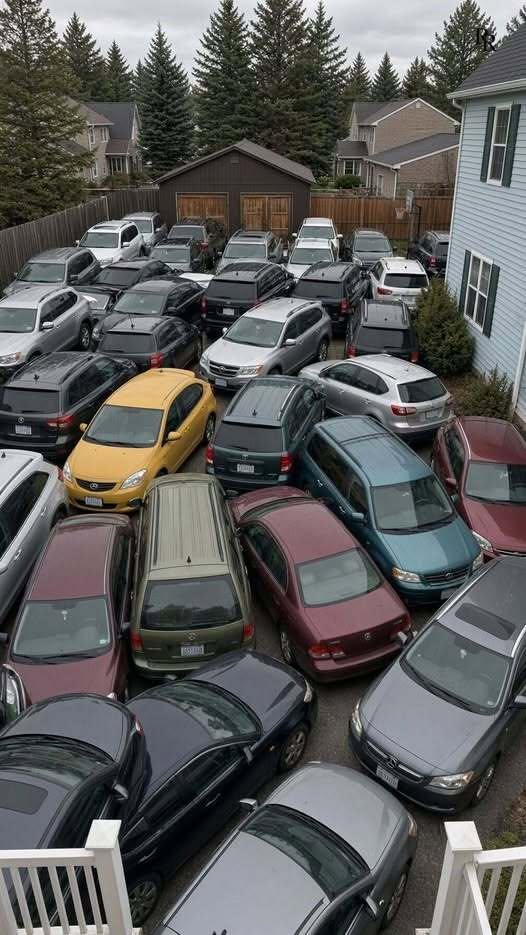
By ten, vehicles were lining the long gravel section behind my house.
At eleven, there were more than twenty.
By noon, approximately thirty cars had filled the driveway and gravel lane.
Roberta’s SUV was buried behind them.
Completely trapped.
I was standing near the porch when she appeared.
She wore a robe.
Her hair was messy.
And she looked furious.
“What is going on?”
“Good morning.”
“Whose cars are these?”
“Visitors.”
“You need to move them.”
I took a sip of coffee.
“I can’t.”
“What do you mean you can’t?”
“They belong to different people.”
“Then tell them to move!”
“Why?”
Her mouth fell open.
“My car is blocked.”
“Oh.”
I nodded sympathetically.
“That’s inconvenient.”
She stared at me.
“You did this deliberately.”
“No.”
“You knew my SUV was here.”
“I did.”
“And you let all these people park behind me?”
“They needed somewhere to park.”
“This is unbelievable.”
Then I repeated the sentence she’d given me so many times.
“You barely use your car anyway.”
Her face went red.
“That isn’t the point.”
“No?”
“No!”
I nodded.
“Interesting.”
Roberta understood immediately.
For the first time, she was standing on the other side of her own argument.
And she hated it.
But the thirty vehicles weren’t there because of her.
That was the part she didn’t know.
Behind my property ran an old gravel lane.
Most people assumed it was part of my driveway.
It wasn’t.
Technically, it was a registered right-of-way that continued beyond our property toward an old orchard.
The lane had existed longer than most of the houses nearby.
Frank knew its history better than anyone.
Years earlier, when brush and fallen branches had nearly swallowed the path, he decided to restore it.
People told him he was wasting his time.
The orchard had been neglected.
Hardly anybody used the lane.
But Frank loved old maps.
Property boundaries.
Local history.
He spent four years clearing that route.
He removed fallen limbs.
Repaired drainage.
Filled washed-out sections.
Rebuilt a small footbridge.
Eventually, a group of volunteers began joining him.
Every autumn, they held a survey walk.
They’d gather at our property, compare historical maps and walk the old right-of-way toward the orchard.
Frank loved those mornings.
After he died, I couldn’t bring myself to cancel them.
So the tradition continued.
For eleven years, people had gathered there every autumn.
That Monday happened to be the annual walk.
The cars weren’t revenge.
They were expected.
Roberta simply hadn’t bothered to ask why my “empty” driveway sometimes needed to remain empty.
One by one, the volunteers eventually returned.
Cars began leaving.
Roberta stood beside her SUV with her arms crossed, glaring at everyone.
Then the final man came down the lane.
He walked slowly.
He was seventy-eight.
Tall despite his age.
Dark coat.
Gray hair.
A weathered leather folder beneath one arm.
His name was Harold Beckwith.
Harold had been a surveyor for most of his life.
He was one of the people who’d originally mapped the lane in 1974.
Frank adored him.
Whenever those two started discussing property maps, everybody else knew we’d lost them for at least an hour.
Harold stopped beside me.
“Good turnout.”
“Best we’ve had.”
“Frank would’ve liked that.”
I smiled.
“Yes.”
Then Harold looked toward Roberta.
The folder slipped slightly beneath his arm.
He stopped moving.
Roberta stopped too.
I’d never seen color disappear from someone’s face so quickly.
For several seconds, neither spoke.
Then Harold said one word.
“Roberta.”
I looked between them.
Roberta’s lips parted.
“Harold?”
His expression was impossible to read.
Not angry.
Not exactly.
More like somebody who had unexpectedly opened a door into a room he’d locked decades earlier.
“You know each other?” I asked.
Neither answered.
Then Harold said:
“I haven’t seen you in twenty-six years.”
Roberta looked as though she might faint.
“Please.”
Harold’s jaw tightened.
“My son looked for you.”
“Not here.”
“He looked for years.”
“Harold.”
“You disappeared.”
I stepped backward.
Suddenly, the argument about parking seemed very small.
Harold was Roberta’s former father-in-law.
His son had been her husband.
In 1998, Roberta had left.
Not divorced normally.
Not separated after a long conversation.
According to Harold, she simply disappeared from their lives.
There were explanations later.
Fragments.
Legal paperwork.
Rumors.
But never the conversation Harold’s son believed he was owed.
Roberta eventually created another life.
Different town.
Different people.
A past she rarely discussed.
For twenty-six years, she’d apparently managed to keep those worlds apart.
Until she parked in my driveway on the wrong Monday.
“I didn’t know you lived here,” Harold said.
Roberta looked at me.
For once, there was no arrogance in her expression.
No irritation.
Just fear.
“I need to go.”
Harold didn’t stop her.
Neither did I.
She got into her SUV as soon as the remaining vehicles cleared.
Before leaving, she sat behind the wheel for several minutes.
Then she drove away.
Roberta never parked in my driveway again.
In fact, she moved that spring.
I didn’t force her out.
I didn’t complain to her landlord.
I didn’t threaten her.
She simply left.
Maybe seeing Harold reopened something she’d spent decades trying to close.
Maybe she realized the past she’d worked so hard to avoid was no longer far away.
I never asked.
Some stories belong to the people who lived them.
But I thought about that Monday for a long time.
Especially after the orchard finally reopened.
Last October, after years of restoration, the public was allowed to walk the old route again.
There’s a bench near the top of the lane now.
A small plaque bears Frank’s name.
I cried the first time I saw it.
Harold sits there most Sundays.
Sometimes I bring coffee.
We don’t always talk.
He looks toward the orchard.
I look down the lane Frank spent four years bringing back to life.
And occasionally, I think about Roberta.
For eight months, she looked at my driveway and saw empty pavement.
Nothing there.
Nothing happening.
Nothing important.
So she decided it was hers to use.
But that driveway wasn’t empty.
It held history.
It held a route people had walked for generations.
It held eleven years of autumn gatherings.
It held Frank’s work.
His muddy boots.
His wheelbarrow.
His ridiculous collection of old maps.
It held memories I wasn’t required to explain to someone simply because she couldn’t see them.
And in a strange way, Roberta made the same mistake with me.
She saw a widow living alone.
One car.
A quiet house.
An unused parking space.
She assumed emptiness.
She assumed that because something looked unoccupied, it held nothing important.
She was wrong.
Some things aren’t empty simply because you don’t recognize what they’re holding.
Sometimes an empty driveway holds a road into the past.
And sometimes, if you keep standing where you’ve been asked not to stand, that past comes walking straight toward you.