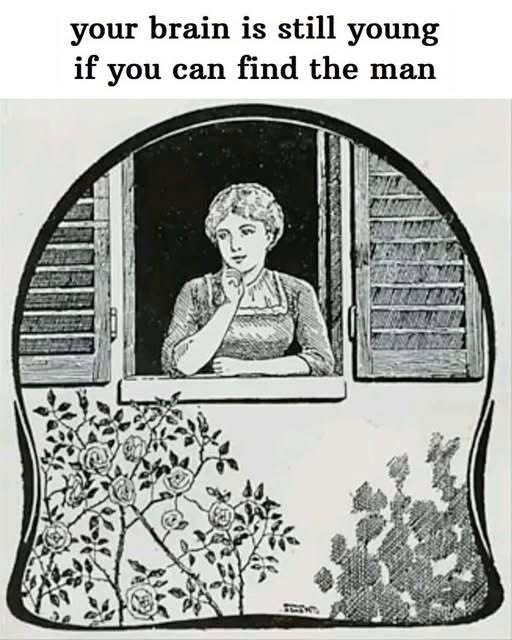
And once you finally see him, you may wonder how you missed him in the first place.
The challenge sounds simple: find the hidden man’s face.
Most people immediately begin searching the garden. They inspect the spaces between the flowers, study the shadows beneath the leaves and look behind the woman, expecting to discover a tiny figure cleverly tucked into the scenery.
But that’s exactly what makes the puzzle so difficult.
The man isn’t necessarily hidden as an obvious miniature person.
Instead, the illusion relies on the shapes already present in the drawing. Lines belonging to the window, plants, flowers, shadows and other parts of the scene can work together to create an entirely different image.
In other words, you may be looking directly at the hidden man without realizing it.
The woman herself makes the challenge even harder.
Because she is the clearest and most recognizable figure in the picture, your eyes naturally move toward her first. Your brain quickly identifies a woman standing near a window and then begins interpreting everything surrounding her as background scenery.
That’s where the illusion gets you.
To solve it, try changing the way you look at the picture.
Instead of concentrating on individual roses, leaves or tiny details, allow your eyes to move across larger sections of the illustration.
You can even move slightly farther away from the image.
Sometimes squinting gently or viewing the picture from a greater distance makes complicated details blend together, allowing a larger hidden shape to emerge.
Try looking at the empty spaces too.
Our brains are extremely good at recognizing familiar objects, especially human faces. But when the features of a face are divided among unrelated objects, we can fail to connect them.
A dark patch that appears to be nothing more than a shadow could help form an eye.
The edge of a flower or leaf might become part of a nose.
A line that seems to belong to the window or garden could suddenly become the outline of a face.
The trick is to stop asking, “Where is the man standing?”
Instead, ask:
“Where could the picture itself become a man’s face?”
That small change in perspective can make all the difference.
And don’t worry if you don’t spot him immediately.
Optical illusions like this work precisely because our brains try to organize complicated visual information as quickly as possible. Once we’ve decided what we’re looking at, it can become surprisingly difficult to reinterpret those same lines and shapes in another way.
It’s also why the moment of discovery can feel so satisfying.
For several minutes, you may see nothing except a woman, a window and a garden.
Then suddenly—
There he is.
Once your brain recognizes the hidden face, it can become almost impossible to stop seeing it.
Some versions of puzzles like this claim that quickly finding the hidden figure means you have a “young brain” or unusually sharp intelligence.
That’s a fun way to turn the illusion into a challenge, but it shouldn’t be taken as a scientific test of someone’s age or intelligence.
What the puzzle really demonstrates is something arguably more interesting: how strongly attention and expectation influence what we see.
Our eyes can receive the same visual information while our brain interprets it in completely different ways.
So give yourself another look before searching for the answer.
Don’t stare only at the woman.
Don’t search exclusively for a tiny man hiding among the flowers.
Step back.
Scan the entire illustration.
Look at the larger shapes instead of the individual details.
And remember the most important clue:
The man may not be hiding inside the picture.
The picture itself may be hiding the man.
Once you finally spot his face, you’ll probably be surprised by just how obvious it suddenly seems.
That’s the beauty of a good optical illusion.
Nothing in the image has changed.
Only the way you see it has.