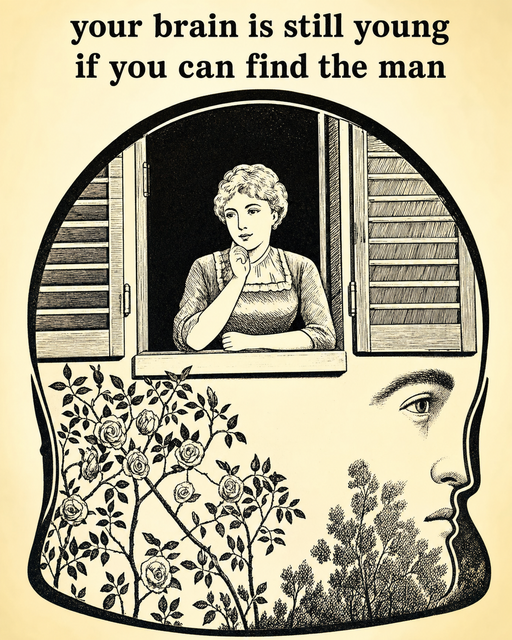
That figure is a man’s face, built entirely out of details already present—the window frame, the flowers, the leaves, the shadows—waiting for the eye to rearrange them into something new. He isn’t standing apart from the scene at all; he’s assembled purely through reinterpretation, not addition.
A Closer Look at the Illustration
The woman dominates the frame. She’s drawn with the most detail and the clearest silhouette, which makes her the natural first stop for anyone’s eyes. Below her, a garden bursts with roses, leaves, and layered shadows.
It’s easy to assume the puzzle is asking you to find another person hiding somewhere in that greenery. It isn’t. The trick lives in how the existing lines double up as something else entirely.
Where the Hidden Face Comes From
Lines that appear to belong to the flowers or the window may actually trace part of the man’s facial features. Nothing new was added—it’s all reinterpretation.
Tips to Spot the Man
Puzzle-solvers are encouraged to look through the image, not just at it. Focusing too intensely on one section, like the flowers or the window, tends to backfire, since the face only emerges when you take in the bigger picture.
A few strategies help:
- Let your eyes drift slowly across the whole illustration instead of locking onto one spot.
- Step back or blur your focus slightly to let larger shapes take shape.
- Resist the urge to search for a full, obvious portrait—the face is made of fragments, not a clean outline.
What This Illusion Reveals About Perception
The woman is deliberately the most eye-catching element in the drawing. Because she’s so clearly defined, the brain defaults to processing her first and treating everything else as background detail.
That’s exactly what makes the second face so easy to miss. Recognizing it depends less on sharp eyesight and more on perspective, visual grouping, and a willingness to reinterpret shapes you’d already dismissed as flowers or shadows.
Some versions of the puzzle claim spotting the man quickly proves you have a “young brain.” That framing is more playful than scientific—the real skill being tested is the ability to shift focus and notice patterns hiding within familiar shapes.
Once the face clicks into place, it tends to stay obvious, almost impossible to unsee. It’s a neat reminder that sometimes the biggest detail in an image is hiding in plain sight, and that changing how you look can completely change what you find.