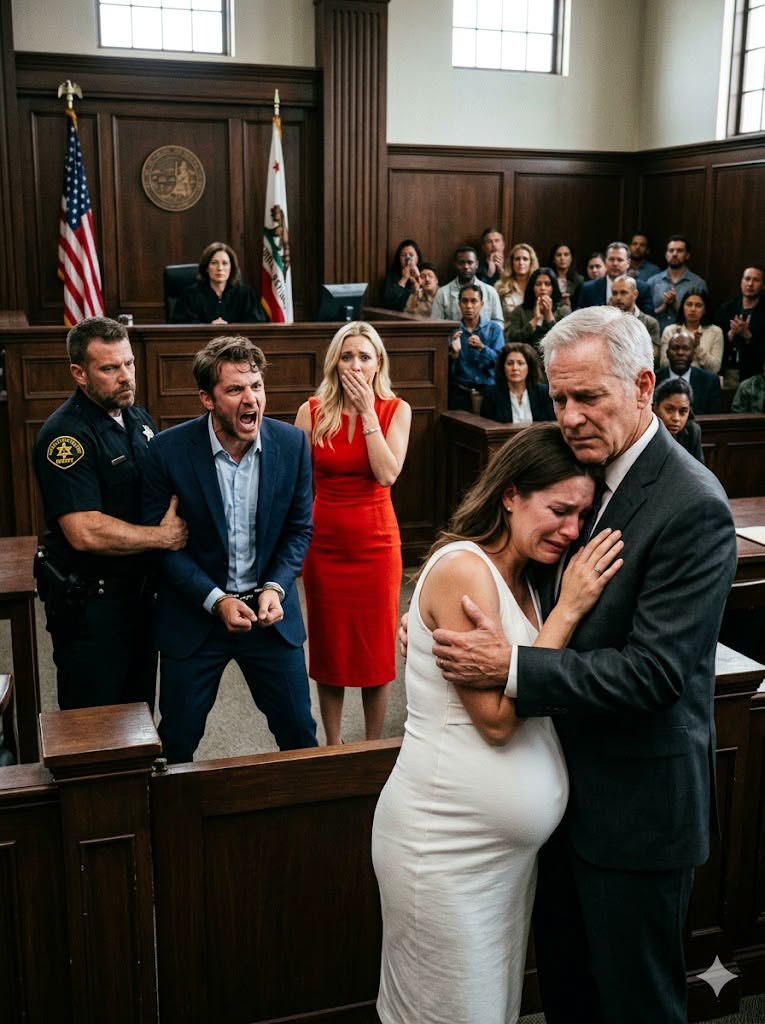
The judge didn’t literally give Jacob everything, but the temporary financial orders went badly for me, and several larger property disputes remained unresolved. I left the courtroom frightened, exhausted and unsure how I was going to afford somewhere to live before my daughter was born.
Jacob caught me in the hallway.
“You wanted independence,” he said. “Now you have it.”
Brenda stood beside him without speaking.
I kept walking.
I had grown up in foster care. There were no parents waiting to take me home, no family property and very little money of my own. I’d already begun contacting housing programs because I couldn’t assume I’d have somewhere stable to bring my baby.
Then an attorney approached me.
“Are you Evelyn Carter?”
I almost kept walking.
He introduced himself and said he represented Harrison Payne.
I knew the name. Almost everyone did.
Harrison was the founder of a multinational logistics and investment group and the kind of wealthy businessman whose photograph appeared in financial magazines.
“I think you should speak with him,” the attorney said.
“Why?”
His answer made absolutely no sense.
“Because Mr. Payne believes you’re his daughter.”
The DNA evidence wasn’t something Harrison had discovered that morning. For months, people working for him had been trying to confirm a match that appeared through a genetic genealogy service. My mother’s name, my birth records and eventually an independently verified DNA test connected the pieces.
Harrison had known my mother when they were young.
Then she disappeared from his life.
He had spent years believing she had left voluntarily and never knew she’d had his child.
I didn’t immediately call him Dad.
I barely knew him.
But when we finally sat together, Harrison didn’t begin by promising revenge against Jacob.
He asked me what I needed.
“An attorney,” I said.
He nodded.
“And somewhere safe until the baby comes.”
“You have both.”
That was how my life changed.
Not because a billionaire stormed into court and commanded everyone to obey him, but because for the first time in my life, I had resources behind me.
My new legal team reviewed the divorce from the beginning.
They couldn’t simply erase unfavorable rulings, but they could challenge disputed financial representations, pursue proper discovery and make sure Jacob’s lawyers weren’t succeeding simply because I lacked the money to fight them.
That review uncovered something unexpected.
Some of Jacob’s financial disclosures didn’t match other records.
The problem extended beyond our marriage.
Jacob worked through a venture-capital firm that was struggling to secure new financing. Several investments appeared healthier on paper than the underlying businesses actually were, and questions emerged about transfers between companies he controlled.
I had initially wanted to hurt him.
Harrison stopped me.
“You don’t manufacture someone’s downfall,” he said. “If he’s done something wrong, you document it.”
So we did.
Attorneys and forensic accountants examined records obtained through the divorce process and, where appropriate, referred concerns to the relevant parties. Separately, investors and lenders began scrutinizing Jacob’s company more closely.
The deeper they looked, the worse it became.
There were questionable transfers, misleading financial representations and transactions that appeared to benefit Jacob personally.
None of it ended in a dramatic boardroom confrontation.
Investigations rarely work that way.
My water broke while I was at Harrison’s estate reviewing paperwork with my attorney.
For once, I didn’t care about Jacob.
I cared about getting to the hospital.
Hours later, my daughter was born.
June.
Harrison stood beside my bed holding her with both hands as though someone had entrusted him with the most fragile object on Earth.
He cried.
I’d known him only a short time, and I still wasn’t sure what our relationship would become.
But watching him hold June, I allowed myself to imagine that perhaps neither of us had to be alone anymore.
Jacob’s problems unfolded over the following year.
His firm conducted its own internal review. Investors brought claims. Authorities examined financial records independently, and eventually prosecutors pursued charges based on conduct they believed they could prove.
Jacob’s business collapsed under the combined weight of lost confidence, litigation and the evidence uncovered during those investigations.
The divorce was resolved separately.
I received what I was legally entitled to, and arrangements concerning June were handled through family court rather than dictated by what happened to Jacob’s company.
Eventually, Jacob entered a plea in the criminal case.
By then, I had stopped waiting for his punishment to make me feel better.
I had June.
I had begun building a relationship with Harrison.
And for the first time, I had something I’d never possessed growing up: a family history.
Or at least I thought I did.
One evening, Harrison’s longtime security director, Cole, asked to speak with me privately.
He handed me an old photograph.
I was perhaps two years old in it, sitting on my mother’s lap.
I’d never seen it before.
On the back, in handwriting Cole believed belonged to my mother, were several lines referring to Harrison.
The message didn’t match the story he’d told me about their separation.
“Where did you get this?”
Cole hesitated.
“There’s more.”
That was the first moment I understood that finding my father hadn’t necessarily solved the mystery of my childhood.
It had opened another one.
Five years passed.
June grew into a curious, stubborn little girl who asked questions about everything. I used part of the financial security I’d gained to establish a foundation supporting women leaving abusive or financially controlling relationships, particularly those who lacked family support.
At its launch, I stood before a crowded room and thought about the woman I’d been outside that courthouse.
She had believed she was alone because she’d never experienced anything else.
I wasn’t that woman anymore.
But my relationship with Harrison had also become more complicated.
I loved him.
June adored him.
And yet questions about my mother remained.
Harrison always had an explanation, but certain dates didn’t fit. Documents were missing. People who had known them remembered events differently.
Then, late one evening after I’d put June to bed, my phone vibrated.
It was Cole.
I found the files. Geneva. You need to see them before you talk to Harrison.
I read the message twice.
Downstairs, I could hear Harrison laughing with June over something she’d left beside his chair earlier that evening.
Five years before, I’d thought the great mystery of my life was why my husband had treated me as though I were worthless.
I’d eventually learned that his opinion had never determined my value.
Now I was facing a harder question.
The man who had found me, protected me and become the grandfather my daughter loved had kept something from me about my mother.
I didn’t know whether it would destroy the family we’d built.
But this time, I wasn’t the frightened woman waiting for someone else to decide what happened next.
I picked up my phone.
Send me everything.