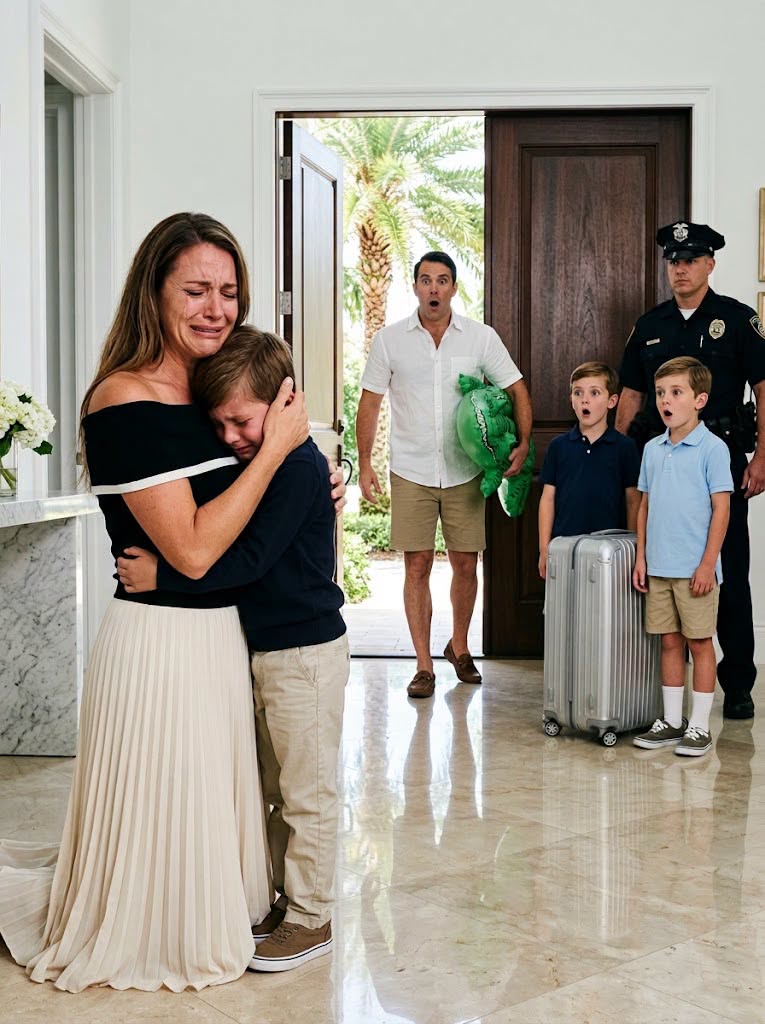
Every day Brandon sent reassuring updates.
Everything’s fine. Liam’s good. Don’t worry about us.
So when the woman on the phone told me Liam had admitted there were no adults at home, I initially thought there had to be some misunderstanding.
There wasn’t.
Brandon had taken Lucas and Alyssa to a resort in San Diego.
He had left Liam behind.
Alone.
For six days.
The grocery store manager had noticed him outside that afternoon and eventually started asking questions. When she realized an eight-year-old appeared to be caring for himself without an adult in the home, she contacted authorities.
I could barely understand what she was telling me.
Brandon had apparently constructed different stories for everyone. He told me Liam was with him. He told Lucas and Alyssa that Liam didn’t want to go on vacation. My Aunt Nora was led to believe Liam was traveling with the family, while Liam had been told Nora wasn’t available.
Everyone who might have checked on him had been given a reason not to.
I arranged for Nora to take Liam immediately and booked the earliest flight I could get back to Columbus.
When I finally held him, I kept apologizing.
“You didn’t know,” he said.
That somehow made it worse.
The next day I returned to our apartment.
It was almost unnaturally clean. On the kitchen counter were frozen meals, cereal and instructions Brandon had written for Liam explaining how to heat food and what he was allowed to eat.
One part told him not to bother me unless it was absolutely necessary because I was dealing with Grandma’s affairs.
I sat there staring at that sentence.
Brandon hadn’t simply made a reckless decision and forgotten to arrange childcare.
He had planned around the possibility that Liam might ask me for help.
I began looking through the travel paperwork Brandon had left behind and found something else. Earlier booking records suggested the trip had originally been planned differently, with arrangements that included more of the family. Later changes had removed Liam and me while money was redirected toward the vacation Brandon ultimately took with his children.
By the time Brandon returned from San Diego carrying souvenirs, authorities were already investigating.
He walked into the apartment smiling.
Then he saw me.
His explanation was worse than anything I’d imagined.
He said he wanted uninterrupted time with Lucas and Alyssa. He insisted Liam was mature for eight and that he’d left food, a phone and instructions. When I asked why Liam’s calls had gone unanswered after some of the food ran out, Brandon said he’d assumed Liam would “figure something out.”
“He’s eight,” I said.
“He’s always been independent.”
“No. He’s been forced to be.”
I told Brandon I didn’t want Liam staying under the same roof with him while the situation was being investigated. Brandon initially argued that it was his home too, but eventually stayed elsewhere while attorneys dealt with our separation and temporary arrangements.
The police and child-welfare investigation didn’t disappear because Brandon insisted he’d left food behind. Investigators spoke with Liam, me, Brandon and other people who had been given conflicting stories. They reviewed messages and the circumstances surrounding the trip.
I didn’t exaggerate what Brandon had done.
I didn’t need to.
He had knowingly left an eight-year-old without adult supervision for nearly a week and deliberately allowed the people around us to believe someone else was caring for him.
In the weeks that followed, Brandon repeatedly asked me to describe it as a misunderstanding.
He wanted me to emphasize the frozen meals.
The phone.
The written instructions.
As though preparing an eight-year-old to be abandoned somehow made abandoning him more responsible.
I refused.
Our legal separation moved forward, and eventually so did the divorce.
One of the hardest parts was what happened to Lucas and Alyssa.
They hadn’t known.
Their father had told them Liam wanted to stay home, and once they understood what had actually happened, they were angry too. I didn’t want Liam to believe they had chosen the vacation over him when they hadn’t even been given the truth.
So I allowed the children to remain in contact when it was appropriate and when Liam wanted it.
Brandon eventually came to Nora’s house hoping to apologize.
I stayed nearby while Liam spoke to him.
Brandon repeated some of the same things he’d told me—that he’d made a terrible judgment, that he thought Liam could handle more responsibility than most children his age.
Liam listened quietly.
Then he asked one question.
“If being independent was good for me, why didn’t you leave Lucas home too?”
Brandon had no answer.
For months I’d been trying to understand whether there was some explanation that could turn what happened into one catastrophic mistake.
My eight-year-old understood it more clearly.
Brandon hadn’t treated the children equally.
Looking backward, I could see smaller examples I’d explained away over the years—different expectations, different patience, different assumptions about who deserved attention. None had prepared me for what he eventually did, but the pattern was there.
Liam and I eventually moved into a bright apartment close to his elementary school.
Recovery wasn’t dramatic. It looked like ordinary things.
Walking to school. Making dinner together. Letting him invite friends over. Answering the phone every time he called, even when the emergency was something as serious as forgetting where he’d put his favorite sweatshirt.
Months later, we visited the grocery store where he’d been found.
The manager recognized him immediately.
Outside was the same concrete bench where Liam had waited that afternoon. Someone had since painted it bright blue.
We sat down together.
“This is where I waited,” he said.
“I know.”
“What if you’re really far away again?”
“I come back.”
“What if you’re in another country?”
“I find a plane.”
“What if there aren’t planes?”
“I find something else.”
He smiled because he’d realized I was willing to continue the game indefinitely.
But beneath the joke was a question I understood.
Will you come for me?
So I stopped joking.
“Liam, I don’t care where I am. If you need me because you’re not safe, I come. You never have to worry about whether you’re bothering me.”
He leaned against my shoulder.
The grocery store manager had saved my son from spending another night wondering whether anyone would notice he was alone.
What I could give him afterward was something different.
The certainty that somebody always would.