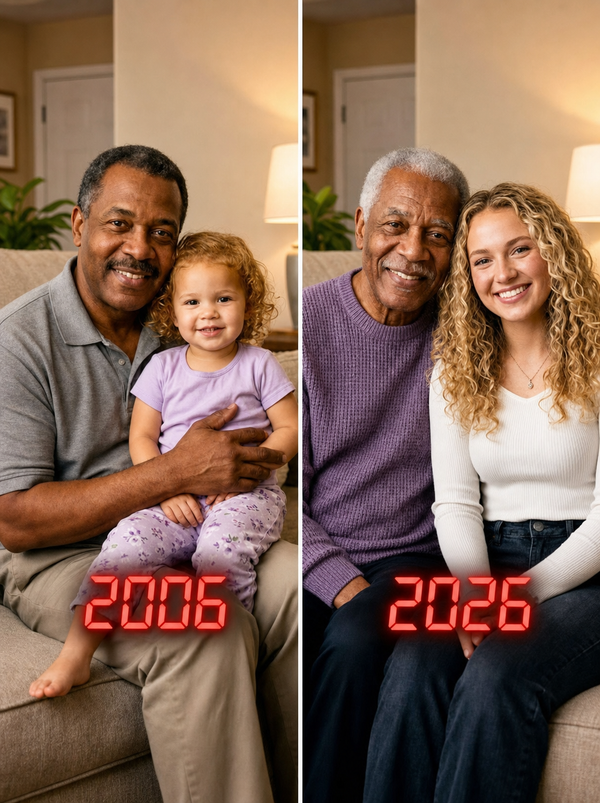
Until last Sunday, when she stood in my entryway with her coat still buttoned, holding a folded piece of paper that would undo two decades of careful, gentle lies.
Raising Emily After the Crash
The night it happened, my family had come over for an early Christmas dinner. They left around seven. Three hours later, Officer Reynolds knocked on my door with the kind of news that changes a house forever.
The rural road had iced over, the car had gone off the shoulder into the trees. My son, his wife, and my oldest grandson didn’t survive. Only Emily did. She was five, with a concussion, broken ribs, and deep seatbelt bruising.
Doctors said her memory of that night was fragmented at best, and warned me not to push her to recall it. So I never did. I became her guardian overnight, learning to cook again and comb a five-year-old’s hair, watching her perform as Snowflake Number 3 in a school gym while I held back tears.
Whenever she asked why her parents weren’t coming home, I gave her the only answer I could bear to give. It was an accident. A terrible storm. Nobody was to blame. She accepted it quietly, every time, and never asked twice.
Emily grew into a thoughtful, observant young woman. She excelled in school, loved puzzles and mystery novels, and never gave me a moment of trouble. After college she came home to save money, took a job as a paralegal at a small legal research firm downtown, and settled back into our old rhythm of dinners and quiet evenings.
Strange Questions Before the Anniversary
A few weeks before the anniversary of the crash, something in her shifted. She grew quieter, not in a moody way, but focused, as though her mind had wandered somewhere I couldn’t follow.
Over dinner she started asking questions that scratched at things I’d spent years trying not to touch. She wanted to know what time her parents had left my house that night. Whether anyone else was supposed to be on that road. Whether the police had ever come back to question me more than once.
I told myself she was just curious, maybe looking for closure before the anniversary passed. But the way she studied my answers, as if weighing them against something she already knew, unsettled me more than I let on.
The Note and the Hidden Phone
Then she came home early, coat still buttoned, and asked if we could sit down. We took our places at the kitchen table that had held every birthday, every scraped knee, every Sunday pancake of her childhood.
She slid a folded paper toward me and asked me to read it before she said anything else. In her own neat handwriting were four words: IT WASN’T AN ACCIDENT.
I tried to laugh it off, asked if this was some law school exercise. She didn’t laugh. Instead she told me she remembered things — things everyone had always told her she couldn’t.
She pulled a scratched silver flip phone from her bag, the kind nobody had carried in over a decade. She’d found it in the county archive, sealed and untagged, requested by serial number alone. On it were voicemails from the night of the crash, one partially deleted.
She played it for me. Through wind and static, a panicked voice said, “—can’t do this anymore. You said no one would get hurt.” Another, colder, answered, “Just drive. You missed the turn.” Then it cut off.
It didn’t prove anything on its own. But it was enough to send her digging further.
Uncovering Officer Reynolds’ Secret
Using her firm’s legal database, Emily traced old employee rosters, badge numbers, and internal investigation records from that year. What she found staggered me.
Officer Reynolds — the man who had stood in my doorway that night, face heavy with rehearsed sorrow, the man who’d eaten chili at our church potluck — had been under Internal Affairs investigation at the time. He’d taken bribes from a trucking company to bury accident reports and blame faulty conditions on weather instead of equipment.
That road shouldn’t have been open at all. A semi had jackknifed on it earlier that day, and barricades should have gone up. Emily believed Reynolds had them pulled. Her parents had swerved to avoid the truck that was never supposed to be there — which was why the tire marks never matched a simple slide.
I asked her how she had survived it. She said she’d been asleep in the back seat, and her seatbelt had caught differently than the others. She hadn’t braced for the impact because she never saw it coming. She told me she hadn’t remembered any of it until recently, when nightmares that weren’t quite dreams began pulling the fragments back.
A Letter and a Fragile Peace
I asked what happened now. Emily told me Reynolds had died three years earlier of a heart attack. There was no case to bring, legally or otherwise.
But that wasn’t why she’d kept digging. She pulled out a worn folder and handed me a letter addressed to me by name. It had come from Reynolds’ widow, found among his files along with redacted reports and an unfiled confession.
In it, she wrote that her husband had been desperate and buried in debt, and that the trucking company had paid him to look away. He hadn’t expected a snowstorm, or a family on that road that night. He’d tried, too late, to undo what he’d already set moving. She closed by saying she couldn’t undo what he’d done, but hoped the truth might bring me some peace.
I read it three times. The weight I’d carried for twenty years didn’t disappear, but for the first time it finally had a shape I could understand.
That night, Emily and I lit candles the way we always had at Christmas, but this time we didn’t sit in silence. We talked about her parents and about Sam — how she used to mistake her mother’s voice for the wind, how she still sometimes woke gasping, feeling the seatbelt holding her back.
I told her I’d carried one of Sam’s drawings in my wallet for twenty years, like a secret handshake to the life we’d lost.
She reached across the table and took my hand, not needing comfort this time, but offering it. “We didn’t lose them for nothing,” she said. “And you weren’t wrong to feel something was off. You were right.”
I couldn’t speak for a moment. Then I pulled her close and told her what I should have said years before. She had saved us both — and in the end, she still had.