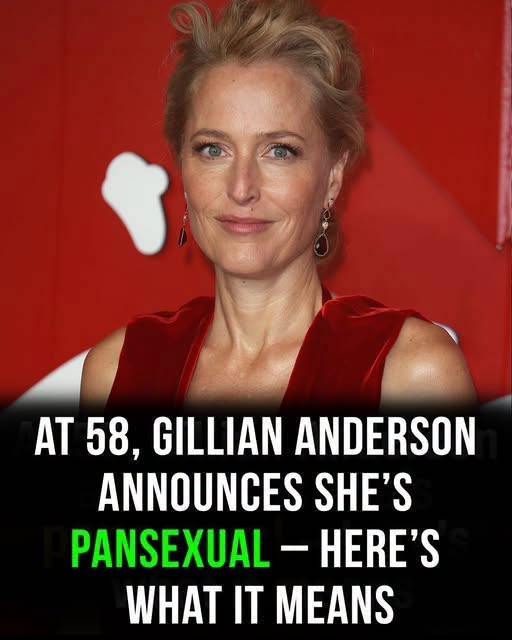
Anderson has previously spoken openly about relationships with women when she was younger.
In a 2024 profile in The New Yorker, she was still considering which terminology felt appropriate, asking herself whether she might be pansexual or bisexual. At the time, she discussed having had relationships with women while also expressing some hesitation about claiming a label that might not accurately represent her experiences.
Her latest comments are more definitive.
During her interview with journalist Nikki Gemmell, Anderson described herself as pansexual and discussed attraction to both men and women. She is currently in a relationship with playwright and The Crown creator Peter Morgan, whom she has described as her life partner.
A person’s current partner, of course, does not necessarily define the full scope of their sexual orientation. Anderson’s comments indicate that she understands her capacity for attraction as extending beyond one gender.
Sexuality Has Become Part of Her Creative Work
The revelation comes as Anderson continues exploring sexuality and desire outside her acting career.
Her new book, More, follows her bestselling 2024 collection Want. Both books bring together anonymous sexual fantasies submitted by women, with Anderson curating and introducing the material. More expands that project with submissions from women around the world.
Her role as sex therapist Jean Milburn in Netflix’s Sex Education also influenced this chapter of her career. Anderson has credited the character with helping her become more comfortable discussing sexuality openly, eventually contributing to the work that produced Want and More.
The connection between her work and personal reflection has therefore developed gradually rather than through a single public announcement.
A New Chapter for Anderson
Anderson has also suggested that this period of her career may be approaching a natural conclusion.
While discussing More and her acting projects, including Teenage Sex and Death at Camp Miasma, she reflected on the possibility that finishing this work could mark the end of a particular chapter focused heavily on sexuality and desire.
That makes her latest statement particularly notable.
Two years ago, Anderson was publicly questioning whether bisexual or pansexual best described her. Now, at 58, she appears more comfortable using a specific term.
Her experience also illustrates something easily overlooked in discussions about sexuality: people do not necessarily settle on the language that describes them when they are young. For some, understanding attraction—and deciding whether a particular label feels appropriate—can continue evolving much later in life.
After years of speaking openly about relationships with both men and women and questioning how best to describe those experiences, Anderson now has a more direct answer.
She identifies as pansexual.