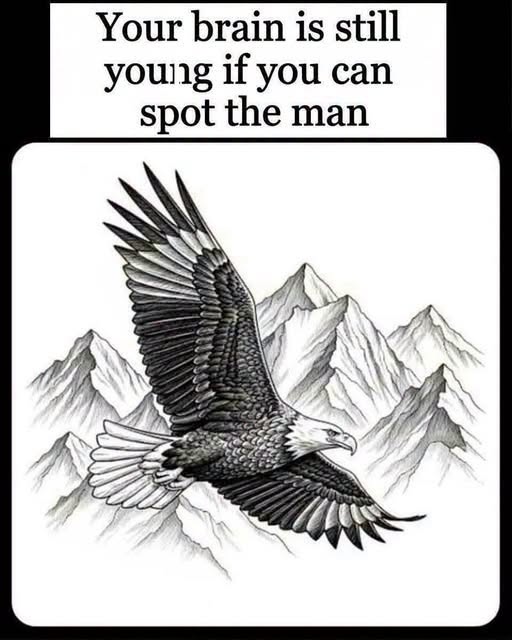
Your attention is naturally drawn toward the most recognizable parts of the picture. In this case, the eagle and mountains immediately dominate the scene, so your brain quickly decides what it’s looking at and begins interpreting everything else as part of that landscape.
The hidden man doesn’t necessarily appear as a separate, clearly drawn figure. His features are created by lines, curves, shadows and spaces that also belong to the surrounding image.
That’s what makes the illusion effective: the hidden picture is part of the picture you’re already seeing.
Can You Find Him?
Take another look without concentrating too heavily on the eagle itself. Slowly scan the mountain ridges, the eagle’s body and the spaces surrounding the larger shapes.
Instead of searching for a complete person, look for something simpler—a facial outline, forehead, nose, mouth or other feature that could suddenly make several unrelated lines form a human figure.
Still can’t see him?
Try stepping slightly farther away from the image or briefly looking elsewhere before returning to it. Sometimes focusing harder actually makes these puzzles more difficult because your brain keeps reinforcing its original interpretation.
Why Optical Illusions Fool the Brain
The brain constantly tries to organize visual information into familiar objects and patterns. Once it recognizes an eagle flying over mountains, that interpretation becomes difficult to abandon.
But eventually, the right combination of lines may suddenly register as a human figure.
That’s usually the most satisfying part of a hidden-image illusion. Nothing in the picture actually changes, yet the moment you recognize the second image, the entire scene seems different.
Take one more careful look.
Can you find the hidden man before someone points him out?
And once you see him, there’s a good chance you’ll wonder how you ever missed him.