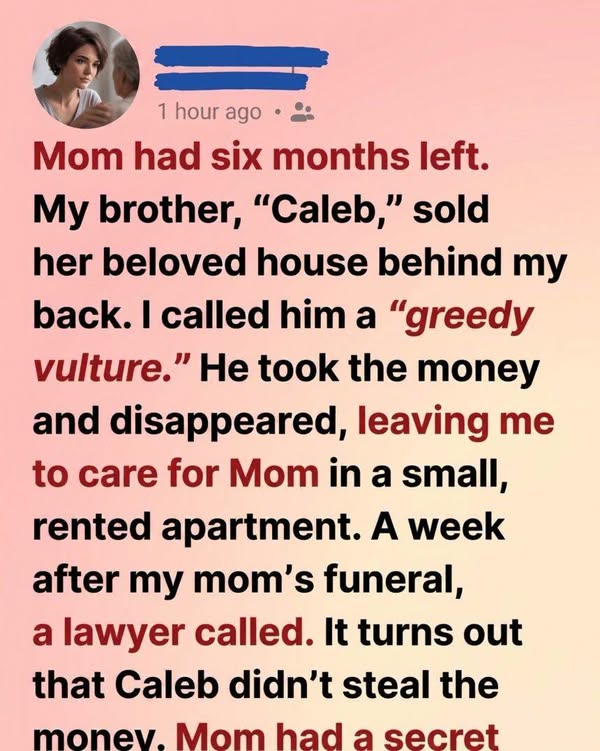
By the time I reached his apartment that night, my hands wouldn’t stop shaking. When he opened the door and admitted he’d sold it, offering no explanation, no apology, just a quiet “yes,” something in me snapped.
A Devastating Diagnosis and a Betrayal
“You greedy vulture,” I said. “Couldn’t even wait until she was gone before cashing in?” He flinched but didn’t argue back. He just stood there, silent, as if he’d already accepted that nothing he said would change my mind.
That silence felt worse than any excuse could have. I told him I didn’t want to see his face again, and he let me walk away without a word of protest.
Grief, Silence, and a Lonely Goodbye
Without the house, I moved my mother into a small rental apartment across town. It never felt like home, no matter how many family photos I set on the shelves. Sometimes she’d stare at the walls and ask, “Do you remember the garden?” I remembered every inch of it.
Caleb vanished completely after that. No calls, no visits, no offer to help. I did everything alone—holding her hand through painful nights, listening to her breathing shift and stumble while the television flickered in the background.
Sometimes she asked if I’d heard from her son. I always lied and told her not to worry about him. She would nod slowly, like she understood something I didn’t.
The morning she died was painfully ordinary. Sunlight came through the curtains, a kettle whistled somewhere down the hall, and her hand rested weakly in mine. Then, without warning, her breathing simply stopped.
At the funeral, Caleb’s empty seat felt louder than any prayer. Part of me wanted him there so I could hate him properly. Mostly, I just wanted to understand how someone could disappear from their family at a time like that.
A Lawyer’s Call Changes Everything
A week after the funeral, a lawyer called. I almost hung up, certain there was nothing left to discuss. Instead, his careful tone made my stomach tighten before he’d said anything at all.
He explained that, twenty years earlier, our parents had taken on debt after a failed business venture. The balance had grown quietly through refinanced loans until the bank was preparing to seize the house entirely. Our mother, he said, had never wanted either of us to know.
Caleb had discovered the truth months before. He’d sold the property privately to settle the debt before foreclosure could take it. Once everything was paid, there was money left over—and he’d transferred all of it into my name, keeping nothing for himself.
I stopped hearing anything else the lawyer said. Every memory from the past six months rearranged itself into something I could barely stand to look at: his silence, his disappearance, the way he never once defended himself.
Finding Caleb: The Truth Behind the Silence
Three days later, I found him in a parking lot behind an auto repair shop on the edge of town. I almost didn’t recognize the car—rust along the doors, fogged windows, clothes piled in the backseat.
When he saw me, he opened the door and said “Hey,” quietly, like we’d spoken only yesterday. I asked if he’d been living there. He shrugged and said it was temporary, but the blanket, the cooler, the folded clothes told a different story. It hadn’t been temporary at all. It had been sacrifice.
I told him the lawyer had explained everything. He leaned back and looked away. “I didn’t want Mom to know how bad it was,” he said. “And I didn’t want you carrying it too.”
“So you let me think you were stealing from her?” I asked.
A faint, tired smile crossed his face. “It seemed easier,” he said. That single word broke something in me completely—as if carrying my hatred had somehow been lighter for him than letting us worry beside him.
A Reckoning in the Parking Lot
“I called you a greedy vulture,” I whispered.
“I’ve been called worse,” he said.
“But I meant it,” I said.
He nodded once. “I know.”
I asked how, after everything, he’d still paid it all himself and taken nothing. He looked at me directly for the first time. “She was our mom,” he said simply. No speech, no resentment. Just that.
Every ounce of anger I’d carried collapsed under the weight of what he’d quietly done for all of us. I started crying, not neatly, but the kind of crying that comes from realizing you were cruel to someone who loved you anyway.
“I’m sorry,” I said, again and again. He stood there for a moment, unsure what to do with my grief, and then stepped forward and pulled me into a hug.
Standing in that empty parking lot, beside the car he’d been sleeping in so our mother could die without losing her dignity, I understood something that hurt almost as much as losing her. The brother I thought had abandoned us had been carrying us the entire time.