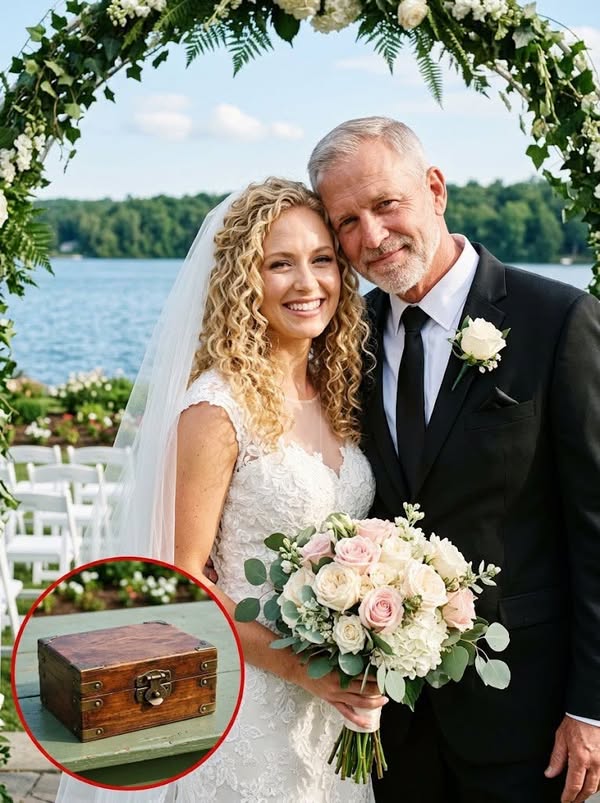
…a sentence he spoke calmly to his daughter Marlene the very night we married, after she cornered me near the staircase and told me I would get nothing. He simply said I would get exactly what I deserved.
A Waitress and a Widower
I met Russell while serving champagne at a charity dinner, balancing a tray after a shift I’d worked hungry to fit into my uniform. He asked my name, then quietly asked if my feet hurt. No one had shown me that kind of care in years.
He called the next morning, and every morning after. Three months later, in a small restaurant, he slid a ring across the table and said he wasn’t asking me to love him, only to let him take care of me. I said yes, telling myself I was simply being practical.
Marrying Into Hostility
His children never hid their suspicion. His daughter, Marlene, looked at me the night we announced our engagement as if I’d tracked mud across her father’s life. “So you’re the new project,” she said.
After our wedding, she caught me near the staircase and hissed, “You think you’re getting the house? You’ll get nothing.” Russell heard her. He didn’t raise his voice. He only said, “She’ll get exactly what she deserves.”
I carried that sentence home like a bruise, unsure whether it was a promise or a warning. What I hadn’t expected was how ordinary kindness could accumulate into something real. Russell remembered how I took my tea, left the curtains cracked so I could sleep, and stopped treating every comfort like something I had to earn. I had married him for safety. I stayed because I had fallen in love with him.
Six Weeks to Say Goodbye
The diagnosis came in November. We were given six weeks, and his children treated every one of them as another chance to push me aside. Marlene met me outside his hospital room more than once, insisting he needed rest, not a scene.
I sat in the hallway for hours some days, waiting for a moment alone with him. When it came, he squeezed my hand and told me not to fight them. “Just trust me,” he said. I told him I didn’t care about the house. “I know,” he answered. “That’s why.”
I thought I would have time to ask what he meant. I didn’t. At the funeral, his three children stood across from me like a wall, and I cried alone by the casket, certain no one there believed my grief was real.
The Box the Lawyer Delivered
The next morning, Russell’s lawyer called us all to his office. There was no will laid out, no stack of documents — only a small wooden box sitting in the center of the desk. Marlene was already there with her brothers, watching me like a jury.
“How generous of you to come,” she said. “When do you plan to leave our father’s house?” I said nothing, folding my hands so they wouldn’t shake.
The lawyer slid the box toward me. Inside were no keys, no cash, no jewelry — only a folded letter and a worn photograph of me at that first charity dinner, mid-laugh, holding a tray I didn’t remember anyone photographing.
Marlene demanded to know what the letter said, but the lawyer stopped her gently, saying it was private. She insisted he read the actual will instead. As he turned the pages, her anger shifted into something closer to fear.
The Will and the Letter
The will left the house, the estate, and controlling interest in Russell’s company to me. His children would receive trust allowances tied to specific conditions — allowances forfeited entirely if anyone contested the will. Marlene stood so fast her chair struck the wall, accusing me of manipulating a sick, lonely man.
I finally looked at her directly. “Maybe I said yes because I was tired of drowning,” I told her, “but I would have stayed if he’d lost everything. The box was the gift.” Then I unfolded the letter and read one line aloud.
Russell had written that he’d watched me refuse his money the night before his diagnosis, that I’d told him I only needed him. He wrote that he’d guessed I was pregnant before I knew it myself — from the tea, the pale mornings — and that he had quietly arranged for my care.
The room went silent. Marlene’s brothers stared at the floor. “You’re pregnant,” one of them finally said. I answered simply, “Yes. He knew before I did. He wrote it before he died. Read the date.” No one stopped me as I picked up the box, the letter, and my coat, and walked out.
Finding Peace in His House
In the months after, Marlene sent one letter through her attorney, then nothing more. Her brothers accepted their allowances and kept their distance. I kept the charity photograph on my dresser, not because I looked polished in it, but because I looked unguarded — seen by someone before I ever noticed him watching.
Some evenings I still speak to Russell as if he were downstairs making tea, telling him the baby kicks whenever it rains. Standing in his kitchen with one hand on my belly and his letter worn thin in the other, I finally understood what he meant that first night. Exactly what I deserved was never the house or the money. It was being fully seen, and loved without conditions.