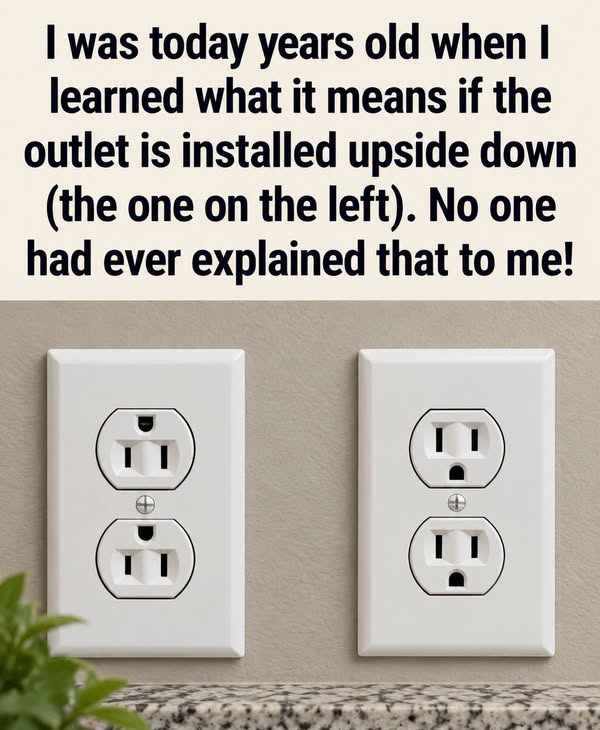
Miss that clue, and you might mistake a perfectly normal outlet for a broken one, unplugging and replugging devices that simply need the nearby switch turned on.
The Upside-Down Outlet Mystery
At first glance, a receptacle installed with its ground hole facing up looks like a simple installation error. But in many older or unusually wired rooms, that orientation is doing a specific job: flagging that this particular outlet answers to a wall switch instead of staying live all the time.
How Switched Outlets Replaced Ceiling Lights
The setup traces back to rooms that were never built with an original ceiling light. Instead of running wiring to the ceiling, builders wired a wall outlet to a switch, so a lamp plugged into that outlet became the room’s main light source.
Flip the switch, and the lamp turns on just like a fixture would. To make that switched outlet easy to identify later, some electricians intentionally installed it upside down as a quick visual marker.
Often, only half of a duplex outlet is wired this way. The other half stays permanently powered, useful for clocks, phone chargers, or a router that needs to run continuously.
Why Orientation Isn’t an Official Code
It’s tempting to treat an upside-down outlet as a guaranteed signal, but there’s no national electrical code requiring switched receptacles to be installed that way. The practice is a habit some electricians use, not a universal rule.
That means a flipped outlet could indicate a switched circuit, but it could just as easily reflect a personal safety preference or simply the taste of a previous homeowner. Orientation by itself isn’t proof of anything.
Testing Your Outlets to Know for Sure
The only dependable way to confirm what’s going on is to test it directly. Plug in a lamp, then check the outlet against the switches nearby to see which one, if any, controls it.
Once you’ve mapped out which outlets are switch-controlled, you can use them intentionally, powering a lamp for lighting on demand instead of assuming the outlet is faulty. Understanding this quirk turns a confusing detail into a practical feature of your home’s wiring.