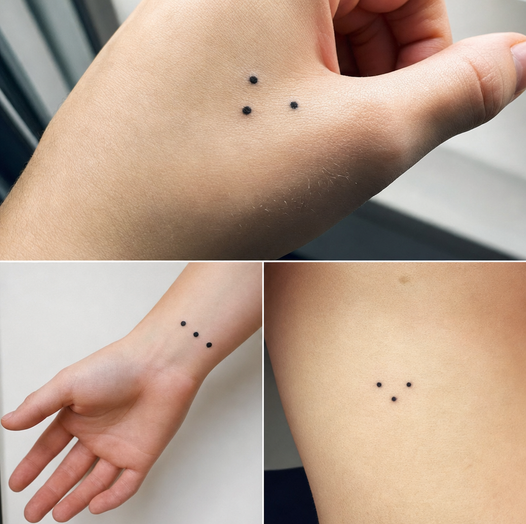
ignore the alarmist framing, because the real story behind three-dot tattoos is far less sinister and far more personal than the viral warning suggests. While the symbol has been linked to gang culture in certain places, that association alone does not mean everyone who wears it is dangerous or involved in crime.
Where the Viral Warning Comes From
Posts urging people to avoid anyone with this tattoo present it as a clear-cut danger sign. That framing strips away context and turns a small, common design into an automatic red flag, ignoring how differently the same symbol can be used from one person to the next.
What the Three Dots Can Actually Mean
For some wearers, the three dots stand for Mi Vida Loca, or ‘My Crazy Life,’ a phrase tied to hardship, resilience, or simply surviving difficult chapters. For others, the same three dots have nothing to do with struggle at all.
They might represent three children, family members, or close friends. Some people choose the design to mark important personal moments, turning it into a quiet, permanent reminder rather than any kind of coded warning.
Why Context and Culture Matter
Placement matters too. Where the dots sit on the body, how they’re arranged, and the wearer’s cultural background can all shape what the tattoo is meant to communicate.
Symbols also shift over time. A design that once carried one specific meaning in a particular community can later be adopted for entirely different personal or purely aesthetic reasons, with no connection to its earlier associations.
Looking Beyond the Ink
Judging someone based solely on a three-dot tattoo risks getting it wrong. A tattoo doesn’t reveal a person’s character or intentions, and for many people it’s simply a private story, a tribute to loved ones, or a minimalist choice with sentimental value.
The most accurate conclusion is also the simplest one: a three-dot tattoo is not a universal warning sign. Its true meaning depends entirely on the individual wearing it, not on a viral post’s assumptions.