“Where is she?”
My mother sighed as though I were inconveniencing her.
“I sent you the location.”
“You left my eight-year-old daughter somewhere by herself?”
“It’s a market. There are people around.”
Then she said something I will never forget.
“We paid too much for this vacation to let her ruin it.”
I walked out of the meeting.
The drive took about thirty minutes.
I don’t remember most of it.
I remember gripping the steering wheel.
I remember checking the location repeatedly.
And I remember imagining every possible thing that could happen to an eight-year-old child left beside a busy road.
Then I saw her.
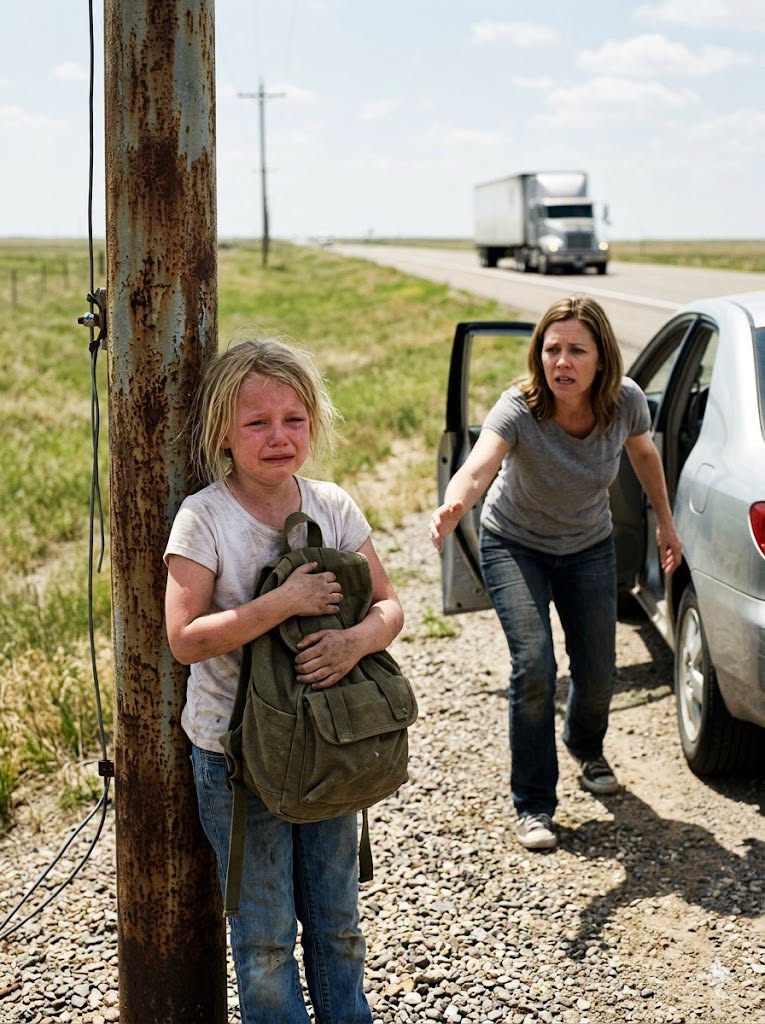
Abigail was standing near the market with her backpack against her chest.
She looked impossibly small.
I pulled over and ran toward her.
“Mom!”
She started crying before I even reached her.
I wrapped my arms around her.
“I’m here.”
“Grandma said I ruined everything.”
“No.”
I pulled back and looked directly at her.
“You didn’t ruin anything.”
She’d become carsick on the way to the airport.
That was it.
She hadn’t thrown a tantrum.
She hadn’t deliberately delayed anyone.
She’d gotten nauseous.
My parents decided the easiest solution was to leave their granddaughter behind and send me a location pin.
At home, I put Abigail on the couch with a blanket.
She kept apologizing.
That hurt almost as much as finding her alone.
“I’m sorry I got sick.”
“You never apologize for getting sick.”
“But Grandma—”
“Grandma was wrong.”
Eventually she fell asleep.
I sat beside her for a long time.
And something I’d avoided admitting for years finally became obvious.
My parents hadn’t suddenly become selfish that morning.
I’d simply spent years making their selfishness easier to tolerate.
Whenever they needed money, I helped.
Car repairs.
Unexpected bills.
Vacations.
Loans.
Six hundred dollars every month into an account they called their “emergency fund.”
I’d even contributed toward the trip they’d just taken.
Somewhere along the way, I’d convinced myself that generosity would create the kind of grandparents I wanted Abigail to have.
It hadn’t.
I’d been financing the illusion.
The following morning, I went through every financial connection between us.
I canceled the recurring $600 transfer.
I stopped future payments I’d agreed to make toward an upcoming cruise.
I removed them as authorized users anywhere I legitimately could.
Then I made a list of the obligations that weren’t so simple.
Years earlier, I’d helped guarantee financing connected to their vehicle and another loan.
I couldn’t simply call the bank and erase my legal obligations.
So I contacted the lenders and an attorney to understand exactly what exposure remained and what options existed for refinancing or eventually separating my finances from theirs.
Then I called my parents.
My father answered.
“Did Abigail get home?”
I almost laughed.
“You mean after you left her beside a highway?”
“It wasn’t beside a highway.”
“That is what you’re arguing about?”
“Your mother said there were employees inside.”
“She is eight.”
Silence.
Then he said:
“We would’ve missed the flight.”
That sentence ended something in me.
Not because they made a terrible decision.
People make terrible decisions.
Because even afterward, knowing Abigail was safe, neither of them seemed capable of understanding why what they’d done was unacceptable.
I told him the monthly money was ending.
So were the vacation contributions.
Any future financial assistance was over.
His tone changed immediately.
“You can’t just punish us financially because you’re angry.”
“I’m not punishing you.”
“That’s exactly what you’re doing.”
“No. I’m stopping paying your expenses.”
There was a difference.
They simply hadn’t needed to notice it before.
I also demanded repayment of the money I’d contributed specifically for Abigail’s portion of the vacation.
They refused.
They said they’d already spent it.
They complained about nonrefundable reservations.
They talked about how stressful the morning had been.
My mother even said:
“You have no idea what it’s like traveling with a child who gets carsick.”
I stared at the phone.
“I am literally her mother.”
That conversation made the decision easier.
I stopped looking for an apology.
Word eventually spread through the family.
Not because I launched some campaign to humiliate my parents.
Because relatives asked why Abigail had suddenly returned home while my parents continued their vacation.
I told them.
Some didn’t believe me at first.
Others called my parents.
Their explanations changed depending on who was asking.
They said Abigail had been safe.
Then they said they’d thought I was closer.
Then they said she’d been causing problems all morning.
None of those explanations changed the central fact.
Two adults responsible for an eight-year-old child had deliberately left her behind because getting her home safely interfered with their travel plans.
Some relatives defended them.
Most didn’t.
For once, I didn’t argue with anyone.
They were free to have whatever relationship with my parents they wanted.
Abigail’s relationship with them was my responsibility.
And unsupervised visits were over.
The financial consequences unfolded more slowly.
Without my monthly support, my parents had to confront expenses they’d quietly built around the assumption that I would always help.
They cut back.
They eventually changed vehicles.
Later, they sold their larger home and moved somewhere more affordable.
I didn’t celebrate.
I didn’t want them homeless or miserable.
I simply stopped believing their lifestyle was my responsibility.
There is a difference between helping your parents and becoming the financial structure holding up choices they couldn’t otherwise afford.
I’d crossed that line years earlier without realizing it.
Now I stepped back across.
Abigail took longer to recover than I expected.
For months, whenever another adult drove her somewhere, she’d ask:
“You’re bringing me back, right?”
That broke my heart.
So we worked on rebuilding the sense of safety my parents had damaged.
No dramatic speeches.
Just consistency.
If I said I’d pick her up at five, I was there at five.
If Mark took her somewhere, he told her exactly where they were going and when they’d return.
We made sure she understood one thing:
Adults responsible for you don’t abandon you because you’re inconvenient.
About six months later, Mark and I took her to the beach.
Nothing luxurious.
Just the three of us.
Halfway there, Abigail announced from the back seat:
“My stomach feels funny.”
Mark immediately pulled into the next safe place.
No frustration.
No sighing.
No complaints about lost time.
We got out.
Abigail drank some water and sat with me until the nausea passed.
Twenty minutes later, she climbed back into the car.
“Sorry.”
I looked at her.
“What did we say about apologizing for getting sick?”
She smiled slightly.
“Don’t.”
“Exactly.”
Mark turned around from the driver’s seat.
“Besides, the ocean isn’t going anywhere.”
Abigail laughed.
And we continued when she was ready.
That moment probably meant nothing to anyone driving past us.
To me, it meant everything.
My parents had taught my daughter that love disappeared the moment she became inconvenient.
Our job wasn’t to tell her they were wrong.
It was to show her.
Again and again.
Until she believed us.
I used to think keeping a family together meant forgiving, accommodating and helping no matter how much it cost.
I don’t anymore.
Sometimes protecting your family means deciding who no longer gets unrestricted access to it.
And sometimes the most loving thing you can do for your child is make absolutely certain she never again has to wonder whether the adults beside her will still be there when she’s difficult, sick, scared—or simply eight years old.