“Mom?”
She disappeared.
Seconds later, I heard the lock turn.
Then another.
I knocked again.
“It’s me.”
My father appeared behind the glass.
“Leave.”
I actually laughed because I thought I’d misunderstood him.
“Dad, what are you talking about?”
“We don’t know who you are.”
I stopped smiling.
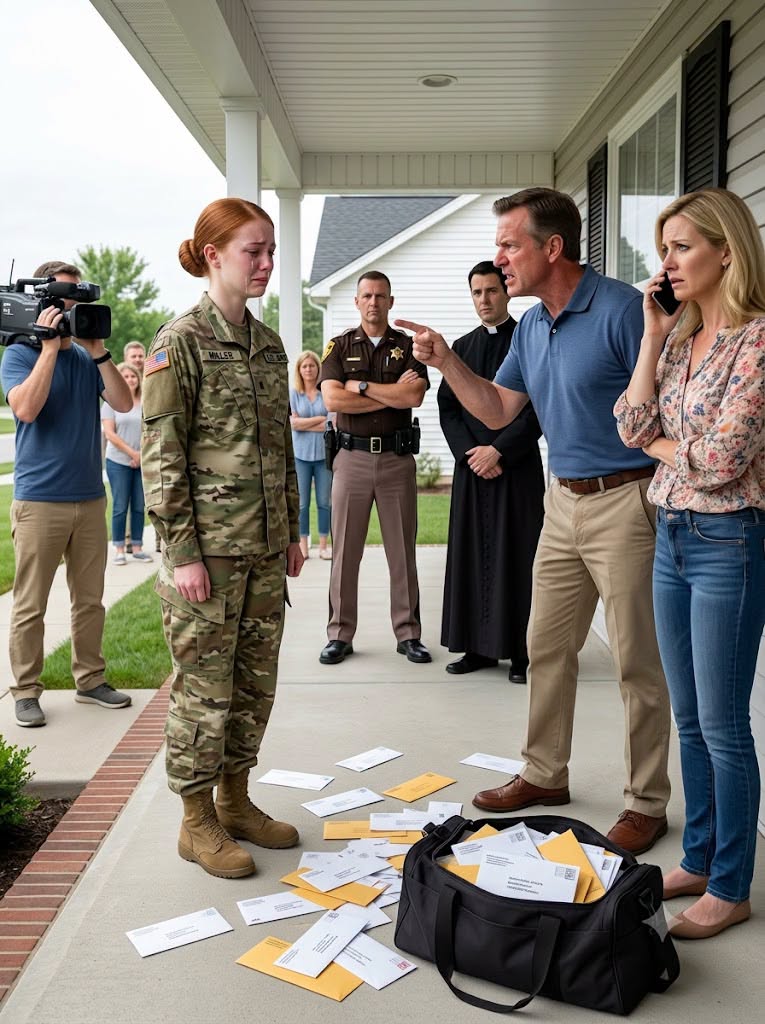
Twenty minutes later, a sheriff’s vehicle pulled onto the street.
My parents had called the police.
They’d reported an unknown woman impersonating their daughter.
By then, neighbors had begun coming outside.
Mrs. Donnelly, my middle-school teacher, stood across the road.
Mr. Holloway, our longtime mail carrier, had stopped his truck nearby.
People I’d known since childhood were staring at me as though they couldn’t decide whether to hug me or be afraid of me.
Sheriff Walker approached carefully.
“Ma’am, can I see some identification?”
I handed him my military ID and driver’s license.
He studied them.
Then looked at me.
Then at my parents.
My father stepped onto the porch.
“Those could be fake.”
Sheriff Walker’s expression changed.
Not dramatically.
Just enough.
There are procedures for verifying someone’s identity.
And unlike my parents, the military had spent the previous four years documenting exactly who I was and where I’d been.
I wasn’t some missing woman appearing from nowhere.
I was an active service member returning from deployment.
Mr. Holloway finally spoke.
“I knew she was alive.”
Everyone looked at him.
He swallowed.
“I’ve seen mail from her.”
My mother’s face changed.
That was the first crack.
Mr. Holloway explained that letters bearing military postal markings had repeatedly come through for my parents.
Some had been refused.
Others had been returned.
Once, after realizing what was happening, he’d contacted me through information available on one of the envelopes and helped make sure certain correspondence reached the correct destination instead of disappearing.
I stared at my parents.
“You’ve been rejecting my letters?”
My mother folded her arms.
“You don’t understand.”
“Then explain it.”
She wouldn’t.
But someone else did.
Pastor Glenn had arrived after hearing about the commotion.
He looked almost ill when he saw me.
“I thought you were in trouble.”
“What kind of trouble?”
He hesitated.
“Your parents told us you needed help.”
That was when I learned my absence had become a business.
Over several years, my parents had told members of their church that I was experiencing serious personal and legal problems.
They said I was ashamed.
Unstable.
Unable to return home.
They discouraged people from contacting me because supposedly it would make things worse.
And people believed them.
Why wouldn’t they?
These were my parents.
The congregation had organized collections and private donations intended to help their struggling daughter.
Pastor Glenn couldn’t immediately tell me the total.
Later, after church records and individual contributions were reviewed, investigators estimated that tens of thousands of dollars had been collected using stories about me.
I had never received any of it.
I hadn’t even known it existed.
Standing on that street, however, we knew only part of the truth.
The rest took months to uncover.
The biggest problem involved a small blue house on Cedar Lane.
My grandmother Evelyn had left it to me.
It wasn’t enormous or particularly luxurious.
But it was mine.
Before deploying, I’d arranged for basic maintenance and believed the property was sitting largely untouched while I was overseas.
It wasn’t.
When an attorney helped me check the county property records and associated filings, we found transactions I didn’t recognize.
There were loan documents.
Signatures that looked like mine.
And references to authority supposedly granted to my father.
I had never given him that authority.
Investigators eventually focused on documents purporting to give my parents broad power to act on my behalf.
One of the central documents was a power of attorney bearing a signature I disputed.
There were also representations about my mental condition and availability that appeared designed to explain why I wasn’t personally participating in transactions.
That was far more serious than rejected letters.
Someone had been using my absence to move money.
A mortgage broker named Walter Briggs appeared repeatedly in the paperwork.
He wasn’t some stranger who conveniently confessed on my parents’ lawn.
His name surfaced because investigators followed the documents.
Records showed that financing had been obtained against property connected to me.
Money moved through accounts.
Signatures were compared.
Notaries and witnesses were interviewed.
Electronic records were preserved.
The deeper investigators looked, the harder it became to explain everything as a misunderstanding.
My parents had spent years creating a version of me that couldn’t contradict them.
To the church, I was troubled and desperately needed money.
To people asking why I never visited, I was estranged.
On financial paperwork, I was unavailable and supposedly dependent on them to handle my affairs.
To me, meanwhile, they acted as though everything at home was normal.
Different lies for different audiences.
All serving the same purpose.
Control.
I kept asking myself one question.
Why?
Then my attorney showed me the financial picture.
Debt.
Loans.
Spending.
Payments associated with the Cedar Lane property.
My parents had been living beyond what their legitimate income could comfortably support.
My grandmother’s house had become another source of money.
The church donations helped too.
And as long as I remained thousands of miles away, they could keep explaining my absence however they wanted.
My return wasn’t emotional for them.
It was dangerous.
I was evidence that could speak.
The criminal investigation took time.
There was no dramatic moment where a sheriff opened one folder and immediately arrested everyone responsible.
Financial cases rarely work that way.
Investigators reconstructed transactions.
The church provided records.
Property filings were examined.
My military service helped establish where I’d actually been when certain documents were supposedly signed.
Handwriting and signatures were reviewed.
People who’d been told conflicting stories were interviewed.
Walter Briggs was questioned about his role in the financing.
Eventually, prosecutors filed charges based on the evidence they believed they could prove.
My parents faced serious allegations involving fraud and forged documents.
Briggs faced scrutiny over transactions he’d helped facilitate.
The property dispute required its own legal process.
But eventually, the fraudulent claims against my house were challenged and resolved.
For the first time since returning home, I had something solid beneath my feet.
Grandma Evelyn’s house was mine again in every meaningful sense.
The church devastated me in a different way.
Those people hadn’t betrayed me.
They’d been manipulated.
Some had given twenty dollars.
Some had given hundreds.
A few had contributed far more because they genuinely believed they were helping the daughter of people they’d worshipped beside for years.
I refused to let them feel ashamed for being generous.
“You weren’t foolish,” I told Pastor Glenn.
“You were trying to help someone.”
The church reviewed what had happened and worked through the financial consequences with those affected.
I made one thing clear:
I didn’t want another collection taken in my name.
Enough money had already been attached to lies about me.
I moved into Grandma Evelyn’s blue house.
It needed work.
Years of neglect and questionable financial decisions had left their mark.
So I repaired it slowly.
I painted the kitchen.
Replaced damaged flooring.
Fixed the porch.
And installed a new mailbox.
The first time Mr. Holloway delivered a letter there, he stopped.
“You know,” he said, “this one actually gets to stay.”
I laughed.
“So do I.”
He placed it inside.
For reasons I still can’t fully explain, that tiny moment affected me more than almost anything else.
My mail.
My house.
My name.
My life.
All arriving where they belonged.
The legal cases eventually produced consequences.
Not every accusation became a conviction.
Not every dollar was recovered.
Real life rarely closes every account perfectly.
But enough was proven that my parents could no longer hide behind the story they’d created.
For years, they’d made my absence useful.
Then I’d come home.
And simply by standing there alive, in uniform, with identification in my hand, I’d destroyed the foundation of the lie.
Healing took considerably longer.
I had spent four years serving my country while imagining that somewhere across the world were two parents waiting for their daughter.
Discovering that they’d instead been rewriting my life for money was harder to accept than any financial loss.
Eventually, I stopped trying to understand how parents could do that.
Understanding wasn’t required for me to move forward.
Months later, the town invited me to speak at a small veterans event.
I almost declined.
Then I thought about all the people who’d believed my parents because they’d never heard my voice.
So I went.
I didn’t give some grand speech about revenge.
I talked about coming home.
About how easy it is for someone else to control your story when you’re absent.
And about the importance of documents, independent relationships and people willing to ask questions when something doesn’t make sense.
Afterward, I drove back to Cedar Lane.
The porch light was on.
My duffel bag—the one I’d carried home that first afternoon—sat inside a closet.
Outside was the little mailbox Mr. Holloway now filled with letters addressed directly to me.
For four years, my parents had tried to turn my absence into proof that I no longer belonged.
They were wrong.
I hadn’t disappeared.
I hadn’t abandoned anyone.
And I certainly hadn’t died.
I had simply been far away.
Now I was home.
And this time, nobody else got to decide what that meant.