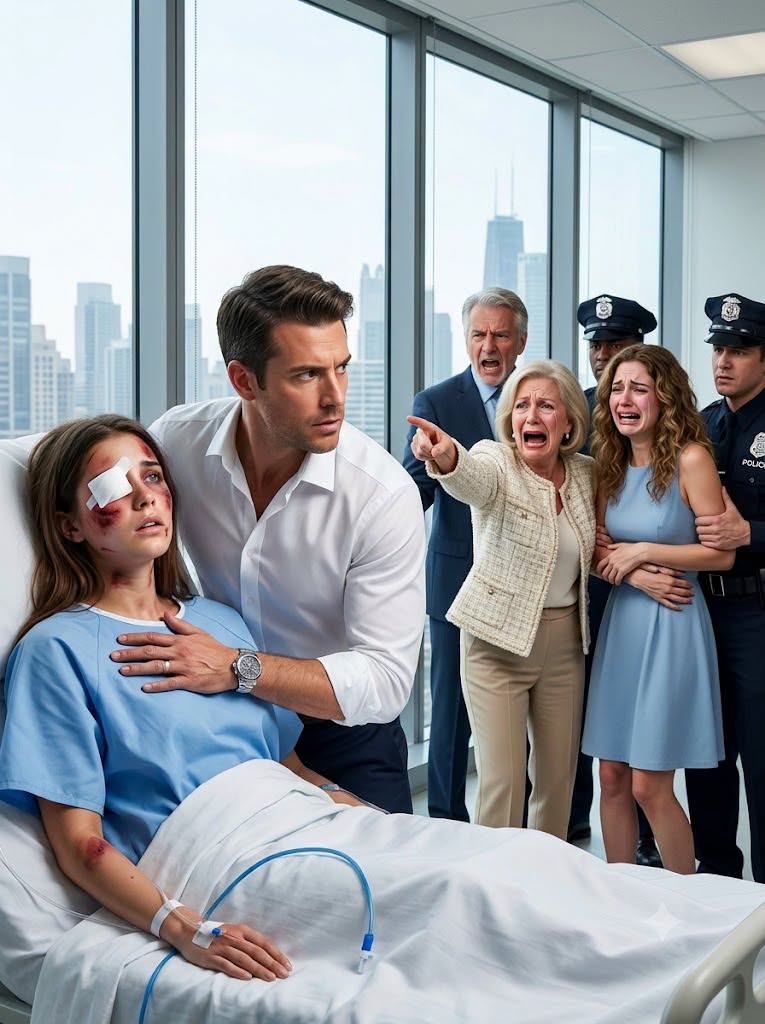
Wyatt caught me before I fell.
“Stay with me. Please stay with me.”
Through my right eye, I could see my mother standing several feet away.
She wasn’t screaming.
She wasn’t running toward me.
She was simply watching.
My father dropped what he’d been holding onto the grass.
Then Melanie stepped outside.
My younger sister looked irritated more than frightened.
“This didn’t have to happen,” my mother said.
Even half-conscious, I understood what she meant.
This wasn’t really about my wedding.
It was about Wyatt.
For years, my parents had treated our relationship like a temporary inconvenience.
Then Wyatt’s business became successful.
Suddenly they became obsessed with him.
My mother started inviting him over without me.
Melanie began messaging him.
They made jokes about how he’d “chosen the wrong sister.”
At first, Wyatt and I laughed about it.
Eventually, it stopped being funny.
Wyatt pulled out his phone.
“We’re calling an ambulance.”
My father knocked it from his hand.
Wyatt shoved him away from me, and within seconds they were struggling near the bushes.
Then a truck stopped in the road.
An electrician working nearby had seen enough to realize something was seriously wrong.
“I’ve called 911,” he shouted. “Don’t touch either of them again.”
That stranger may have prevented the situation from becoming even worse.
I woke in the hospital with the left side of my face bandaged.
There were fractures around my eye and cheek that would require surgery.
The doctors couldn’t yet promise what would happen to my vision.
Wyatt sat beside me.
He looked worse than I’d ever seen him.
“I’m sorry,” he whispered.
“For what?”
“I should’ve gotten you away from them sooner.”
I squeezed his hand.
“They’re my parents. You didn’t do this.”
Police interviewed both of us.
I told them everything.
The comments about Wyatt.
Melanie’s messages.
My mother’s attempts to arrange situations where Wyatt and Melanie would be alone.
My father’s escalating anger whenever I objected.
I had always treated those things as family dysfunction.
Now they looked different.
Police already had independent evidence.
The electrician had witnessed part of the confrontation.
Neighbors had heard and seen portions of it.
Several nearby security cameras had also captured pieces of what happened outside the house.
My parents initially claimed I’d provoked the confrontation.
That explanation didn’t hold up well against the physical evidence and witness accounts.
My father was arrested in connection with the assault.
The investigation into everyone else’s involvement continued.
And that distinction mattered.
My mother and Melanie had behaved horribly.
But horrible behavior and criminal participation aren’t automatically the same thing.
Investigators would have to determine what each person had actually done.
Two days later, an older man came to see me.
His name was Harvey Berry.
“I knew your grandfather Walter,” he said.
“How?”
“He was my best friend.”
I barely remembered my grandfather. He’d died when I was young.
Harvey brought photographs.
In one, my grandfather stood outside a hardware store with his arm around Harvey.
In another, he was working on something made of wood.
“A crib,” Harvey said.
“For you.”
I stared at him.
“My grandfather made my crib?”
“He started it before you were born.”
According to Harvey, Walter had been thrilled about his first granddaughter.
My father hadn’t shared that enthusiasm.
He’d wanted a son.
There had been tension between him and Walter for years—over money, entitlement and the way my father treated people when he didn’t get what he wanted.
Eventually, Harvey had been pushed out of our family’s life too.
“I should’ve tried harder to stay in contact,” he said.
I didn’t know what to say.
Then he handed me several envelopes.
Birthday letters.
All addressed to me.
All written by my grandfather.
None of them had ever reached me.
The larger surprise came from an attorney.
Her name was Janice Foster.
She was also my aunt.
My grandfather’s daughter from an earlier marriage.
My father had barely acknowledged her existence.
Walter had accumulated substantial assets during his lifetime: property, investments, the hardware business and a family trust.
But the structure he’d created was considerably more complicated than my father had ever told me.
My father did not simply own an $11 million inheritance.
He was a beneficiary of a trust.
That distinction changed everything.
Years earlier, after discovering financial misconduct and becoming increasingly concerned about my father’s behavior, Walter had revised his estate plan.
Certain benefits were conditional.
There were provisions designed to protect other family members and prevent trust assets from rewarding serious misconduct.
Janice was careful with me.
“Your father’s arrest doesn’t magically transfer eleven million dollars into your bank account,” she explained.
Real life wasn’t that simple.
There would be attorneys.
Trustees.
Documents.
Potential challenges.
And the criminal case was separate from the estate.
But Walter had anticipated the possibility that his son might someday become dangerous.
He’d made sure my father could never treat the family’s wealth as untouchable personal property.
Now the trustees had grounds to review—and potentially terminate—his remaining benefits.
I sat there stunned.
My grandfather had been dead for years.
Yet somehow he’d understood my father better than I had.
Meanwhile, police examined phones, messages and other records connected to the assault.
What emerged was disturbing.
My family’s fixation on Wyatt hadn’t existed only in my imagination.
There had been conversations about our relationship.
About getting him away from me.
About Melanie.
And about humiliating me badly enough that the engagement might collapse.
Whether every ugly message amounted to a criminal conspiracy was for prosecutors to determine.
But my father’s violence was no longer something the family could explain away as a momentary misunderstanding.
There was context behind it.
Eventually, charges moved forward based on the evidence against each person.
My father’s case was the most serious.
The consequences for my mother and Melanie depended on what prosecutors could actually prove about their involvement rather than simply their relationship to him.
For once, I didn’t need everyone punished equally.
I needed the truth separated from the family mythology I’d grown up with.
My surgery went well.
The weeks afterward were frightening, but gradually my vision improved.
Eventually, doctors told me the damage was healing better than they’d initially feared.
Wyatt cried when we received the news.
So did I.
Not because my face would look exactly as it had before.
It wouldn’t.
For a while, I hated the scars.
Then I stopped seeing them as evidence that my family had ruined something.
They were evidence that I’d survived them.
The trust dispute took much longer than the criminal case headlines would have suggested.
Lawyers reviewed Walter’s amendments.
Trustees examined my father’s conduct.
Old financial records surfaced.
Janice helped me understand the family history I’d been deliberately kept away from.
Ultimately, my father’s access to substantial family assets was terminated under the trust’s provisions.
A significant portion was preserved for me and other protected beneficiaries.
It wasn’t a magical punishment triggered the instant he struck me.
It was something Walter had deliberately built into his estate years earlier because he understood that wealth in the wrong hands could become another instrument of control.
I inherited enough to change my life.
But I didn’t want a mansion.
I wanted something that felt like Walter.
So I restored his old hardware store.
Part of the property became a training center where young people could learn practical trades from experienced electricians, carpenters, plumbers and other craftspeople.
Harvey attended the opening.
So did Janice.
Near the entrance, we installed a small bronze plaque.
WALTER BERRY
He believed honest work should leave something useful behind.
Harvey stood in front of it for a long time.
Then he wiped his eyes.
“He would’ve liked that.”
A month later, Harvey took me to the cemetery.
Before we left, he handed me a small piece of old wood.
It had been preserved for decades.
Part of the crib.
On the underside were words Walter had carved by hand.
For my beautiful first granddaughter.
I ran my fingers across them.
For most of my life, my father had made me believe I had somehow arrived in the world already disappointing him.
That little piece of wood proved something else.
Before I could speak—
before I could achieve anything—
before I could make anyone proud—
someone had simply been happy that I existed.
That evening, Wyatt and I sat beside the lake cabin that had also been preserved through Walter’s estate.
He pulled one of my grandfather’s letters from his jacket.
Then he looked at me.
“So…”
I smiled.
“So?”
“We never actually finished announcing our wedding date.”
I laughed.
It hurt slightly around my healing cheek.
“I remember.”
“Do you still want to marry me?”
I looked at the man who had caught me before I hit the ground.
“Yes.”
He smiled.
“Good. Because your family has made this engagement unnecessarily complicated.”
I laughed again.
For once, the future didn’t feel complicated at all.
My grandfather couldn’t protect me from everything.
Neither could Wyatt.
Ultimately, I had to learn to protect myself.
But Walter had left me something more valuable than money.
Proof.
Proof that my father’s inability to love me properly had never meant I was difficult to love.
And after spending most of my life believing otherwise, that was the inheritance that mattered most.