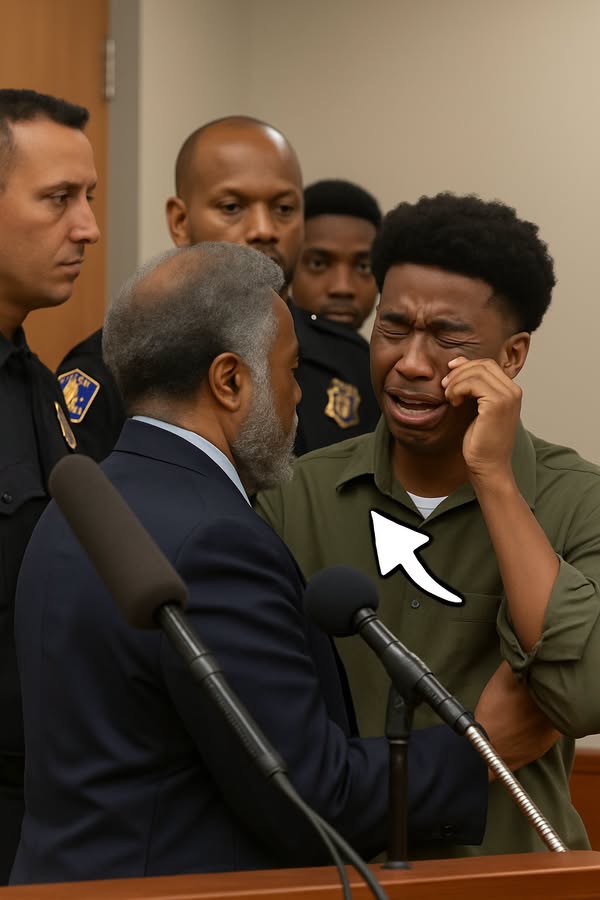
The sentence itself was final, but the reaction to it was anything but settled. As word of the ruling spread, it moved beyond the courtroom into public conversation, stirring arguments about what punishment is actually meant to accomplish when the person receiving it is still, in the eyes of many, a child.

A Sentence That Shook the Nation
No single moment in the trial drew as much attention as the reading of the sentence. Four hundred and fifty-two years is not a number tied to any realistic lifespan — it is symbolic, a legal maximum stacked charge upon charge until it became something closer to a statement than a calculation.
That distinction mattered to observers who saw the ruling less as a practical measure and more as a message. The court, intentionally or not, had produced a sentence that would outlive the teenager by centuries, transforming a legal proceeding into something that felt, to many, like a public reckoning.
The Families Behind the Verdict
For the relatives of the victims, the number was not abstract. It represented the only available response to a loss that ordinary sentencing guidelines could never fully address. Their grief demanded scale, and the law, however blunt its arithmetic, tried to meet that demand.
To these families, the sentence functioned as a kind of fortress — a barrier against the possibility that anything less severe might be read as forgiveness they were not prepared to offer. Leniency, in their eyes, risked minimizing what had been taken from them, as though mercy toward the offender would erase the memory of the dead.
That perspective, painful and deeply human, helps explain why the ruling was embraced by those closest to the harm even as it unsettled observers further removed from it. Their support was not abstract enthusiasm for harsh punishment; it was survival, expressed through the only tool the courtroom offered them.
A Nation Questions Redemption
Outside the immediate circle of grief, the sentence provoked a different kind of unease. Critics did not dispute that something serious had occurred, but they questioned what it meant for a justice system to declare a teenager permanently, irreversibly beyond redemption.
A sentence measured in centuries leaves no room for change, growth, or reconsideration. It forecloses the very possibility of a different outcome decades from now, regardless of what that person might become. For many, that felt like more than punishment — it felt like erasure.
Some observers argued the ruling revealed something uncomfortable about collective attitudes toward the young and the broken: a growing reluctance to believe that people, especially those who offend early in life, can ever be trusted to change. The case, they suggested, exposed a system more at ease with symbolic permanence than with the slower, riskier work of rehabilitation.
What the Case Reveals About Justice
Beneath the specifics of this single case lies a larger tension that has long shadowed criminal justice systems everywhere: the pull between punishment as closure and punishment as prevention of any future at all. The 452-year sentence sits squarely inside that tension, satisfying one side’s need for finality while alarming the other’s insistence on possibility.
It is a case that resists easy resolution, precisely because both reactions come from legitimate places. The families’ insistence on proportional weight is not irrational; neither is the critics’ discomfort with a ruling that assumes, permanently, the worst about a person still young enough to change.
What the sentence ultimately symbolizes, more than the specific facts of the crime, is a society still uncertain how to hold both truths at once — that harm must be answered, and that even the most damaged among us might not be beyond reach. The number itself, absurd in its scale, became a kind of test, reflecting back whichever fear or conviction the observer brought to it.
Whether the ruling will face further legal review remains unclear based on what has been made public so far. What is certain is that the sentence, as handed down, stands as a mirror held up to a divided public, still arguing over what justice is supposed to look like when the person facing it is barely more than a child.