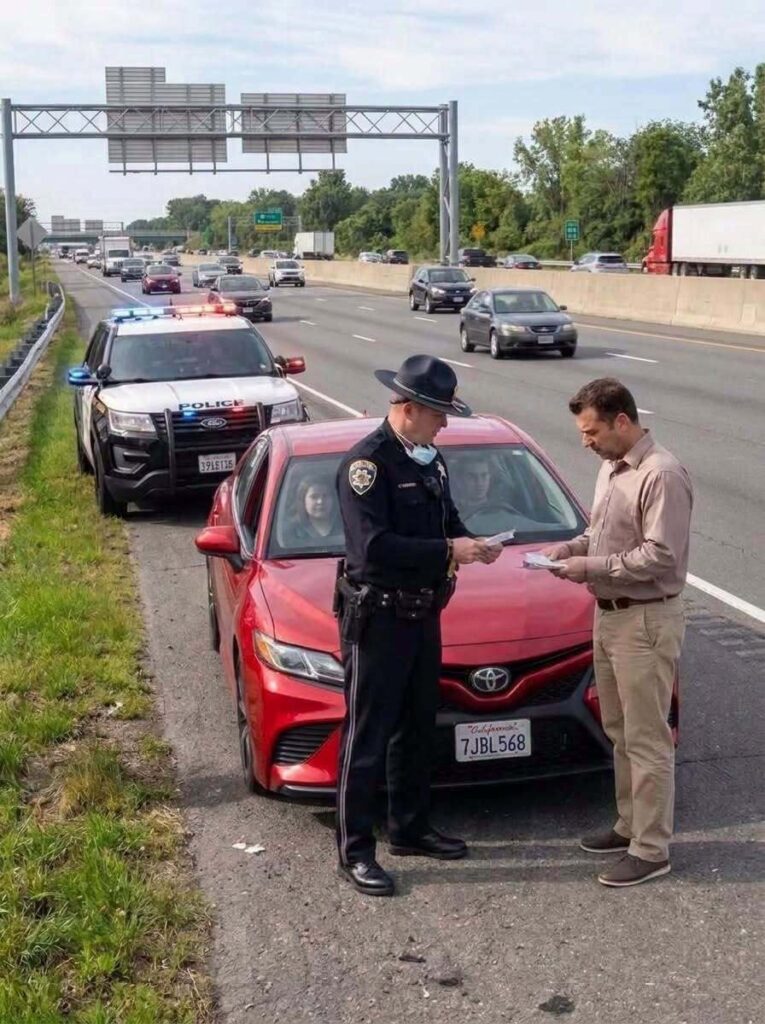
I had no idea that fifteen minutes later, a state trooper would tell me not to go home with my own wife.
Sarah pulled our Honda onto the shoulder of Route 35 and lowered her window.
A trooper approached.
His nameplate read MARTINEZ.
“License and registration, please.”
Sarah gave him both.
“Do you know how fast you were going?”
“Probably a little over.”
“Seventy-eight.”
She sighed.
“I’m sorry.”
He nodded, took the documents, and returned to his cruiser.
Nothing unusual.
At least not yet.
Five minutes passed.
Then eight.
Sarah checked the mirror.
“What is taking so long?”
“Maybe he’s running everything.”
“For a speeding ticket?”
I shrugged.
Another few minutes passed.
Then Trooper Martinez got out.
But instead of walking to Sarah’s side of the car, he came toward me.
He tapped lightly on my window.
I lowered it.
“Sir, could you step out for a moment?”
Sarah immediately looked at him.
“Why?”
Martinez kept his eyes on me.
“Just need to clarify something.”
I opened the door.
Sarah grabbed my sleeve.
“What does he need from you?”
“I don’t know.”
I stepped outside.
Martinez led me several feet toward the rear of the vehicle.
Far enough that Sarah couldn’t easily hear us.
Then his entire expression changed.
His voice dropped.
“Listen carefully.”
I stared at him.
“Okay.”
“Do not go home tonight.”
For a second, I thought I had misunderstood.
“What?”
“Go somewhere safe.”
He glanced toward the car.
“Somewhere she doesn’t know about.”
I actually laughed.
Not because anything was funny.
Because my brain refused to process what he was saying.
“My wife?”
Martinez didn’t smile.
“Don’t react.”
My stomach tightened.
“What are you talking about?”
He reached into his pocket and handed me a folded piece of paper.
“Put this away.”
I took it.
“Read it when you’re alone.”
I looked toward Sarah.
She was staring at us through the windshield.
“What is this?”
Martinez lowered his voice even further.
“Be careful who you trust.”
Then he stepped away.
Just like that.
He walked back to Sarah’s window, handed over her license and registration, and gave her a warning.
No ticket.
Two minutes later, we were driving again.
Sarah glanced at me.
“What did he want?”
I forced myself to shrug.
“He thought I looked familiar.”
She laughed.
“That’s weird.”
“Yeah.”
My hand remained in my jacket pocket, wrapped around the folded paper.
For the rest of the drive, every ordinary detail suddenly felt wrong.
The way Sarah tapped her fingers against the steering wheel.
The way she hummed along with the radio.
The way she asked whether I wanted Thai food on Friday.
This was my wife.
We had been married ten years.
I knew how she took her coffee.
I knew she hated sleeping with the closet door open.
I knew she cried at dog adoption commercials.
I knew the exact face she made when she was pretending not to be angry.
At least, I thought I knew those things.
But a police officer had just told me not to go home with her.
Halfway there, Sarah’s phone rang.
She looked at the screen.
“Mom.”
She answered.
Whatever her mother said apparently changed our plans.
Sarah frowned.
“She fell trying to bring laundry downstairs.”
“Is she okay?”
“She says she is.”
Sarah sighed.
“I’m going over there.”
My pulse jumped.
“You staying?”
“Probably.”
She glanced at me.
“You mind?”
“No.”
It came out too quickly.
She looked at me.
I softened my voice.
“No. Of course not.”
She dropped me at home and drove away.
I stood in the driveway watching her taillights disappear.
Then I went inside.
Locked the door.
Pulled the curtains.
And opened the note.
Seven words were written across the paper.
SHE ISN’T WHO SHE SAYS SHE IS.
Underneath was a phone number.
No name.
Just:
DET. REYNOLDS.
I stared at it for several minutes.
Then I called.
A man answered on the second ring.
“Reynolds.”
I swallowed.
“My name is Mark. A Trooper Martinez gave me your number.”
Silence.
Then:
“Where are you?”
“At home.”
“Is your wife there?”
“No.”
“Are you certain?”
“Yes.”
“Can she hear this call?”
“No.”
His tone changed.
“Good.”
I sat down.
“What is going on?”
The detective exhaled slowly.
“Your wife has been under investigation for approximately eight months.”
I didn’t understand the sentence.
“For what?”
“Financial crimes.”
“What kind?”
“Money laundering, fraud, identity manipulation, movement of criminal proceeds through shell businesses.”
I stood up.
“You have the wrong person.”
“I understand why you think that.”
“Sarah works in marketing.”
“No.”
The answer came instantly.
“What?”
“The marketing company she told you she works for does not exist in the way she represented it.”
I laughed again.
That same nervous, disbelieving laugh.
“I’ve been to company events.”
“Some were staged.”
“She travels for conferences.”
“Some of those trips were not conferences.”
I gripped the kitchen counter.
“She has business cards.”
“They’re real cards.”
He paused.
“The business isn’t.”
My mouth went dry.
“This is insane.”
“I know.”
“No, you don’t.”
I paced across the kitchen.
“You’re telling me my wife invented her career?”
“Parts of it.”
“Why?”
“To explain income, travel, contacts, and time away.”
I stopped.
“What exactly do you think she does?”
Reynolds was quiet for a moment.
Then he said:
“We believe she’s connected to a group that has been moving large amounts of money through construction contracts, consulting firms, property purchases, and fake vendor accounts.”
My knees felt weak.
I sat again.
“There has to be a mistake.”
“There isn’t.”
“You don’t know her.”
His answer chilled me.
“We know quite a bit about her.”
Then came the sentence that changed everything.
“Your marriage has helped her.”
I frowned.
“What does that mean?”
“You provide stability.”
“Stability?”
“A husband. A home. A normal-looking financial life. Neighbors. Tax records. Social media. Holiday photos. All of it.”
I stared at the dark window across from me.
“So you’re saying she married me as cover?”
“I can’t tell you what she felt.”
“That isn’t what I asked.”
Another pause.
“We believe the relationship was useful to her.”
Useful.
Ten years reduced to one word.
I thought about our wedding.
Our first apartment.
The night my father died and Sarah sat on the bathroom floor with me until sunrise.
Our anniversaries.
Christmas mornings.
The miscarriage we never talked about after the first year.
Was all of that useful too?
Reynolds continued.
“We also have reason to believe she’s preparing another identity.”
I gripped the phone tighter.
“For what?”
“Possibly to leave.”
“Leave me?”
“Leave everything.”
I felt cold.
He told me they had been watching money move through several accounts connected indirectly to Sarah.
Some transfers were small.
Others were not.
A second financial identity had started appearing.
Different mailing addresses.
Different contact information.
Documents being prepared.
A life waiting somewhere I had never heard of.
“Does she know you’re watching her?”
“We don’t believe so.”
“Then why warn me?”
“Because something changed this week.”
My stomach tightened.
“What?”
“I can’t tell you everything yet.”
“That’s my wife.”
“I know.”
“You’re asking me to believe my entire marriage might be fake.”
“No.”
His voice softened.
“I’m asking you to believe that there are things about your wife you don’t know.”
I closed my eyes.
“What am I supposed to do?”
“Tonight? Leave.”
“Where?”
“Hotel. Friend’s house. Anywhere she wouldn’t expect.”
“And tomorrow?”
“That depends on whether you’re willing to help us.”
I didn’t answer.
Reynolds waited.
I looked around the kitchen.
Sarah had chosen the light fixtures.
Her coat hung by the door.
There was a photograph of us in Maine on the refrigerator.
My entire life suddenly looked like evidence.
“What would helping you involve?”
“Observing.”
“Spying on my wife.”
“Documenting.”
“That sounds like spying.”
“Yes.”
At least he didn’t pretend otherwise.
I drove to a small hotel twenty miles away.
At 11:47 p.m., Sarah texted.
MOM’S FINE. STAYING HERE. LOVE YOU.
I stared at the words.
Then typed:
LOVE YOU TOO.
For the first time in ten years, I didn’t know whether either of us meant it.
The next morning, I met Reynolds.
He wasn’t alone.
Two federal investigators were with him.
They showed me enough evidence that denial became impossible.
Photographs.
Financial documents.
Travel records.
Company registrations.
Addresses.
A picture of Sarah meeting two men in a parking structure on a day she’d told me she was attending a brand strategy seminar.
Another photo showed her entering an office building under a different name.
I stared at it.
“Who is that?”
Reynolds looked at me.
“Your wife.”
“No.”
I pointed at the name attached to the image.
“I mean that.”
He paused.
“An identity she’s used.”
I sat back.
I don’t remember much of the next ten minutes.
Eventually, they asked whether I would cooperate.
I almost said no.
Then I thought about going home and pretending I hadn’t seen any of it.
Sleeping beside Sarah.
Listening to her tell me about work.
Kissing her goodbye.
Wondering every morning whether she would come back.
I agreed.
For the next six weeks, I became an actor in my own marriage.
I hated every second of it.
I photographed paperwork when Sarah showered.
Copied files from a storage cabinet in her office.
Wrote down names I heard during phone calls.
Recorded conversations when investigators instructed me to.
And every evening, I put everything away before she came home.
Then we ate dinner.
“How was your day?” she’d ask.
“Fine.”
“You seem tired.”
“Long meeting.”
She would smile.
“Come here.”
Then she would kiss me.
That was the hardest part.
Not the fear.
Not even the deception.
It was realizing how easily ordinary intimacy could survive inside something rotten.
One night, Sarah sat across from me eating pasta.
She looked up.
“Do you remember our honeymoon?”
I almost dropped my fork.
“Of course.”
“You got sunburned so badly you slept sitting up.”
I laughed automatically.
“You laughed at me.”
“You looked ridiculous.”
Then she smiled.
For one dangerous second, I forgot everything.
She was simply Sarah.
My wife.
Then her phone buzzed.
She checked it.
Turned it facedown.
And I remembered.
Three days before the arrests, I found the document Reynolds had warned me might exist.
A passport application.
Not Sarah’s name.
Her photograph.
Different birth information.
Different address.
Beside it was a property rental agreement in another state.
Six months prepaid.
She wasn’t just moving money.
She was building an exit.
I photographed everything.
Then sat alone in the basement for nearly twenty minutes trying not to be sick.
The arrests happened on a Monday morning.
I was already out of the house.
Agents arrived shortly after seven.
Sarah was taken into custody along with several other people connected to the investigation.
I didn’t see it happen.
That was intentional.
Reynolds called me afterward.
“It’s done.”
I sat in my car.
My hands shook.
“Did she ask for me?”
There was a pause.
“Yes.”
I stared through the windshield.
“What did she say?”
“She wanted to know where you were.”
I almost laughed.
For once, she didn’t know.
The case took months.
The evidence was larger than I understood.
Multiple companies.
Layered transactions.
False invoices.
Money moved through legitimate-looking operations.
Sarah eventually pleaded guilty to federal charges tied to the scheme.
She was sentenced to prison.
I testified.
Provided records.
Answered questions.
Signed papers ending a marriage I no longer knew how to describe.
People asked whether I felt stupid.
Some didn’t use the word.
But I heard it anyway.
How could you not know?
Ten years?
You never noticed anything?
The answer is simple.
Trust makes ordinary things look ordinary.
A late flight is a late flight.
A locked drawer is privacy.
A second phone is work.
A spouse traveling frequently is a spouse with a demanding job.
You don’t conduct forensic audits on someone you love.
At least, I didn’t.
The house was sold.
I moved into an apartment across town.
For months, I slept badly.
Every time I met someone new, I wondered what they were hiding.
I checked stories twice.
Then hated myself for checking.
Two years have passed.
I still have Martinez’s note.
It’s folded inside an old brown wallet I no longer carry.
Sometimes I take it out.
Seven words.
She isn’t who she says she is.
That piece of paper ended my marriage.
It may also have saved my life from becoming collateral damage in hers.
I’m seeing someone now.
Her name is Claire.
She knows everything.
The first time she traveled for work, I barely slept.
When she came home, I admitted why.
I expected her to be offended.
Instead she sat beside me and said:
“You don’t have to pretend you’re fine.”
That sentence mattered more than she knew.
I’m still learning how to trust without becoming blind.
And how to question something without assuming it’s a lie.
Sarah taught me something I wish I had learned differently.
Love and truth are not the same thing.
You can love someone deeply and still not know them.
You can share a bed, a bank account, a decade, and thousands of ordinary mornings with a person while entire rooms inside their life remain locked.
Real trust isn’t never asking questions.
It isn’t ignoring contradictions because love is supposed to make suspicion disappear.
For me, trust means something much simpler now.
It means being able to sit across from someone, hear their story, look into their eyes, and slowly discover that the person in front of you is the same person they claim to be.
After what happened with Sarah, I no longer take that for granted.
I consider it one of the rarest forms of peace.