Or what they believe someone owes them.
I just never expected to learn that lesson inside my own family.
My husband Richard built our house outside Cedar Falls, Iowa.
Literally.
We poured the foundation in 1988.
Three years later, he finished the last beam.
Richard was a civil engineer, but he loved working with his hands.
He installed the white-oak floors himself.
Built the walnut cabinets.
Fixed things that weren’t broken simply because he thought he could improve them.
He died seven years ago at sixty-four.
We’d been married thirty-eight years.
Afterward, I didn’t rebuild my life so much as rearrange it around the space he’d left behind.
The house remained mostly unchanged.
But one object mattered more than everything else.
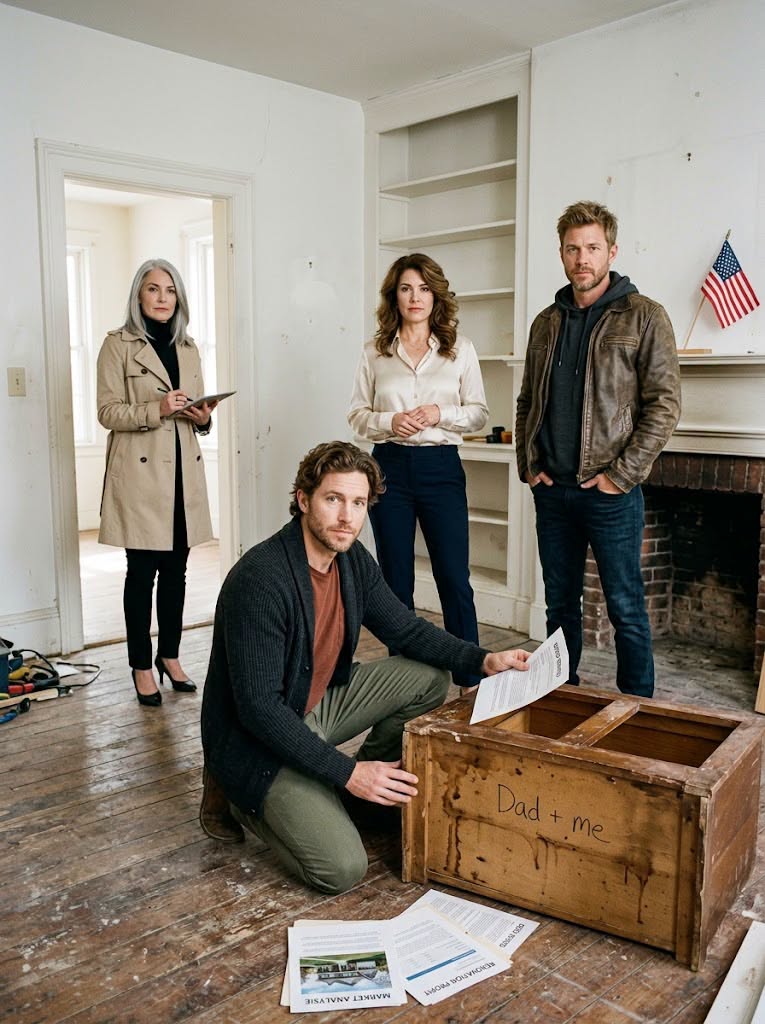
A crooked pine bookshelf.
Richard built it with our son, Derek, when Derek was nine.
It leaned slightly to the left.
The shelves weren’t perfectly level.
Burned into the back panel were two shaky words:
Dad and me.
I’d been offered beautiful replacements over the years.
I never considered it.
Derek eventually became a corporate attorney in Des Moines.
Then he met Morgan Ellis.
Morgan worked in commercial real-estate marketing.
She was intelligent, polished and extraordinarily interested in my house.
The property had recently been appraised at just under $700,000.
Morgan knew that number.
She asked about the lot.
The neighborhood.
Property taxes.
Whether I’d considered downsizing.
At first, I told myself she was simply interested because real estate was her profession.
Then her brother Gavin visited.
He was a contractor.
What began as a casual tour became something resembling an inspection.
He looked at the foundation.
The cabinets.
Windows.
Roofline.
I noticed.
I said nothing.
Maybe thirty-one years on the bench had made me suspicious.
Or maybe I’d simply learned that people reveal themselves most clearly when they think nobody is evaluating them.
Despite my reservations, I wanted Derek to be happy.
I paid roughly $72,000 toward their wedding.
And I planned something much larger.
I intended to give him the house.
My estate attorney, Patricia Hames, had prepared the necessary documents for me to review.
Nothing had been executed.
Nothing had been transferred.
The house was still entirely mine.
I planned to complete everything after the wedding.
I thought Richard would have wanted Derek to have the home we’d built together.
Then came the rehearsal dinner.
I’d paid for the winery months earlier.
When I arrived, I discovered my seat was near the restrooms, far from Derek and Morgan.
That stung.
But seating charts are not worth destroying a wedding over.
So I smiled.
I ate.
I talked to relatives.
Then Morgan approached me in the hallway.
“I wanted to talk privately.”
“Of course.”
Her voice was calm.
Almost rehearsed.
She told me Derek was beginning a new chapter.
They needed independence.
They needed space.
Then she said:
“The best wedding gift you could give us would be to step back completely.”
I stared at her.
“What does completely mean?”
She hesitated.
Then she said it.
“Derek doesn’t need you involved in his life anymore.”
Thirty-one years as a judge teaches you not to respond immediately when someone says something important.
So I waited.
Morgan filled the silence.
She explained that married couples needed boundaries.
That mothers sometimes had trouble letting go.
That Derek needed to focus on his new family.
I listened.
Then I thanked her for being honest.
Inside my blazer was a folder containing paperwork related to the house I was preparing to give them.
Morgan didn’t know that.
I drove home.
Walked into Richard’s old workshop.
Put the documents on his workbench.
Then I called Patricia the following morning.
“The transfer isn’t happening.”
She didn’t ask why.
“Understood.”
Because I had never signed the deed, there was no gift to reverse.
The house was mine.
Later, Patricia helped me review my estate plan so there could be no confusion about what would happen to the property in the future.
I didn’t attend the wedding.
I knew my absence would hurt Derek.
But after what Morgan had said, I couldn’t sit there smiling as though nothing had happened.
Over the next several days, I made another decision.
I moved.
Not because Morgan had driven me from my home.
Because I suddenly realized I’d spent seven years preserving Richard’s house instead of deciding what I wanted from the rest of my own life.
I rented a comfortable apartment near the river.
I took Richard’s engineering jacket.
His old pencil.
Photographs.
Books.
Thirty-four years of accumulated possessions.
And I left one thing behind temporarily.
The crooked pine bookshelf.
That belonged to Derek.
Before leaving, I placed an envelope beside it.
Inside was a copy of the unsigned transfer paperwork.
Across it I’d written:
NOT EXECUTED.
There was also information I’d received after asking questions about Morgan and Gavin’s unusual interest in the property.
It showed that they’d already been discussing the home’s market value and possible improvements as though Derek’s ownership were practically guaranteed.
Maybe Morgan hadn’t been secretly plotting some elaborate scheme to steal my house.
I couldn’t prove that.
But she had clearly begun planning around an asset that wasn’t hers.
The final item was a letter.
Not to Morgan.
To my son.
I told Derek what she’d said at the rehearsal dinner.
Then I wrote:
Your father loved you more than this house.
So do I.
That’s why I’m not asking you to choose between your wife and your mother.
Your marriage is your decision.
My home is mine.
Please don’t confuse the two.
Derek called several days later.
His voice sounded exhausted.
“Mom, did Morgan really tell you to disappear?”
“Yes.”
“All of it?”
“As closely as I can remember.”
He was quiet.
Then he asked about the house.
I told him the truth.
“I was going to give it to you.”
Another silence.
“I didn’t know.”
“I know.”
Apparently, Derek had told Morgan for years that he would probably inherit the house someday.
Somewhere along the way, “someday” had become “after the wedding.”
Then expectation had become planning.
Derek confronted Morgan about the conversations surrounding the property’s value.
She argued that she’d merely been preparing for their future.
Maybe she believed that.
Maybe part of her still does.
I stayed out of it.
That surprised Derek.
After three decades in family court, I’d watched too many parents make their adult children’s marriages into battlegrounds.
I wasn’t going to become one of them.
Derek and Morgan entered counseling.
I didn’t ask for reports.
I didn’t tell him to divorce her.
I didn’t tell him to stay.
I remained his mother.
Nothing more.
Nothing less.
Several months later, Derek came to my apartment for dinner.
We talked about Richard.
Derek told me he’d recently remembered helping his father build that terrible bookshelf.
“He wouldn’t let me use the power tools.”
“You were nine.”
“I thought that was extremely unfair.”
I laughed.
“So did you ever fix the lean?”
“No.”
“Why?”
“Because your father said we’d built it that way together.”
After dinner, we drove to collect it.
Derek ran his fingers across the burned words on the back.
Dad and me.
Then he carefully loaded the crooked bookshelf into his car.
I’m sixty-eight now.
The house Richard built is still mine.
Someday Derek may inherit it.
Maybe he won’t.
I’ve stopped treating inheritance as something children are automatically entitled to simply because their parents once imagined giving it to them.
A gift is still a gift until it’s given.
And love doesn’t require surrendering everything you’ve built to prove that it’s real.
Richard left me more than a house.
He left memories.
A son.
Thirty-eight years of marriage.
And one crooked bookshelf.
The bookshelf belongs to Derek now.
The rest of my life still belongs to me.