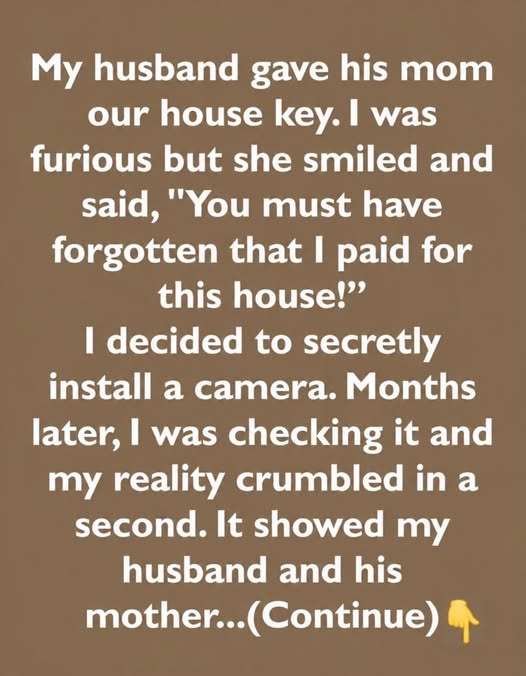
It started as a small precaution, nothing dramatic. I’d noticed papers disappearing from the desk drawer, phone calls he took outside on the porch with the door shut. So I set up a hidden camera in the study, telling myself it was probably nothing, that I was being paranoid after two decades of marriage. I was wrong about the paranoid part.

Twenty Years, One Signature
For most of my adult life, this house was the story I told myself about who we were. We picked out the tile together. We fought over the color of the fence and laughed about it later. I believed, the way you believe in gravity, that building a life together meant building it together — on paper, not just in memory.
I never once asked to see the deed. Why would I? Marriage, to me, meant shared stakes, shared names, shared everything. It never occurred to me that somewhere along the way, my name might have quietly slipped off the one document that mattered most.
Looking back now, I can trace small moments that should have worried me — a locked filing cabinet, a lawyer’s name mentioned once and never again. At the time, I dismissed them as nothing. Now I understand they were the edges of something much larger, hidden just out of view.
What the Hidden Camera Revealed
The footage wasn’t dramatic in the way movies make betrayal look. There was no shouting, no dramatic confrontation caught on tape. Just my husband, calm and unhurried, sitting at that desk with documents spread in front of him, speaking quietly on the phone about paperwork and his mother’s name.
I watched it more than once, hoping I’d misunderstood. I hadn’t. He had signed the house — our house — over to his mother, in a transaction so quiet it left no ripple in our daily life. No argument. No warning. Just erasure, dressed up as paperwork.
What struck me hardest wasn’t just the act itself, but how ordinary he looked doing it. No guilt, no hesitation, no sign that he understood what he was taking from me. It was as if I had already been written out of the story, and he was simply making it official.
I sat with that footage for days before I could bring myself to act on it. Part of me kept hoping there was an explanation that would make this smaller, more forgivable. But some truths don’t shrink no matter how long you stare at them.
Inside the Lawyer’s Office
I finally called a lawyer on a Tuesday morning, my hands shaking as I dialed. I wasn’t sure what I wanted from the meeting — validation, maybe, or just someone to tell me I wasn’t losing my mind. What I got instead was a word I didn’t expect: marital fraud.
She said it plainly, without drama, the way professionals say things they’ve said a hundred times before. But for me, it landed like a door opening in a room I’d thought had no exits. What had felt like an unspeakable personal wound suddenly had a name, a legal shape, a history of other people surviving it before me.
I sat across from her desk, still wearing the same devastated expression I’d walked in with, but something inside me had shifted. This wasn’t just heartbreak anymore — it was a documented act with consequences, options, and a process. I wasn’t imagining harm. I wasn’t overreacting. I had been wronged in a way the law recognized.
She explained, gently but clearly, what steps might come next — how ownership could potentially be challenged, what documentation I’d need, what timelines mattered. None of it erased the ache sitting in my chest. But it gave that ache somewhere to go besides in circles.
I left her office that afternoon into ordinary daylight, cars passing, people walking their dogs, as if the world hadn’t just reorganized itself around me. I remember thinking how strange it was that grief and clarity could arrive in the same hour, wrapped around each other so tightly I couldn’t tell where one ended and the other began.
Choosing Her Own Path Forward
In the days that followed, I noticed my questions changing shape. I stopped asking how could he and started asking what do I need now. It wasn’t a dramatic transformation — no lightning bolt of resolve — just a quiet redirection of energy toward something useful.
I still don’t know if I’ll file for divorce. Some mornings I feel certain; other mornings I feel only exhausted by the idea of untangling twenty years of shared life. What I do know is that the decision, whatever it becomes, will be mine to make — deliberately, not out of panic or pressure.
What matters most to me now isn’t punishing him or proving a point. It’s protecting what’s left of my footing — my rights, my security, my sense of self in spaces I once thought were permanently shared. Those things aren’t negotiable anymore, regardless of what happens next in the marriage.
I think often about the version of me who lived in that house for twenty years without ever checking the deed, who trusted so completely that scrutiny felt unnecessary. I don’t fault her. She loved fully, the way people do when they believe they’re safe.
But I’m not her anymore. Whatever home I build going forward — whether it’s this one, reclaimed and renegotiated, or somewhere entirely new — will be a place where my name is written down, where my presence is documented, where no one can quietly erase me while I sleep beside them.
That’s the promise I’ve made myself in the aftermath of all this: never invisible again, not in my own house, not in my own life. The heartbreak hasn’t fully lifted, and maybe it never will completely. But the fog has cleared enough for me to see the road ahead, and for the first time in a long while, I’m the one deciding which direction to walk.