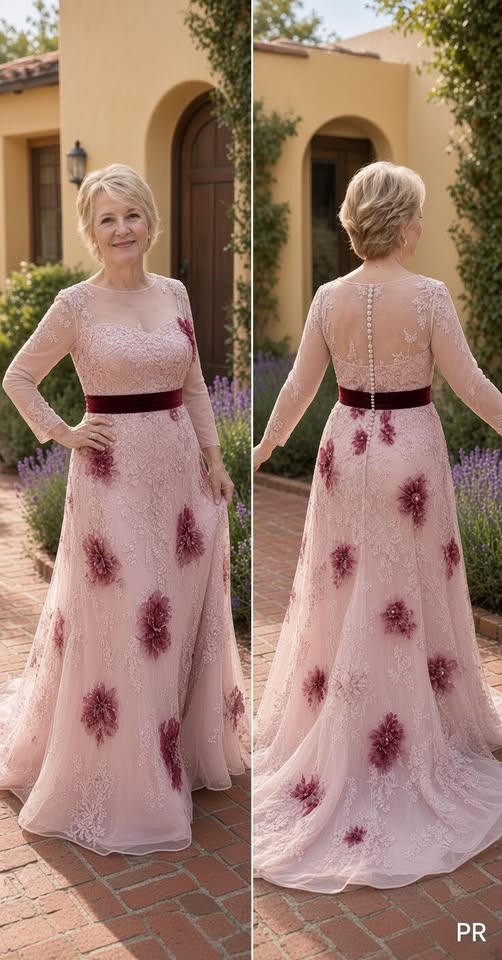
She argued that at my age, nobody expected anything fancy, and that spending money on a new dress was an unnecessary extravagance for a woman who had already walked down the aisle twice before. I understood her pragmatism, yet it stung because she could not see the history etched into my skin. My first marriage, at nineteen, was defined by the frantic necessity of a pregnancy and the heavy, moth-balled scent of my mother’s borrowed gown. My second, at forty-one, was a muted affair in a beige courthouse suit, a choice dictated by a heart that had grown tired of believing in the grandiosity of romance. Those weddings were about duty and resignation, but this time, I was choosing joy. I wanted to feel like hope wasn’t just for young women who don’t know better yet.
The dress arrived in a plain box, but when I slipped it on, the mirror reflected something I hadn’t seen in decades. I didn’t focus on the loose skin or the physical changes that come with seven decades of living. Instead, I saw a woman who had raised three children entirely on her own, a woman who had weathered two divorces and emerged with her capacity for love intact. This dress was not a costume; it was a testament. I decided to transform the simple garment into something that felt uniquely mine, ordering delicate blue Swarovski crystals and intricate lace appliques. I spent my evenings at the kitchen table, my reading glasses perched precariously on my nose, following online tutorials to learn the precise art of beadwork. It was a slow, meditative process, one that required patience and a steady hand, and with every crystal I secured, I felt a layer of my old self-doubt dissolving.
My daughter’s initial disapproval slowly gave way to curiosity as she watched me labor over the fabric. She would hover near the doorway, watching me struggle with a needle or squint at a screen, until one afternoon, she finally pulled up a chair. She didn’t say much at first, but she reached out to help me align a particularly difficult piece of lace. In that quiet moment, the tension that had defined our conversation shifted into something tender and collaborative. We were no longer arguing about the cost of a dress; we were building a memory. She began to understand that my desire for lace and sparkle wasn’t about vanity, but about the right to celebrate a life that was still unfolding. We spent hours working together, our hands moving in sync, the dress becoming a tapestry of our shared history and newfound connection.
The blue crystals, which I had chosen to represent the calm that follows a long, turbulent storm, caught the light beautifully, turning the simple Poshmark find into a gown that felt regal and earned. As we worked, I told her stories I had never shared—the fears I held while raising her, the moments I felt invisible, and the quiet determination that kept me moving forward. She listened with a new depth of empathy, and I realized that by allowing myself to be vulnerable, I was teaching her that hope has no deadline. There is no expiration date on happiness, and there is certainly no age at which a woman must stop honoring the life she has built. We laughed about the mistakes I made with the needle and the times I had to rip out a seam, finding humor in the imperfection of the process. I explained that after spending much of my life being a mother, wife, worker, and caregiver, I had finally realized I was also a woman with dreams of my own. I did not need an expensive wedding or anyone’s approval; I simply wanted to celebrate.
When the final crystal was set, the dress hung on the back of my bedroom door, not just as a garment, but as a symbol of renewal. It represented the right to be seen, to be celebrated, and to believe that love could be peaceful and honest. The imperfections in my handiwork were small reminders that a meaningful life does not require perfection. Walking down the aisle would not be a performance for others, but a private promise to myself and the man who had taught me that I was worthy of being cherished. My daughter stood beside me as I tried on the finished piece, her eyes bright with a pride that mirrored my own. We had bridged the gap between our generations, finding common ground in the simple act of creation. I realized then that the wedding was not merely about the ceremony or the vows; it was about the journey I had taken to arrive at this place of peace. I was ready to walk toward my future, wearing the proof of my own resilience, knowing that the best chapters are often the ones we write for ourselves, regardless of the time on the clock. The house was quiet, but my heart was full, and for the first time in my life, I felt entirely, unapologetically ready for the beginning of everything. I finally understood that the dress was never just about the fabric; it was about the woman wearing it, and at seventy-two, I was finally the woman I had always hoped to become. My daughter hugged me, and in that embrace, the past was finally laid to rest, replaced by the bright, shimmering promise of the day to come.