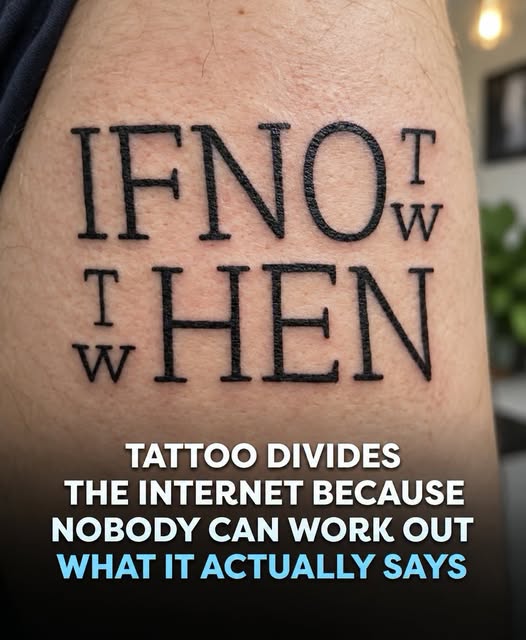
a foreign language or perhaps a complex, intentional code. As the image circulated, the internet responded with a predictable mix of skepticism, humor, and genuine frustration. Some observers dismissed the design as a catastrophic failure of artistic execution, while others transformed the confusion into a series of viral memes, poking fun at the bizarre aesthetic choices. Yet, beneath the mockery, a genuine sense of curiosity began to take hold among those who refused to let the puzzle remain unsolved.
Users started zooming in on the image, rotating their screens at various angles, and meticulously tracing the contours of each character in an attempt to find a logical sequence. This collective effort turned a simple piece of body art into a collaborative digital project. Threads on various forums filled with competing theories and heated debates, with participants breaking down the visual information piece by piece. The process was not merely about reading text; it was an exercise in pattern recognition and visual linguistics.
The initial perception of the tattoo was one of utter frustration. Because the spacing between words was inconsistent and the letters were stacked in a non-linear fashion, the human brain struggled to parse the input as language. Instead, it was processed as a series of abstract shapes. This cognitive dissonance is what fueled the viral nature of the post. People felt compelled to solve the mystery because the human mind is inherently wired to seek order out of perceived chaos.
Eventually, the persistence of the crowd paid off. By mentally rearranging the spacing and recontextualizing the fragmented lines, a group of determined viewers finally uncovered the intended message: “If not now, then when.” Once the phrase was identified, it seemed remarkably obvious, yet the path to that clarity had required a massive, shared effort that spanned across different time zones and backgrounds. The revelation transformed the perception of the tattoo from a confusing mistake into a fascinating case study in human communication.
The viral nature of this event highlights a fundamental aspect of human interaction in the digital age. We are naturally drawn to puzzles, and when faced with a collective mystery, we often find satisfaction in pooling our resources to reach a solution. The tattoo, which was initially perceived as a failure, became a testament to the power of shared attention. It serves as a reminder that even when communication is distorted by errors or poor formatting, the human drive to find clarity remains a powerful force. This phenomenon demonstrates how digital communities can transform a moment of individual confusion into a unified, productive, and ultimately satisfying intellectual exercise.
When you are designing any form of permanent visual communication, such as a tattoo, a logo, or even a simple sign, the most important factor is the balance between aesthetic flair and functional readability. If the message is the priority, ensure that spacing, font choice, and layout are tested by individuals who are seeing the design for the first time. A design that looks clear to the creator may be entirely opaque to an outsider. Always prioritize legibility to ensure your intended meaning is conveyed without requiring a crowd-sourced investigation to decode it. Clear communication is the ultimate goal of any visual medium, and simplicity often yields the most lasting impact.