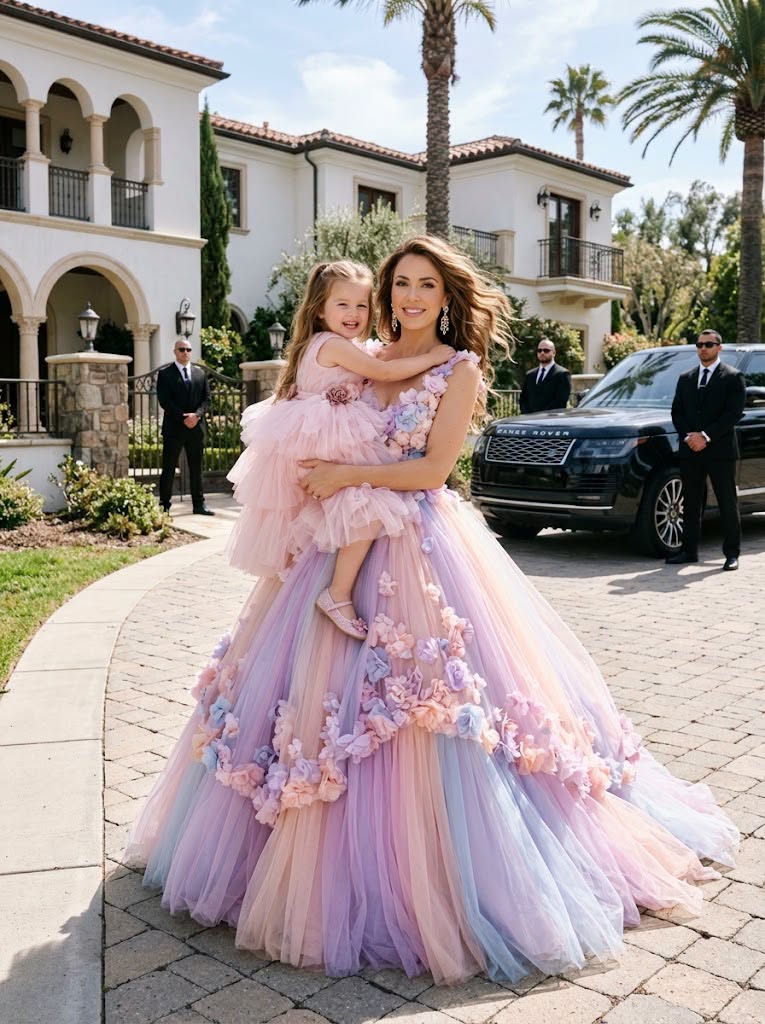
Years earlier, I’d walked away.
I was tired of the expectations surrounding my family name and wanted a life that belonged entirely to me.
When Alistair proposed, I thought I’d found it.
Instead, my isolation gradually became useful to him.
At first, his control was subtle.
He criticized what I wore.
Questioned where I’d been.
Made financial decisions without me.
Eventually, he stopped pretending.
Then, six months before everything ended, he moved Genevieve into our guest room.
His mistress.
He didn’t even bother calling her that.
She was supposedly “helping with work.”
I knew better.
So did our eight-year-old daughter, Paisley.
Genevieve behaved as though the house already belonged to her.
She criticized my clothes.
Rearranged rooms.
Used my things.
And Alistair expected me to tolerate it.
I had become so accustomed to avoiding conflict that I barely recognized myself anymore.
Then came the Tuesday that changed everything.
I’d been working quietly at a bakery, building savings Alistair didn’t control.
That evening, I brought cupcakes home for Paisley.
The moment I stepped inside, I heard her crying upstairs.
Not ordinary crying.
Fear.
I dropped the box.
“Paisley?”
I ran toward the master bedroom.
My daughter was on the floor.
Alistair stood over her, furious.
Genevieve was sitting on the bed beside what remained of an expensive evening gown.
The fabric had been cut repeatedly.
Ruined.
Genevieve claimed Paisley had done it.
Alistair believed—or pretended to believe—every word.
He had subjected my daughter to a humiliating punishment and was demanding that I reimburse Genevieve for the dress.
“Ten thousand dollars,” he said.
“By tomorrow.”
I looked at Paisley.
She wouldn’t meet my eyes.
Then Alistair added:
“If you can’t pay for what your daughter destroyed, maybe neither of you should be living here.”
Something inside me became very quiet.
I didn’t scream.
I didn’t threaten him.
“Okay.”
He looked almost disappointed.
I took Paisley to her room and locked the door.
Only then did she tell me what happened.
“She did it, Mom.”
“Who?”
“Genevieve.”
Paisley said she’d walked past the bedroom and seen Genevieve cutting the dress herself.
Then Genevieve noticed her.
By the time Alistair arrived, the story had already been invented.
Paisley had destroyed it.
Paisley was jealous.
Paisley needed to be punished.
I believed my daughter.
But I also knew belief wasn’t evidence.
So I asked whether she’d seen anything else.
Paisley pointed toward the hallway.
That’s when I remembered the security cameras.
Alistair had installed cameras around the property years earlier because he was obsessed with security.
Some covered entrances and hallways.
One had a partial view through the open master-bedroom doorway.
I didn’t know whether it had captured anything useful.
But suddenly I knew what I needed to do.
For nearly a decade, I had convinced myself that staying quiet protected my daughter from upheaval.
Watching her trembling on that bed made me understand the opposite.
My silence was no longer protecting her.
It was protecting Alistair.
I took out a phone he’d never known I kept.
Then I called a number I hadn’t called in years.
My oldest brother, Xavier, answered.
He recognized my voice immediately.
There was a long silence.
Then:
“Where are you?”
“Arizona.”
“Are you safe?”
“For tonight, I think.”
“Is Paisley with you?”
“Yes.”
Another pause.
“What do you need?”
I started crying.
Not because I was frightened of Alistair.
Because nobody had asked me that question in years.
“I need to leave.”
Xavier didn’t send helicopters.
He didn’t buy Alistair’s company.
My brothers didn’t storm the house carrying weapons.
They did something far more useful.
They believed me.
Within hours, I was speaking with an attorney experienced in domestic-abuse and family-law matters.
My brothers arranged somewhere secure for Paisley and me to stay.
They told me not to confront Alistair again.
Don’t threaten him.
Don’t delete anything.
Don’t move money that wasn’t clearly mine.
Preserve messages.
Photograph injuries or damage.
Save financial records.
Secure evidence legally.
And get Paisley somewhere safe.
The next morning, while Alistair was at work, I left.
Paisley and I took clothes, medication, identification, important documents and the things she couldn’t bear to leave behind.
Everything else could be replaced.
My daughter couldn’t.
My attorney helped me seek the appropriate court protections based on what had happened.
The security footage became important.
It didn’t capture every second inside the bedroom.
But it showed enough.
Genevieve entered with the gown intact.
Later, she could be seen near the doorway handling the dress and something in her hand.
Paisley appeared only afterward.
Combined with Paisley’s account and other evidence, it seriously undermined the story Alistair and Genevieve had told.
Then the lawyers began examining something else.
Money.
Once I stopped living inside Alistair’s version of reality, I started asking questions I’d avoided for years.
Accounts.
Property.
Business expenses.
Debts.
Transfers.
Some of what I discovered concerned only our divorce.
Other transactions raised questions that had nothing to do with me.
Those matters were turned over to the appropriate professionals and, where warranted, authorities.
My brothers didn’t manufacture charges against Alistair.
They didn’t need to.
They gave me the resources to investigate what was already there.
Alistair’s employer eventually learned about issues involving his conduct and finances through legitimate channels.
His career didn’t disappear overnight.
But his carefully constructed image began cracking.
Genevieve disappeared from his side surprisingly quickly.
That taught me something too.
She had enjoyed Alistair when he had the house, the title, the car and someone else quietly keeping his life functioning.
She was less interested once lawyers, financial scrutiny and custody proceedings entered the picture.
The divorce was ugly.
Alistair accused my family of manipulating me.
He claimed I’d kidnapped Paisley from him.
He said I’d suddenly become vindictive.
My attorney kept bringing everything back to the same place.
Evidence.
Dates.
Messages.
Financial records.
Witnesses.
Paisley’s welfare.
For the first time in our marriage, Alistair couldn’t win simply by being louder.
And my family didn’t have to destroy him.
They only had to make sure he couldn’t isolate me anymore.
A year later, Paisley and I were living in California.
Not in some militarized compound surrounded by guards.
Just somewhere peaceful, close enough to family that she had people around her who made her feel safe.
My brothers became uncles again instead of names from stories.
They took Paisley swimming.
Helped with homework.
Argued over who spoiled her most.
I started working with my family’s charitable foundation, particularly on programs supporting women and children trying to rebuild after unstable homes.
The legal matters involving Alistair continued far longer than the dramatic ending I’d once imagined.
Some allegations led to consequences.
Others remained disputes between attorneys.
Family court addressed custody separately from whatever happened professionally or financially.
Real life didn’t deliver one spectacular moment where every bad person was marched away and every good person won.
It gave us something quieter.
Distance.
Safety.
Choices.
One afternoon, my attorney forwarded a letter from Alistair.
He wanted to talk.
He said he’d changed.
He said we had both made mistakes.
I read enough to recognize the voice.
Then I stopped.
For years, I’d believed my family name was something I needed to escape.
I associated it with pressure, influence and a life other people had designed for me.
So I’d run as far from it as possible.
And somewhere along the way, I confused independence with isolation.
They weren’t the same thing.
My brothers hadn’t saved me because they were rich or powerful.
The money certainly helped.
The lawyers helped.
Having somewhere safe to go helped enormously.
But the most important thing Xavier gave me happened during that first phone call.
He asked what I needed.
Then he listened to the answer.
Alistair had spent years convincing me that having nobody made me easier to control.
He was right about one thing.
Isolation had made him stronger.
But I eventually learned that accepting help didn’t make me weak.
And protecting my daughter didn’t require five powerful brothers, helicopters or revenge.
It required one decision I’d postponed for far too long:
When Paisley needed me to choose between preserving our family and protecting her, I finally understood they were no longer the same thing.